
The Builder Era: How AI Is Rewriting the Role of Product Management
AI-assisted development is changing how teams prototype, iterate, and ship. Here’s how we’re approaching the shift of AI in product management at BlueConic.


For 15 years, I’ve built product roadmaps the same way.
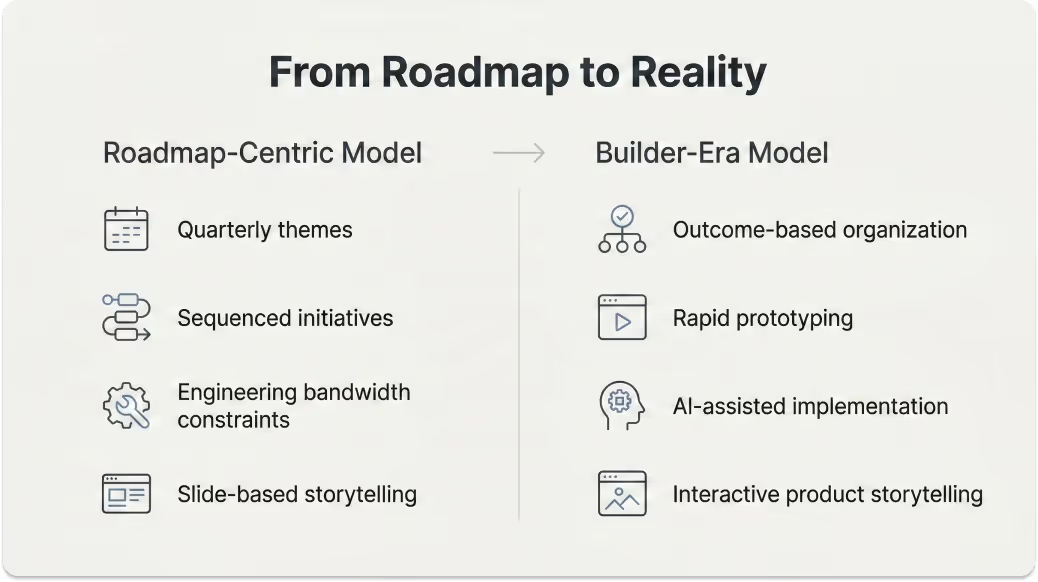
Quarterly themes. Sequenced initiatives. Carefully crafted slides tailored to the audience—executives, customers, internal teams.
We would describe where we were going and why it mattered.
Today, instead of describing the future, we can show it.
Coding agents are writing production code. Prototyping tools can spin up interactive workflows in hours. Automation handles tasks that once consumed entire sprints. What used to require coordination across multiple roles can now start with a single person and a clear idea.
I’m not in the prediction game. But it’s increasingly clear that the mechanics of building software are changing fast. A measurable percentage of production commits are already being generated by coding agents—something that didn’t meaningfully exist a year ago. Large companies are experimenting with writing nearly all new code through AI-assisted workflows.
The headline isn’t that AI writes code. The headline is that everyone can build.
AI in product management marks the start of a new builder era.
From roadmaps to reality
Historically, product management was constrained by implementation bandwidth. Ideas had to compete for engineering time. Roadmaps were artifacts of tradeoffs and sequencing. Now, the constraint is shifting.
Instead of bullets on a slide describing a concept we hope to deliver in two quarters, we can prototype the experience and put it in front of customers next week. Instead of debating edge cases abstractly, we can interact with them. Instead of telling a story about where the product is heading, we can demo it.
When customers can see and click through the future, the conversation changes. It becomes less about convincing and more about collaborating.
This has fundamentally changed how I think about storytelling. A roadmap is now an evolving artifact customers can experience.]
The blurring of roles
These tools are also blurring the traditional boundaries within product teams.
Product managers can open pull requests. Engineers can draft customer-facing copy. Support teams can log issues and, with the help of coding agents, push rapid fixes without waiting on heavy process. Designers can influence workflows earlier, with prototypes that inspire product thinking before a single pixel is finalized.
But this doesn’t eliminate specialization.
Engineers still have a deep understanding of architecture, performance, and long-term scalability that agents don’t inherently reason about. Designers understand human behavior, friction, and time-to-value — especially as SaaS interfaces evolve from point-and-click UIs to agent-driven workflows. Product managers remain grounded in market needs, customer research, and outcome orientation.
The difference is that we’re no longer gated by role-based access to creation.
We’re all builders now, just with different lenses.
What this means at BlueConic
At BlueConic, this shift isn’t theoretical. We’ve been building agentic workflows and decisioning agents for years. Automation and intelligent orchestration are core to how our platform operates, and increasingly, how our teams operate internally.
We’re not simply collecting feature requests and sequencing them into quarterly releases. We’re organizing around outcomes and experimenting rapidly.
Co-creation becomes real. Instead of hearing, “That’s on the roadmap,” customers can see and interact with early concepts within weeks. They can pressure-test workflows, react to real experiences, and help shape how capabilities evolve.
And 0-to-1 concepts move faster than they used to. Our Vwam AI Shopping Assistant is one example—an idea that went from concept to tangible experience in months, not years.
The speed of iteration changes what’s possible.
The new friction
As with most things, this new era comes with new tensions.
If coding agents dramatically increase the volume of commits, how do we maintain code quality without spending all day in human review?
When prototypes are easy to spin up, how do we clearly distinguish between vision and production-ready product?
How do we avoid over-promising when something feels real but isn’t fully hardened?
Just because we can build something in a week doesn’t mean we should ship it in a week.
Making the right decision and taste matter more than ever.
The craft of product development doesn’t disappear, it evolves. Governance, architecture discipline, UX cohesion, and long-term thinking matter more, not less, when velocity increases.

Elevating AI in product management
What excites me most about this shift isn’t efficiency. It’s elevation.
When lower-level tasks are automated and prototyping cycles compress, product managers can spend more time in customer conversations. Engineers can focus more on architecture and system design. Designers can push deeper into behavioral insight and agentic interaction models.
The center of gravity moves from managing backlogs to orchestrating outcomes.
As customer growth becomes more autonomous and agent-driven, the way we build products must reflect that same shift. The tools are changing. The workflows are changing. The boundaries between roles are softening.
The opportunity now isn’t just to build faster. It’s to build differently.

Jon is a VP-level product leader with 20 years of experience scaling B2B SaaS companies in marketing and data technology. He specializes in helping companies navigate pivotal transitions — from founder-led product to structured, revenue-driving organizations, and from traditional SaaS to AI-enabled platforms. Often the first product leader in the room, Jon builds teams, product foundations, and operating rhythms that turn customer and data insight into clear strategy and shipped outcomes. He has led SaaS-to–AI-native transformations and scaled product organizations at $10–50M ARR, partnering closely with GTM teams to drive adoption and growth.