
Knowing Your Customer Isn't the Hard Part Anymore. Acting on It Is.
Knowing your customer isn't enough anymore. See how BlueConic Agent Studio turns real-time signals into coordinated decisions that actually drive growth.
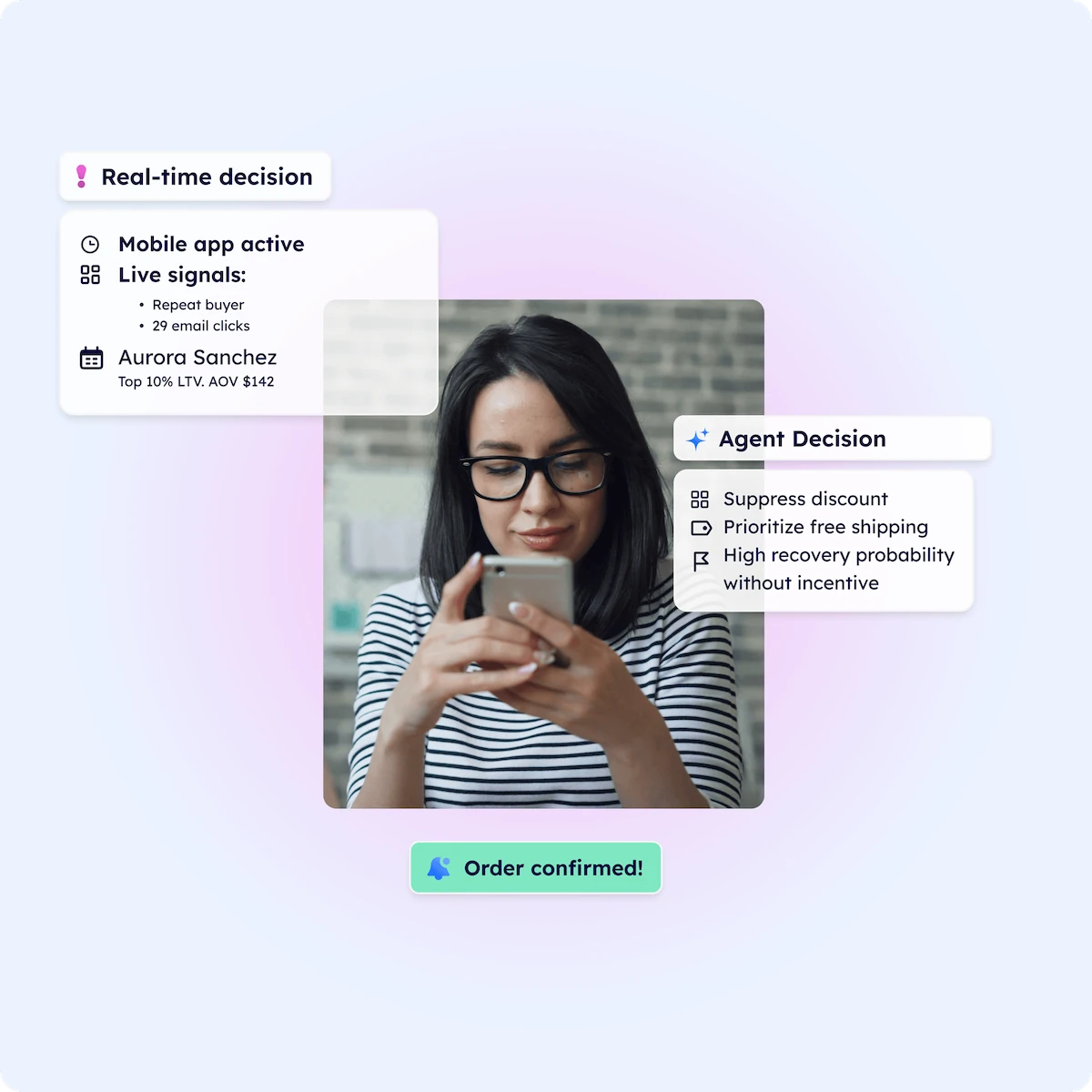

A customer puts a high-margin item in her cart. She buys it at full price. A few minutes later, an abandonment email lands in her inbox offering 15% off the thing she just paid for. A retargeting ad follows her across the web for another two days. A push notification nudges her toward a purchase that's already happened.
She came ready to buy. What she got was a brand that had no idea what just happened.
This isn't a one-off glitch. It's a pattern playing out across every customer, every day, at scale and it's quietly becoming one of the most expensive problems in modern marketing.
The real gap isn't data. It's decisioning.
Every platform in a modern stack was built to know the customer. CDPs profile her. Analytics tools describe her. Personalization engines segment her. The industry has spent a decade getting extraordinarily good at understanding who she is.
What's missing is the system that does something about it in time to matter.
Knowing who a customer is and knowing what to do about her right now are two completely different problems. Most stacks have solved the first one and left the second one to chance, or worse, left it to a dozen channel tools each making their own calls in isolation, with no shared understanding of what the others are doing.
That's how you end up with Klaviyo and Meta pulling the same customer in opposite directions. How a loyalty trigger fires on someone who was already going to convert. How a win-back offer lands in front of a customer your acquisition team is also paying to reach. None of these systems are broken. They just don't know about each other, and no one is deciding what's actually right for this customer right now.
The cost of that gap is bigger than most teams realize
Disconnected decisioning has a price, and it compounds.
When one channel offers 10% off and another follows with 15% an hour later, customers learn quickly. Abandon the cart, wait for the better deal. Discount sensitivity goes up. Margin goes down. The "recovery win" ends up costing more than the order was worth in the first place.
Meanwhile, it isn't cheap to get her to the site at all. Meta CPMs and Google CPCs have climbed sharply, and on a strong day only a few percent of visitors actually buy. When the stack fumbles the moment she finally arrives, it isn't just a lost sale. It's the acquisition spend that earned that visit in the first place, lit on fire.
For a brand doing $100M in revenue, the recoverable revenue slipping through these cracks typically runs in the $8–10M range every year. That's roughly 10% annual growth, sitting there, uncaptured. For a lot of ecommerce teams, that's the entire growth target.
If you can't act on what you know, the data isn't an asset. It's overhead.
What Agent Studio actually does
Agent Studio is a new AI decisioning system inside the BlueConic Customer Growth Engine. It's the layer that reads every signal, understands what it means, and acts on it in seconds, so the understanding you've already built finally shows up in the experience.
Instead of each channel deciding in isolation, Agent Studio reads across all of them and acts on the full picture in real time. When she purchases, suppression fires everywhere at once because it's a state of her profile, not a rule living inside one tool. The discount email that was about to go out doesn't go out. The retargeting ad stops. The push notification about the thing she already bought never fires. She gets a coherent experience that reflects where she actually is, not where the system assumed she'd be thirty minutes ago.
When she abandons a cart and doesn't come back on her own, Agent Studio already knows her channel preference, her discount history, whether she typically converts without an incentive, and what every other channel has already tried. One relevant response goes out, on the right channel, in seconds — because the window to change her mind is short, and the system is built to move at the speed the moment demands.
Agents, coordinated
Inside Agent Studio, coordinated agents handle different parts of the work:
Build Agents prepare each play before it launches, shaping audiences, checking data readiness, and making sure the right inputs are in place.
The Decisioning Agent evaluates what should happen for each customer in real time: whether to act at all, what kind of action makes sense, and which channel is most likely to move the outcome.
The Experience Agent turns that decision into something the customer actually sees, a recommendation, a message, an offer, or an interactive experience designed to capture new signals.
The Measurement Agent tracks what happens next and feeds results back so the system improves automatically. Models retrain on real outcomes, not assumptions. Every decision teaches the next one.
Underneath all of it, an orchestration layer keeps business priorities intact. If protecting margin matters more than short-term conversion this week, Agent Studio knows. If net-new acquisition takes priority over reactivation this quarter, it knows that too and every automated decision stays anchored to it, even as customer behavior shifts and campaigns are already in motion.
Why AI has to do this work
None of this is realistic with humans alone. The signals move too fast, the variables across channels are too many, and the moments are too short. AI isn't a feature bolted onto Agent Studio, it's the only way the math works at this scale.
That's the point, actually. When the system handles the coordination, marketers get their time back for the work no platform can replicate: the creative instinct, the brand judgment, the message that stops someone mid-scroll because it feels like it was written just for her.
Your team sets the strategy. Agent Studio makes sure it lands, faster, cleaner, with every channel aligned and every decision made at the moment it matters.
What changes when the gap finally closes
The brands pulling ahead right now aren't the ones with the most tools or the fastest campaigns. They're the ones whose systems actually agree on what the customer needs and what the business is trying to do and can act on both at the same time.
When the right offer reaches the right person at exactly the right time, it doesn't feel like marketing. It feels like the brand gets her. That's the customer who doesn't need a reason to look elsewhere. That's the growth that compounds instead of leaking out the sides.
The signal was always the sale. Agent Studio is the system that finally catches it.
BlueConic Agent Studio is available in early access now.

Brittany Gulla is a growth and product marketing leader with extensive experience working across B2B and B2C businesses at various stages. Passionate about crafting brand and product stories that align with data-driven growth tactics in order to fuel business expansion. Brittany specializes in focusing on messaging, website positioning, and AI-driven strategies. Previously, she helped launch a global B2B agriculture tech brand at Resonant Technology and grew revenue to $6M annually at Bow Wow Labs, Inc. She also drove major account growth and branded campaigns at Mashable. Brittany excels in data-driven strategies, customer acquisition, and omni-channel marketing to fuel business success.