
Agentic AF: Everyone's Saying It. Here's What It Actually Takes.
I spent three days on the floor at CMRC, with loyalty and customer marketing for major retail brands. Here's my honest take on what "agentic" actually means for your programs.

Article 1 of 3 | Post-CRMC series By Lindsey Cobb, VP of Growth, BlueConic
I spent three days on that floor talking to the people actually running CRM, loyalty, and customer marketing at major retail brands. Here's my honest take on what "agentic" actually means for your programs—and the one thing standing between you and it.
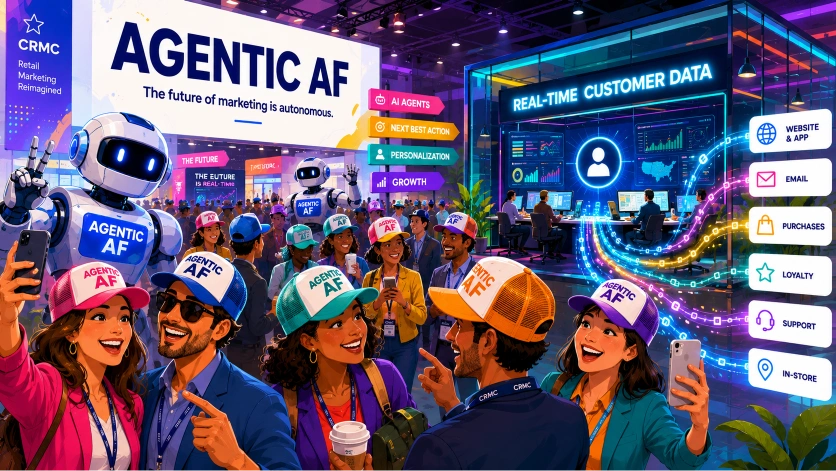
We gave away hats at CRMC that said "Agentic AF." They were everywhere by day two. Which is either a great brand moment or proof that "agentic" has officially become the word everyone wants on their head, and nobody can define the same way twice.
That's what made the conversations so interesting. Underneath that buzzword, there was a clear divide between experimenting with agentic ideas and putting them to work. The difference wasn't bigger models or more AI tools, either. It was deeper.
The problem with your decisioning
Everyone at CRMC is building journeys. Win-back flows, post-purchase sequences, loyalty tiers, reactivation cadences. The work is real. The logic is sound.
The problem is that your journey made its decisions when you built it. Six months ago. In a planning meeting. About a hypothetical customer who may or may not resemble the actual person on your site right now.
Agentic marketing doesn't work that way.
Instead of deciding in advance what a customer will need, agentic marketing:
- Reads what they're doing right now
- Picks the best action in the moment
Not the best action for "lapsed loyalty member, 60 days inactive." The best action for this person, this visit, this signal.
That's the shift. Better decisions, made later. As close to the moment as possible.
Amelia Gitter from Lowe's said it on stage Wednesday morning—CDP-powered omnichannel journeys. Not smarter rules. A connected profile that makes every downstream decision smarter automatically.
"Agentic" without real-time data is just a faster wrong answer
Here's the part that didn't make it into the keynotes: An AI agent is only as good as what it's working with.
Feed it a customer profile that updates overnight, built from three siloed systems that don't talk to each other, and you get confident automation pointed in the wrong direction.
The brands actually getting agentic results (not just talking about it) have one thing in common: a unified, real-time picture of the customer that every system can act on.
That's what enables Next Best Action: the ability for AI to evaluate competing offers, messages, and experiences in real time and determine the single best move for that customer in that moment.
- The agent reads live behavior as it happens
- Scores every possible action against your business goals
- Delivers the one most likely to drive impact (right now, not at the next batch)
Staples Canada's session was the most operational AI talk at the show. Not a vision deck. Actual offer agents replacing mass discounting… in production. The difference between them and most of the room was the data foundation underneath their AI.
What this looks like for your programs
Win-back. Day 30/60/90 cadences treat all lapsed customers the same. A customer who had a bad delivery experience is not the same as one who just got busy. Real-time decisioning reads the signal and picks the right message, channel, and offer — before you've lost them.
Loyalty. Your best customers can churn, and you won't know until the next report. Here's what that looks like in the data before it becomes a lost customer:
- Dropped browse frequency
- Abandoned cart after a return
- Support ticket still open
Connected in real time, that's a churn signal you can act on. Caught in a monthly batch, it's too late.
Post-purchase. That flow you built 14 months ago is still running. Next Best Action adapts to what was actually bought, what happened after, and what behavior predicts they'll need next. Every time.
The one question worth asking yourself
When a customer hits your site today, does your stack know who they are right now—not who they were last Tuesday—and can it do something about it within 30 seconds?
If the answer is no, that's where to start. Before the agent. Before the strategy deck. Before BFCM.
The AI is ready. Is your data?

Lindsey Cobb is Vice President, Growth at BlueConic, the Customer Growth Engine powering AI-driven revenue outcomes for e-commerce brands worldwide. A senior leader within BlueConic's go-to-market organization, Lindsey leads the growth function across demand generation, partnerships, and pipeline strategy, serving as a connector among peers and a player-coach to her team. She joined in 2023 from Return Solutions, where she was Head of Growth, and previously held channel sales roles at HubSpot. In her spare time, Lindsey enjoys working out on her rebounder trampoline (IYKYK) and hanging with her dog, Stanley.