
How BlueConic Turns Loyalty Programs Into a Repeat Purchase Engine
Your loyalty program should drive behavior. Learn how BlueConic connects data with real-time behavioral signals to accelerate tier advancement and repeat purchases.

Key takeaways:
- BlueConic connects loyalty data with real-time behavioral signals so tier progress, rewards, and nudges surface at the moments most likely to drive a repeat purchase.
- Most loyalty programs fail to drive behavior because they operate in isolation from what the customer is actually doing on your site, in your app, and across your channels.
- Effective loyalty progression pairs points and tier data with browsing activity, purchase cadence, and category affinity to determine the right intervention, the right channel, and the right timing for each member.
- The program infrastructure stays where it is. BlueConic optimizes the intelligence and activation layer on top of it.
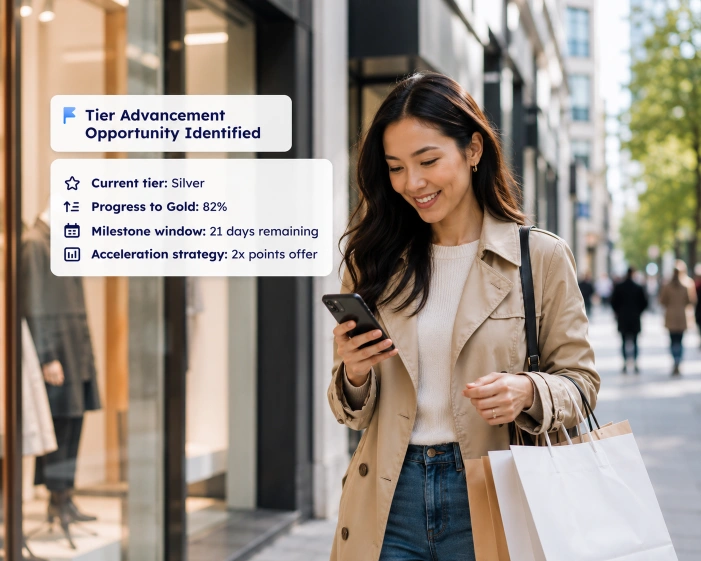
Your loyalty member has 2,400 points, 150 away from Gold tier. He's on your site right now, eight minutes deep in a category he's bought from three times this year. Your loyalty platform will send him a points summary next Tuesday. By then, the moment is gone.
Loyalty programs that don't read behavior leave revenue on the table
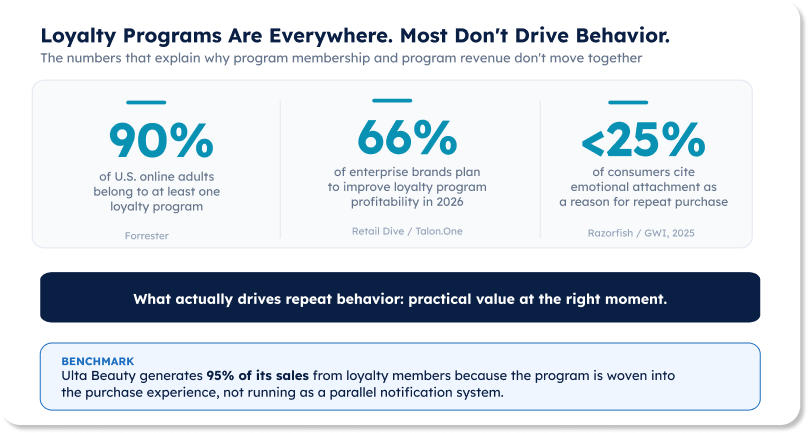
According to Forrester, 90% of U.S. online adults belong to at least one loyalty program and membership is near saturation. Yet Retail Dive and Talon.One research found 66% of enterprise brands plan to improve loyalty program profitability in 2026 because most programs are loyalty in name only: static points systems customers join, forget about, and rarely engage with in ways that change purchasing behavior.
The structural problem is disconnection. Your loyalty platform knows points balance and tier status, your ESP sends a monthly summary, and your website shows a generic rewards banner, but none of these systems know what the customer is doing right now.
Consider the member browsing your outerwear category for the third time this month, 150 points from a tier unlock. The program knows he has 2,400 points. It has no idea he's on the site right now, looking at something he'd buy.
That gap between "knows the status" and "sees the behavior" is where repeat purchases stall. A 2025 Razorfish/GWI study found 65% of marketers believe customers return because of brand love, but fewer than one in four consumers cite emotional attachment as a driver. What actually motivates repeat behavior is practical value at the right moment: seeing how close you are to a reward while you're still in a buying mindset, not in a monthly email you skim and delete. Ulta Beauty generates 95% of its sales from loyalty members, and it works because the program is woven into the purchase experience rather than running as a parallel notification system.
When loyalty communication arrives on a fixed schedule disconnected from what the customer is doing, it functions as a statement, not a motivator.
Progression works when the program responds to behavior
The better model connects loyalty data to behavioral signals so the program can act when a customer is most likely to respond.
Instead of sending every member the same monthly points summary, the system evaluates each member's real-time context:
- proximity to the next tier
- which categories they've been browsing
- whether their purchase cadence is accelerating or declining
- whether they've historically responded to reminders alone or needed an incentive to act
Those signals determine whether to intervene at all, what kind of intervention to deliver, and when to deliver it.
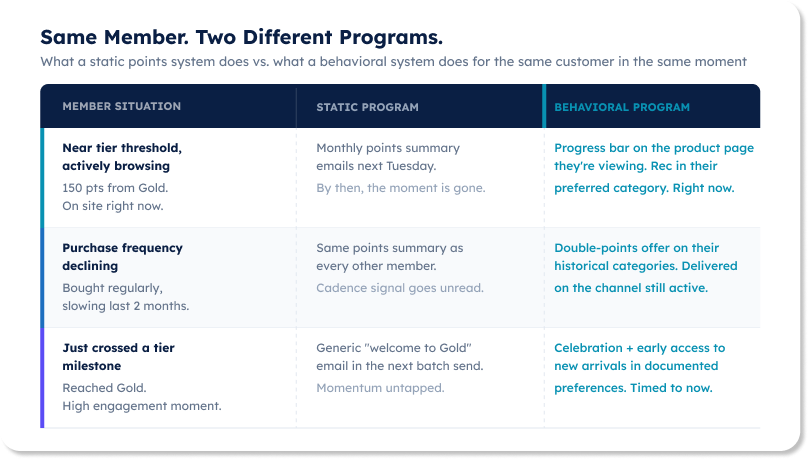
Example 1: A member who is 150 points from Gold and actively browsing a preferred category sees a progress message on the product page they're viewing, paired with a product recommendation in that category. The intervention meets the customer where momentum already exists.
Example 2: A member whose purchase frequency has declined over the past two months gets a double-points offer on the categories they've historically bought, delivered through the channel where they're still engaged, whether that's email, push, or on-site.
Example 3: A member who just crossed a tier milestone gets a celebration with early access to new arrivals in their documented preferences, timed to the moment they're most likely to act on it.
The critical difference from a standard loyalty email program: the intervention fires because the customer is doing something right now, not because a calendar date arrived. That behavioral trigger is what converts a points notification into a purchase prompt.
The loyalty platform stays where it is. What changes is the intelligence layer that connects program data to live customer behavior and acts on the combination.
How BlueConic runs the Loyalty Program Progression play
Here's what changes when you connect your loyalty program to BlueConic's decisioning layer.
What BlueConic reads
BlueConic ingests loyalty data through Connections:
- Points balance
- Tier status
- Reward history
- Program engagement
That data merges into the real-time customer profile alongside browsing behavior that Listeners capture, purchase history, category affinities, email and push engagement patterns, and predicted lifetime value.
The result is a profile that reflects both where the customer stands in your program and what they're doing right now.
What BlueConic builds
The system evaluates each loyalty member against their progression opportunity:
- Proximity to the next tier
- Which categories align with their documented preferences
- Historical responsiveness to different types of outreach
- Predicted purchase timing based on historical cadence
From that evaluation, the Decisioning Agent scores each member on progression likelihood and selects the intervention most likely to drive the next purchase.
What BlueConic triggers
A member nearing a tier threshold and actively browsing sees a contextual progress message through a Dialogue on the page they're viewing: "You're 150 points from Gold" alongside a product recommendation in their preferred category. A member with declining engagement gets a double-points offer on categories they've bought from before, delivered through the channel where they're still responsive. A member who hits a milestone gets a celebration with an exclusive preview or early access offer.
The system activates across web, email, push, SMS, and on-site experiences from the same profile intelligence, so the loyalty experience stays consistent regardless of where the member is.
What the marketer controls
Marketers define the guardrails:
- Which tiers and thresholds trigger interventions
- Maximum incentive levels
- Eligible product categories
- Channel preferences
- Frequency caps
The marketer also controls the messaging framework, whether progression nudges emphasize points, rewards, exclusive access, or recognition. Within those constraints, the Decisioning Agent handles the targeting, timing, and channel selection.
What happens over time
Every progression outcome feeds back into the model. Which interventions drove tier advancement? Which members responded to reminders alone versus requiring incentives? Which channels converted? The system retrains on actual results, improving its ability to predict which members will advance and what it takes to get them there. Each cycle produces better targeting and tighter margin control.
What KPIs move with Loyalty Program Progression
The primary metric is tier advancement rate: what percentage of loyalty members progress to the next tier within a defined period. That number tells you whether the program is actively driving behavior or passively tracking it.
Two secondary metrics move alongside. Repeat purchase frequency among loyalty members increases because the interventions surface at moments when the member is already engaged, converting browsing sessions into transactions. AOV among tier-progressing members climbs because the recommendations are calibrated to their preferences and price sensitivity, rather than showing generic rewards to every member at the same threshold.
Most teams should see clear movement within six weeks of the play going live.
How to start with Loyalty Program Progression
Pick one tier threshold where you have the most members clustered, typically the jump from your base tier to the next level.
Connect your loyalty data to BlueConic, build one set of progression interventions for members within striking distance of that threshold, and measure two things: tier advancement rate compared to your current program cadence, and repeat purchase frequency among the targeted segment.
BlueConic works alongside your existing loyalty platform. You can connect loyalty data through Connections and activate the first progression interventions in weeks. The loyalty infrastructure stays where it is. BlueConic adds the intelligence layer that makes it drive revenue.
See the full Loyalty Program Progression Growth Play
This post is part of a series on Growth Plays, BlueConic's outcome-focused approach to turning customer data into revenue action.

Brittany Gulla is a growth and product marketing leader with extensive experience working across B2B and B2C businesses at various stages. Passionate about crafting brand and product stories that align with data-driven growth tactics in order to fuel business expansion. Brittany specializes in focusing on messaging, website positioning, and AI-driven strategies. Previously, she helped launch a global B2B agriculture tech brand at Resonant Technology and grew revenue to $6M annually at Bow Wow Labs, Inc. She also drove major account growth and branded campaigns at Mashable. Brittany excels in data-driven strategies, customer acquisition, and omni-channel marketing to fuel business success.