
The Complete Guide to Customer Loyalty Programs for B2C Brands
Explore the benefits, types, examples, and best practices for building customer loyalty programs that drive repeat purchases and long-term growth.


Earning customer loyalty is increasingly difficult when consumers face endless choices, rising expectations, and short attention spans. A structured customer loyalty program solves this by creating a reliable value exchange that rewards repeat purchases, ongoing engagement, and active brand advocacy across the consumer journey.
This guide covers how these programs work, their benefits, common types, design steps, best practices, and how unified customer data powers smarter loyalty strategies for B2C brands.
Key takeaways
- Customer loyalty programs are structured business strategies designed to reward repeat purchases, digital engagement, and customer advocacy.
- The most effective customer loyalty programs go beyond transactional discounts to deliver highly personalized, experiential rewards that reflect each consumer’s preferences, behaviors, and relationship with the brand.
- Connecting loyalty data with unified customer profiles gives your marketing teams a complete, real-time view of each individual's brand relationship.
- Building a successful loyalty program requires establishing a clear value exchange, simple participation rules, timely engagement, and measurable key performance indicators (KPIs).
What are customer loyalty programs?
A customer loyalty program is a structured system that encourages returning buyers to keep engaging with your brand. By offering rewards, perks, or exclusive status, you establish a clear, defined value exchange. Customers voluntarily share their contact details and preferences in exchange for structured benefits, providing a compelling reason to self-identify at each interaction.
While traditional systems rely heavily on points-based discounts, modern customer loyalty programs focus on building deeper emotional brand loyalty. Instead of running generic promotions, B2C brands can use these initiatives to drive specific customer behavior, such as repeat purchases, product reviews, referrals, app engagement, preference sharing, and loyalty tier progression. Achieving this level of customer engagement requires looking beyond broad segments and treating each loyalty program member as an individual with unique preferences.
Why customer loyalty programs matter for B2C brands
Structured customer rewards programs provide significant advantages for B2C brands beyond just securing the next transaction. When built correctly, these programs serve as growth engines for sustainable growth and customer retention across high-volume consumer audiences.
- Driving repeat customers: Loyalty rewards give customers a compelling reason to return to your brand rather than explore competitors. This structured approach helps ensure your business remains top of mind whenever they are ready to make future purchases.
- Increasing customer lifetime value: By encouraging repeat business and higher order values, such programs can steadily grow your customer lifetime value (CLV). Over time, loyal customers often become your most profitable assets by spending more per transaction.
- Building stronger customer relationships: Moving beyond transactional interactions lets you treat customers as valued members of your community. Offering personalized rewards and exclusive access helps establish an emotional connection that builds loyalty.
- Collecting high-quality first-party data: A membership program provides a natural opportunity for customers to voluntarily share their customer preferences and contact information. This consent-based customer data serves as a solid foundation for your overall marketing strategy.
- Powering more effective personalization: With access to direct data, your marketing teams can deliver highly relevant product recommendations, loyalty prompts, replenishment reminders, and timely lifecycle messages. This targeted approach ensures that your program’s benefits feel uniquely tailored to each recipient.
- Reducing acquisition dependency: Retaining existing customers is typically far more cost-effective than constantly acquiring new customers. Focusing on your current customer base improves marketing efficiency and protects your operating margins.
How B2C customer loyalty programs work
The best customer loyalty programs operate as continuous loops of engagement, value delivery, and data collection. To maximize the impact of your loyalty program, it helps to understand how these moving parts interact to support the customer experience. When each step functions smoothly, your business can build lasting customer relationships while gathering valuable insights that improve future engagement.
1. Customers join or identify themselves
The journey begins when customers actively enroll in your membership program. This onboarding typically happens through an easy checkout flow, a mobile app, an online quiz, a product finder, a preference center, or a simple email signup form on your website. Making this step as friction-free as possible is crucial to maximizing your initial enrollment rate.
2. The brand collects permissioned customer data
Once a member joins, you begin collecting customer data with their consent at every interaction. This rich dataset includes purchase history, browsing habits, product preferences, declared interests, and explicit consent choices. Gathering this information helps you paint a clear, real-time picture of each individual's unique needs across all digital touchpoints.
3. Customers earn value for specific actions
Customers collect loyalty points or advance through loyalty tiers by taking actions that benefit your business. These actions can include making repeat purchases, writing detailed product reviews, referring friends on social media, completing their online profiles, sharing preferences, engaging with a mobile app, or interacting with personalized experiences. Clearly defining how customers earn rewards and how many points each action is worth keeps your customers engaged and motivated.
4. The brand delivers rewards or experiences
Effective loyalty programs benefit customers and businesses alike. In exchange for their actions, you reward customers with meaningful perks. These benefits can include standard discounts, free shipping, early access to new product releases, VIP customer service, personalized product recommendations, exclusive events, surprise rewards, or tier-based experiences. Providing a variety of reward options ensures the program appeals to different customer types and drives continuous redemption.
5. The program adapts over time
The most effective customer loyalty programs analyze ongoing customer behavior to adjust their outreach. When loyalty data remains stuck in an isolated database, you miss critical opportunities to personalize the full customer journey. Utilizing unified profiles, such as those enabled by BlueConic, ensures that your loyalty insights inform every marketing channel, e-commerce experience, and customer service interaction.
Common types of loyalty programs
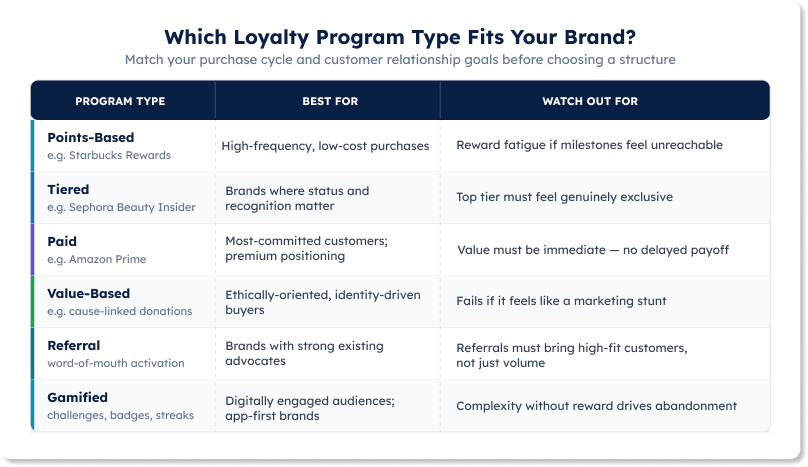
Selecting the right structure for your loyalty program is key to driving long-term engagement. Most brands succeed by aligning their business model, purchase frequency, consumer expectations, and customer relationship goals with one or more of these common loyalty program types.
Points-based loyalty programs
A points-based program is the most common model, where customers earn points for every dollar spent or action taken. Once they collect enough points, they can redeem them for discounts, free products, or future purchases. Many points-based programs, like Starbucks Rewards, encourage customers to collect stars or points with every purchase.
While points-based loyalty programs are familiar and highly accessible, they require straightforward rules and a simple redemption process. If the calculations become too complicated or rewards feel unattainable, loyalty program members may quickly lose interest.
Tiered loyalty programs
A tiered loyalty program rewards customers based on their level of spending or engagement over time. As members reach new milestones, they unlock higher loyalty tiers that offer progressively exclusive benefits and experiential rewards. This structured approach drives deeper engagement by tapping into status and recognition.
Loyal customers are naturally motivated to increase their customer spends when they can clearly see the exclusive rewards and VIP perks waiting for them at the next level. This setup helps turn casual shoppers into brand advocates.
Paid loyalty programs
Paid loyalty programs require members to pay a recurring subscription fee or an ongoing one-time fee to access premium benefits. Think of major retail loyalty programs like Amazon Prime or specialized paid programs. These models work incredibly well because they attract your most loyal customers who are ready to commit. However, the value you deliver must be immediate, highly visible, and strong enough to justify the upfront cost, such as free express shipping, instant credits, or member-only prices.
Value-based loyalty programs
A value-based loyalty program connects rewards to charitable causes, sustainability initiatives, or other shared values. Instead of offering direct discounts, you might donate a portion of each purchase to a charity or plant a tree for every transaction.
These value-based programs excel at building deep emotional loyalty and strong customer relationships because they resonate with modern shoppers' ethical expectations. To succeed, these initiatives must feel completely authentic, align perfectly with your core brand identity, and reflect genuine social commitment.
Referral loyalty programs
Referral programs turn your existing customer base into an active marketing force by rewarding members who introduce new customers to your brand. When a referral completes a purchase, both the advocate and the new buyer typically receive a discount or bonus points.
This strategy leverages the power of word-of-mouth marketing, which is highly trusted by modern shoppers. It is a highly efficient way to acquire high-value customers while simultaneously deepening your relationship with existing advocates.
Gamified loyalty programs
Gamified programs introduce play and competition into the customer experience through challenges, badges, streaks, and interactive quizzes. For example, customers might earn special badges for trying new product categories or maintaining a monthly purchase streak.
This approach keeps customers engaged by making participation fun and dynamic. However, gamification should always support real, tangible value. Avoid adding complex rules that frustrate users, and ensure that earning rewards remains the central focus of the interactive experience, driving genuine value rather than distraction.
What makes a B2C customer loyalty program successful?
Creating a program that truly resonates with your audience requires shifting from a transactional mindset to a customer-centered approach. The most successful loyalty programs share several foundational qualities that ensure long-term engagement and measurable business impact.
- A clear value exchange: Your customers must immediately understand the program's benefits, how they earn rewards, and how to redeem them. If the rules are confusing or the rewards feel out of reach, members will quickly abandon the program. Transparency builds trust and encourages consistent participation from day one.
- Customer-centered design: Focus your rewards on what your target audience actually values, rather than what is easiest for your business to clear from inventory. Use direct customer feedback and ongoing behavior analysis to shape your offerings. Aligning rewards with customer desires makes participation feel incredibly rewarding.
- Highly personalized experiences: Modern loyalty goes beyond generic discounts. Successful brands use customer preferences and purchase history to offer personalized rewards, exclusive access, and tailored product recommendations that feel relevant to the individual. This targeted approach shows your customers that you truly understand their unique preferences.
- Connected customer data: A successful program avoids keeping customer data in separate silos. Unifying data from your e-commerce platform, physical stores, email marketing, and loyalty system ensures you have a single source of truth. This connected data lets you recognize members and apply rewards seamlessly across every channel.
- Timely, automated activation: You must be ready to engage customers when they are most active or when they show signs of slipping. Delivering automated next-best actions based on real-time behavior, such as a milestone celebration or a win-back offer, helps retain customers and encourages continuous interaction.
- Continuous measurement and optimization: Tracking key metrics allows you to refine your strategy constantly. Analyze enrollment rates, active participation, redemption patterns, and incremental revenue to understand how your loyalty strategy impacts your overall business goals. Regular adjustments keep your program fresh and aligned with changing consumer behavior.
How to create a B2C customer loyalty program
Building a customer loyalty program requires careful planning, a deep understanding of your audience, and the right technology foundation. Follow these strategic steps to design an effective loyalty program that drives long-term value for both your brand and your customers.
1. Define your loyalty goals
Before choosing rewards, clearly define what business outcomes you want to achieve. Are you aiming to increase your repeat purchase rate, grow your average order value (AOV), improve retention, or gather better customer data? Setting specific, measurable goals allows you to design a program focused on the right behaviors. This clarity also helps your marketing teams track the program's success and prove its financial impact over time.
2. Understand your customers
An effective loyalty program matches your customer base's actual motivations. Take time to analyze purchase patterns, preferred communication channels, and common barriers to repeat engagement. Utilizing unified customer profiles makes it much easier to identify which customer groups need extra incentives, helpful product education, or exclusive access to stay engaged. When you understand what drives your audience, you can build a highly attractive value exchange that resonates deeply with them.
3. Choose the right loyalty program type
Select a model that aligns with your purchase cycle and brand category. For instance, a points-based rewards program works wonderfully for frequent, lower-cost customer purchases. Conversely, a tiered loyalty program or a paid loyalty model might be better suited for brands with high-value, highly considered purchases where status and exclusive benefits matter most. Carefully evaluate your business dynamics to choose the structure that naturally fits how your customers prefer to engage.
4. Design the rewards and value exchange
Your rewards must be genuinely compelling to encourage active participation. Consider offering a mix of transactional perks, such as free shipping or discounts, and experiential rewards, like early access to new products or VIP events. At the same time, ensure the financial model is sustainable for your brand. Work closely with your finance team to model the costs of your rewards, projected redemption rates, and margin impact to prevent the program from eroding profitability. The goal is to design a balanced system that encourages repeat business and builds brand loyalty without training your customers to rely solely on margin-damaging discounts.
5. Connect your loyalty data
A loyalty program cannot succeed in a vacuum. To deliver a seamless customer experience, your loyalty activity must connect directly with customer profiles, e-commerce platforms, email engines, web behaviors, mobile apps, and consent databases. By unifying your customer data into dynamic, actionable profiles, your marketing teams can deliver seamless personalization, orchestrate multi-channel lifecycles, and run highly effective loyalty campaigns. Connecting this data ensures that your loyalty program rewards and messages reflect each customer's complete, real-time relationship with your brand across all channels.
6. Launch, measure, and improve
Launch your program with a clear, engaging marketing campaign, simple onboarding instructions, and prominent placement across all digital and physical channels. Once the program is live, track your performance closely, monitor redemption trends, and actively gather member feedback. Use A/B testing to refine your reward offerings, point thresholds, and messaging flows. Ongoing optimization helps ensure your loyalty program continues to engage customers and deliver measurable business value over the long term.
Customer loyalty program best practices for B2C brands
Developing effective customer loyalty programs requires ongoing dedication and strategic refinement. To keep members actively participating and maximize your return on investment, your marketing teams should adopt these industry-proven best practices.
- Keep the program simple and easy to understand: Avoid complex earning formulas, confusing point calculations, or hidden rules that frustrate your audience. Customers should easily see how many points they earn per purchase, how to redeem rewards, and the benefits they will receive at each level. If the process is intuitive, participation will naturally increase, and your customer service team will receive fewer support queries.
- Focus on value beyond discounts: Continuous discounting can devalue your brand, squeeze your margins, and attract bargain hunters rather than loyal customers. Instead, consider introducing non-discount benefits, such as member-only content, priority customer support, or early access to new collections, which build stronger emotional connections. These experiential rewards often drive higher engagement and elevate your brand's perceived value.
- Personalize your rewards and communications: A generic, one-size-fits-all email blast will not motivate every member in the same way. Use customer preferences, purchase histories, and lifecycle stages to deliver highly relevant offers and rewards that feel custom-tailored to the individual. For example, offering personalized rewards for products they frequently buy shows members that you value their specific relationship with your brand.
- Provide meaningful reasons for self-identification: Encourage customers to share valuable zero-party and first-party data by creating interactive experiences like style quizzes, preference centers, or lifestyle surveys. Offering immediate, tangible value, such as bonus loyalty points or a personalized recommendation, makes customers much more willing to share their details. This consent-based data serves as a solid foundation for your overall customer experience strategy.
- Act quickly on disengagement signals: Do not wait until a customer has fully churned before attempting a win-back campaign. Monitor key indicators such as declining login frequency, reduced purchase behavior, or inactive loyalty accounts, and use automated lifecycles to trigger timely re-engagement campaigns. Catching slipping members early with highly relevant, personalized outreach dramatically improves your chances of retention.
- Connect your loyalty experience across channels: Your program should feel completely seamless whether a customer is shopping on your website, using your mobile app, or visiting a physical retail store. Ensure your point-of-sale (POS) systems, customer service tools, and online checkouts share real-time data to eliminate frustrating friction. Whether they scan a physical loyalty card or enter an email address at checkout, the experience must be instant. A unified multi-channel customer experience is crucial for building deep, lasting brand loyalty.
By keeping these best practices at the center of your strategy, you can turn a basic rewards program into an invaluable customer retention engine.
Customer loyalty program metrics to track
To understand whether your loyalty initiative is driving profitable growth or simply discounting purchases that would have happened anyway, you need to monitor the right metrics. Tracking performance indicators helps you continuously optimize your program and prove its return on investment (ROI).
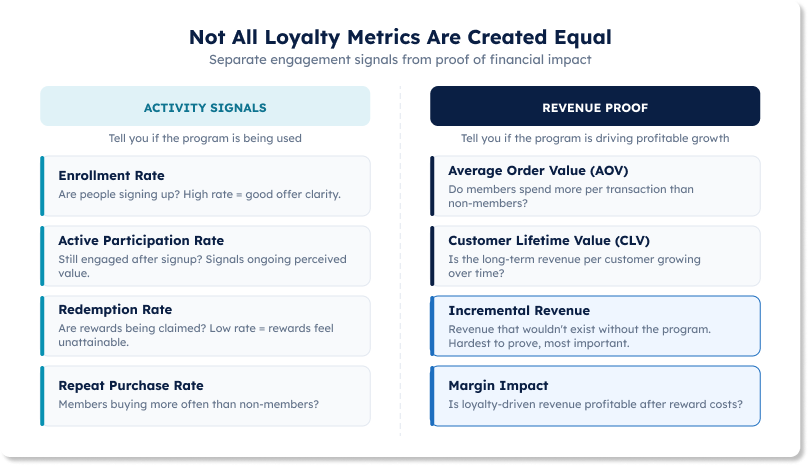
- Enrollment rate: This measures the percentage of eligible customers who choose to join your program. A low rate may suggest that your onboarding process is too complicated or that the program's benefits are not clearly explained.
- Active participation rate: This metric tracks the percentage of members who actively earn, redeem, or progress over a specific timeframe. It helps you see if members remain engaged after their initial signup.
- Repeat purchase rate: Monitor how often loyalty program members make repeat purchases compared to non-members. This indicates whether your program is successfully driving recurring customer behavior.
- Redemption rate: The percentage of issued points or rewards that customers actually redeem. High redemption rates typically correlate with high brand engagement and satisfaction.
- Average order value (AOV): Track whether loyalty members spend more per transaction than non-members. Programs often encourage higher customer spends through tier progression incentives or bundle rewards.
- Customer lifetime value (CLV): Measure the total revenue generated by a customer over their entire relationship with your brand. A successful program should steadily increase this long-term metric.
- Incremental revenue: This critical metric measures the additional revenue generated solely by the loyalty program, separating it from baseline sales.
- Margin impact: Measure whether loyalty-driven revenue is profitable after reward costs, discounts, and fulfillment are considered.
By regularly analyzing these metrics, your marketing teams can make data-driven adjustments that maximize the program's overall business impact.
Common customer loyalty program mistakes to avoid
Even with the best intentions, brands often fall into common traps that can hinder the success of their customer loyalty strategy. Being aware of these pitfalls allows you to proactively adjust your design and protect your margins.
- Making rewards too difficult to earn: If the path to earning rewards is unrealistically steep, members will quickly lose interest. Ensure your points system offers achievable, exciting milestones that keep customers engaged from the very beginning.
- Relying too heavily on discounts: Constant price reductions can erode your profitability and train customers to buy only when there is a sale. Mix in experiential rewards and exclusive benefits to maintain healthy margins and build genuine brand value.
- Creating excessive complexity: Too many rules, tiers, exclusions, or complex redemption steps will frustrate customers and reduce participation. Keep the user experience as straightforward and friction-free as possible across all channels.
- Keeping loyalty data in a silo: If your loyalty database is disconnected from your email engine, website, or CRM, you cannot personalize the customer experience. Unifying your customer data is essential for running targeted, cohesive campaigns that recognize member status.
- Ignoring inactive members: Failing to address members who have stopped engaging is a major missed retention opportunity. Use targeted win-back campaigns and personalized notifications to remind them of their unused rewards, points, or tier benefits.
- Failing to update your offerings: Customer expectations and market trends change constantly. Regularly review your rewards, mechanics, and program structure to ensure they remain fresh, valuable, and highly relevant to your audience.
How BlueConic helps brands build smarter customer loyalty programs
BlueConic helps brands turn loyalty programs into dynamic, personalized growth engines. With BlueConic’s Loyalty Program Progression capabilities, marketing teams can identify which members are ready to advance, determine which incentive is most likely to motivate them, and activate that message across the right channel at the right time.
- Unify loyalty data into complete customer profiles: Connect purchase history, browsing activity, email engagement, loyalty status, and behavioral signals into a single, real-time profile. This gives marketing teams a complete, single view of each individual's brand relationship.
- Identify members ready to progress: Use predictive scoring to find loyalty members who are approaching the next tier or most likely to respond to a timely incentive. This helps your team focus engagement where it can have the greatest impact.
- Personalize rewards without overusing incentives: Select rewards, prompts, or offers based on customer value, loyalty history, tier proximity, and engagement patterns. This allows you to encourage progression without relying too heavily on blanket discounts.
- Activate loyalty moments across channels: Deliver tier updates, reward reminders, personalized prompts, and replenishment messages via web, email, mobile, and paid channels from a single unified profile. Timing and messaging can adjust as customer behavior changes.
- Improve loyalty progression over time: Feed progression outcomes back into your customer profiles and predictive models, helping the system refine which members to target, when to trigger outreach, and which incentives are most effective.
- Build trust through first-party and zero-party data: Use interactive Experiences, quizzes, product finders, and preference centers to capture declared customer preferences. This consented data immediately enriches profiles and powers more relevant loyalty experiences.
Build more personalized loyalty programs with BlueConic
The most effective customer loyalty programs look past generic transactions to deliver genuine, personalized value. When you make your program easy to understand, focus on meaningful rewards, and connect your systems, you build deep brand loyalty that supports long-term growth.
BlueConic helps marketing teams make loyalty progression more intentional by combining loyalty data, purchase history, behavioral signals, and engagement data in unified customer profiles. From there, brands can identify members who are ready to move forward, choose the right incentive for each individual, and trigger the right message across channels when it is most likely to drive action.
Ready to turn customer loyalty into a powerful growth engine? Book a demo today to see how unified first-party customer data, predictive scoring, and agentic decisioning can help transform your loyalty program into a more personalized, profitable customer retention strategy.
Frequently Asked Questions
What is a customer loyalty program?
A customer loyalty program is a structured marketing strategy that rewards customers for their ongoing engagement and brand advocacy, encouraging repeat business. These rewards can include points, discounts, tiered benefits, exclusive access, or personalized offers. By establishing a clear value exchange, these programs motivate customers to keep purchasing from your brand while sharing consented customer data that helps improve their overall customer experience across all touchpoints.
What is the best example of a loyalty program?
The best example of an effective customer loyalty program depends entirely on your industry, business goals, and target customer base. For example, tiered travel programs work beautifully by offering high-value status and exclusive perks to frequent flyers, while points-based retail loyalty programs like the Sephora Beauty Insider excel at encouraging frequent, low-cost purchases. Ultimately, the most successful programs are simple to use, highly personalized, and offer experiential rewards that deliver immediate, obvious value to their members.
What are the 5 levels of customer loyalty?
The five levels of customer loyalty represent the typical stages a customer goes through as they build a relationship with your brand, moving from awareness, to consideration, purchase, repeat purchase, and finally advocacy. In the initial stages, a consumer simply learns about your brand and evaluates your offerings. Once they make a purchase, an effective loyalty program supports their progression toward repeat purchase and, eventually, to active brand advocacy, where they voluntarily recommend your business to others. Supporting this progression requires delivering highly relevant value and personalized experiences at every stage of the customer lifecycle.
