
How to Reduce Cart Abandonment With Generative AI: 10 Effective Strategies
Learn 10 generative AI strategies to reduce cart abandonment, personalize recovery efforts, and recover more revenue with real-time customer data.


Key takeaways
- Cart abandonment is any high-intent action left unfinished.
- GenAI helps marketers act faster and personalize smarter, turning hesitation into conversion by generating real-time, context-aware recovery messages and dynamic incentives.
- From real-time message generation to dynamic incentive testing, these 10 tactics show how GenAI can power more effective cart recovery.
Why shopping cart abandonment happens and how traditional recovery falls short
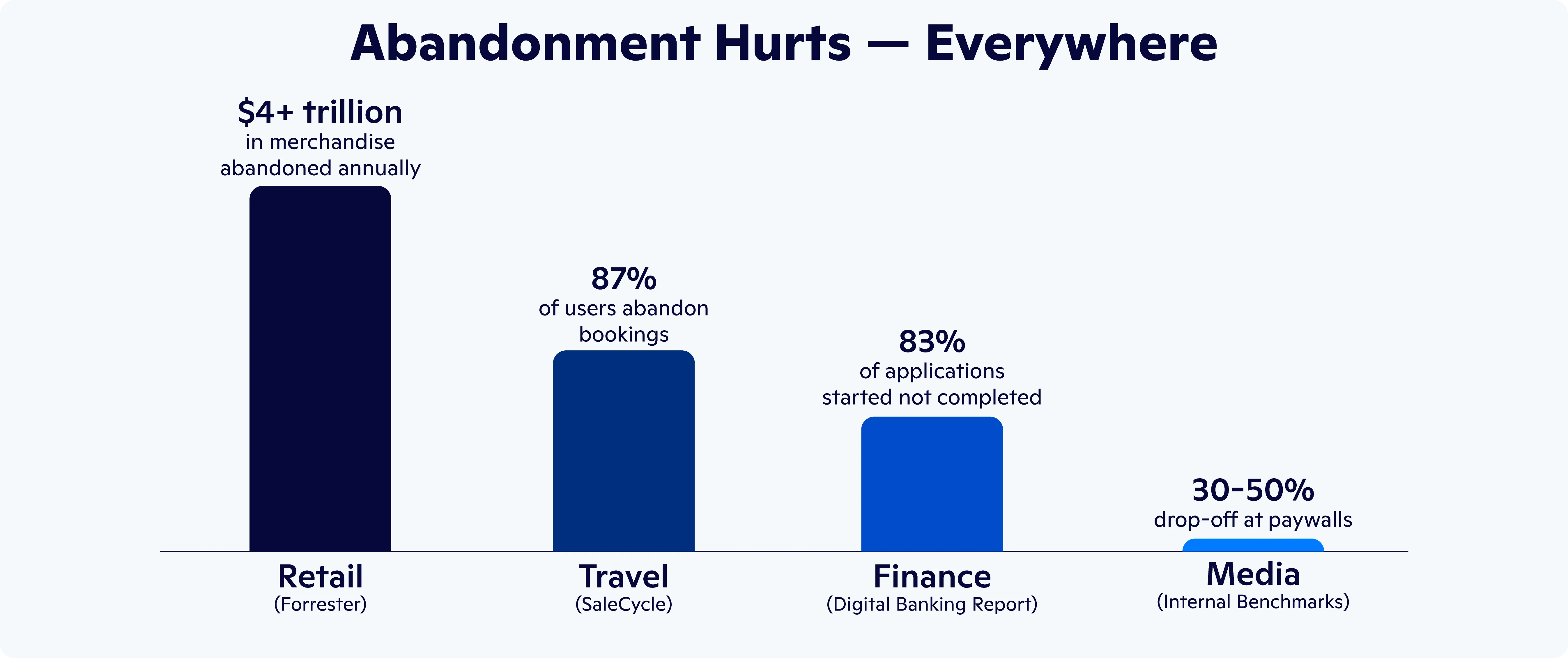
Globally, nearly 70% of online carts are abandoned—and on mobile, that rate rises to over 85%. The intent is real, but the follow-through often fails.
A traveler who selects flights but doesn’t book.
A subscriber who starts registration but doesn’t finish.
A prospect who adds a financial product to compare, then disappears.
For many brands, abandoned carts represent millions in recoverable revenue each year. But most recovery programs rely on static emails, batch campaigns, or one-size-fits-all incentives. By the time a message goes out, the moment has passed, and the consumer has moved on.
Different ways to use generative AI for cart abandonment in real time
Generative AI changes how marketers respond to cart abandonment. Instead of sending the same reminder to everyone, GenAI can:
- Generate context-aware recovery messages in real time
- Adjust tone and content based on customer segment and behavior
- Test incentives dynamically
- Personalize across email, SMS, app, and on-site messaging
- Scale tailored follow-ups without manual copywriting
Abandoned carts (and applications, bookings, subscriptions) become second chances triggered by behavior, shaped by context, and optimized for conversion. Here’s what that looks like in practice.
10 strategies to reduce cart abandonment and recover revenue with GenAI
Here are 10 ways to apply GenAI to make your cart abandonment efforts smarter, faster, and more effective—no matter what you’re selling.
1. Generate recovery messages instantly
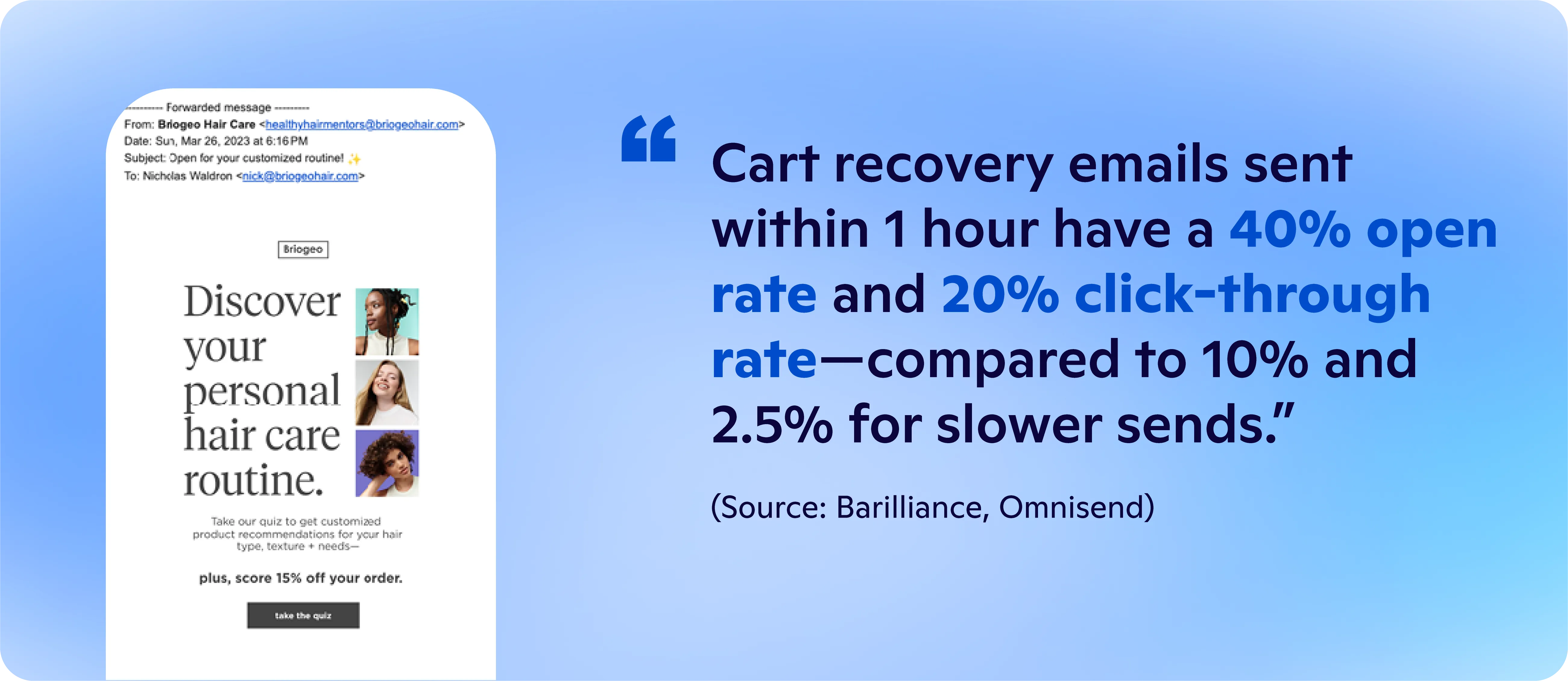
Speed is one of the biggest differentiators in cart recovery. The longer you wait, the more likely the shopper is to forget, get distracted, or convert elsewhere.
GenAI allows you to generate personalized recovery messages the moment someone abandons—whether it’s a product in a cart, a travel itinerary, or a financial application. Instead of relying on prewritten templates or slow batch sends, you can respond in real time with messaging that reflects the shopper’s interest and intent.
2. Personalize based on individual context
The contents of the cart only tell part of the story. GenAI lets you go beyond what someone abandoned to include who they are, what they’ve browsed before, how they typically engage, and where they are in their journey.
That means your recovery message isn’t just personalized—it’s contextual. A repeat visitor might get a helpful reminder. A first-timer might get more product detail. And a high-value customer might get VIP treatment.
3. Tailor incentives or nudges that make sense
Not every customer needs a discount to come back—and offering one unnecessarily can eat into your margins.
GenAI helps you decide when and how to incentivize. Based on behavioral signals and past interactions, it can suggest the right nudge for each user, whether that’s a limited-time reminder, social proof, or a targeted offer. In industries like CPG or travel, this might mean emphasizing convenience, urgency, or reassurance—not always price.
4. Address uncertainty with the right content
Abandonment often signals hesitation, not disinterest. Maybe the customer had a question, wasn’t sure about the product, or needed a little more information.
Use GenAI to generate dynamic reassurance content—like FAQs, testimonials, product comparisons, or benefit highlights—tailored to the item or service left behind. It’s a simple way to reduce friction and make it easier for the customer to move forward, especially for subscriptions or financial products where trust and clarity are essential.
5. Coordinate messaging across multiple channels
Your recovery efforts shouldn’t depend on the shopper checking their inbox. With GenAI, you can craft copy variations for every recovery channel—email, SMS, push notifications, retargeting ads, or onsite messages.
This ensures your messaging feels consistent, cohesive, and context-aware, no matter where the customer re-engages. And because the content is generated in real time, you don’t need to manually write or approve every version.
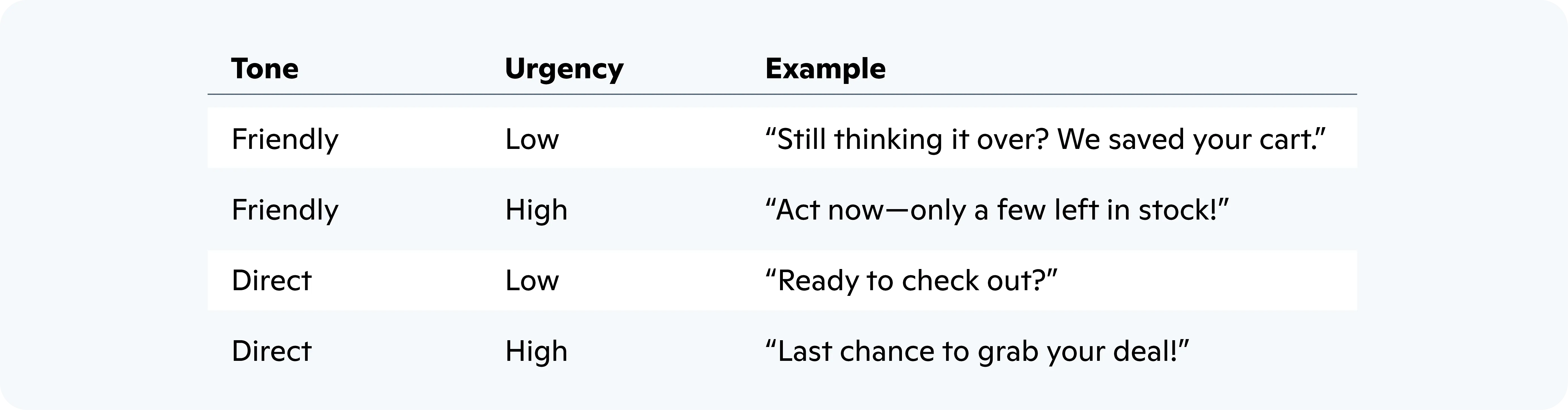
6. A/B test tone, urgency, and content at scale
Testing is critical, but it’s often slowed down by creative production cycles. Remove that barrier by using GEI to create multiple message variants instantly.
You can test different tones (urgent vs. casual), formats (short vs. detailed), or tactics (discount vs. no discount) across segments without waiting on copy teams. This lets you learn faster and continually optimize your recovery performance.
7. Adjust tone based on behavioral signals
How someone abandons can be just as important as what they abandon.
Did they spend 10 minutes reviewing features before exiting?
Did they bounce right after seeing the price?
Adjust your follow-up tone and message timing based on those behavioral cues with AI. That means softer nudges for early-exit users and more direct reminders for high-intent visitors—so the message feels relevant rather than robotic.
8. Localize or adapt for different audiences
For brands operating in multiple markets or serving varied personas, scaling personalization is tough. GenAI makes it easier by adapting messaging to different languages, tones, and cultural nuances without needing to recreate everything from scratch.
Whether you're talking to a traveler in Germany or a digital subscriber in the U.S., you can deliver a message that feels like it was written just for them.
9. Support onsite recovery, not just offsite
Cart recovery doesn’t have to rely solely on emails or ads. If a visitor returns to your site after abandoning, GenAI can help tailor the onsite experience in real time—resurfacing their cart, updating messaging to reflect urgency or relevance, or delivering a well-timed prompt. These subtle reminders can be just as effective as email when they’re grounded in the right context.
10. Learn and improve with AI-driven feedback
Cart recovery isn’t a one-and-done strategy—it’s a cycle of learning and optimizing. Make sense of performance data by summarizing results, spotting patterns, and suggesting what to test next with AI.
Whether it’s refining message timing, adjusting language, or identifying high-intent microsegments, you can continuously improve how you bring people back—and convert more of them each time.
What you need to reduce cart abandonment with generative AI
Reducing cart abandonment with generative AI takes more than fast content generation. To make it effective, brands need the right inputs, the right delivery channels, and a clear plan for turning insight into action. When those pieces are in place, generative AI can help teams respond faster, personalize recovery efforts more effectively, and improve conversion opportunities without adding unnecessary manual work.
Access to behavioral and cart data
Generative AI is only as useful as the signals behind it. To reduce cart abandonment effectively, you need visibility into what a customer added to their cart, where they dropped off, how far they got in the journey, and what actions they took beforehand. Browse history, product views, time on page, repeat visits, and prior purchases can all add useful context that helps shape more relevant recovery messaging.
Audience and intent signals
Not every abandoned cart reflects the same level of intent. Some shoppers are casually comparing options, while others are close to converting but pause because of price, timing, or uncertainty. Generative AI works better when it can draw on audience segments and intent signals to adjust messaging for first-time visitors, loyal customers, high-value shoppers, or users returning to the same product multiple times.
Connected channels for recovery
If your recovery efforts only rely on one channel, you limit how effectively generative AI can support the customer journey. Email is often part of the mix, but SMS, push notifications, onsite messaging, and retargeting can also play an important role. Connected channels make it easier to deliver timely, consistent follow-up that reflects the same context wherever the customer re-engages.
Clear rules for offers and messaging
Generative AI can help create recovery messages quickly, but it still needs boundaries. Brands should define when discounts are appropriate, which products or services should not be discounted, what tone fits the brand, and which claims or urgency tactics are acceptable. These guardrails help ensure AI-generated content stays aligned with business goals instead of chasing conversions in ways that hurt margin or trust.
Testing and measurement
To improve results over time, you need a way to test what generative AI produces and measure what actually works. That includes tracking recovery rates, conversion rates, incentive performance, message timing, and engagement by audience segment. Testing gives teams a clearer view of which approaches help reduce shopping cart abandonment and which ones need to be refined.
A strategy for turning insight into action
Generative AI can support cart recovery at scale, but it works best as part of a broader strategy. Teams need a clear plan for how abandoned cart data feeds into segmentation, message generation, channel delivery, and ongoing optimization. When that process is well defined, generative AI becomes more than a content tool. It becomes a practical way to reduce cart abandonment with more speed, relevance, and consistency.
Mistakes to avoid when using generative AI for cart abandonment reduction
Generative AI can help brands respond to abandoned carts with more speed and relevance, but better technology does not automatically lead to better recovery results. If the strategy behind it is weak, AI can just scale the same problems faster. Avoiding a few common mistakes can help teams use generative AI more effectively and reduce cart abandonment without creating a disjointed or overly aggressive customer experience.
- Treating generative AI like a copy shortcut: Faster content generation helps, but generic recovery messages will not do much to bring shoppers back. AI works better when messages reflect cart details, behaviour, and customer context.
- Sending the same message to every shopper: Different shoppers abandon for different reasons. Using the same follow-up for everyone can make recovery efforts feel broad and less relevant.
- Relying too heavily on discounts: Discounts may recover some carts, but overusing them can hurt margins and encourage shoppers to wait for offers.
- Ignoring timing and channel context: Strong messaging can still fall flat if it shows up too late or in the wrong channel. Recovery tends to work better when outreach reflects when and where the customer is most likely to re-engage.
- Overlooking trust and reassurance: Some shoppers need more confidence before they buy. If messaging leans too hard on urgency, it can feel pushy instead of helpful.
- Measuring the wrong outcomes: Opens and clicks only tell part of the story. Recovery rate, completed purchases, and conversion impact give a clearer picture of what is working.
- Letting AI operate without clear guardrails: Without rules around tone, offers, and messaging standards, AI-generated content can become inconsistent or overly promotional.
How BlueConic helps reduce cart abandonment with generative AI
Reducing cart abandonment takes more than sending a reminder after someone leaves. To recover more lost revenue, brands need real-time signals, relevant messaging, and the ability to act across channels. BlueConic is built to help marketers respond faster and personalize recovery efforts using live customer data and AI-driven decisioning.
With BlueConic, teams can support cart recovery with capabilities such as:
- Real-time behavioral signals: Capture abandonment and drop-off activity as it happens so recovery efforts can start while intent is still fresh.
- Unified customer profiles: Bring together customer data and behavior into a more complete view that supports more relevant follow-up.
- AI-driven personalization: Tailor messages, offers, and product recommendations based on shopper behavior and context.
- Cross-channel activation: Trigger recovery across email, SMS, web, and ads so outreach feels connected rather than fragmented.
- Built-in testing and optimization: Continuously improve performance by testing different messages, offers, and recovery approaches over time.
Together, these capabilities help marketers move beyond generic abandoned cart campaigns and build recovery programs that are faster, more relevant, and easier to optimize at scale.
Reduce cart abandonment at scale with GenAI
When someone abandons a cart, it doesn’t mean they’re gone for good. Most of the time, they’re hesitating. Comparing. Getting distracted. Waiting.
The difference between losing that conversion and winning it often comes down to how you respond — and how quickly.
With the right data and AI working together, you can follow up while intent is still fresh. You can tailor the message to what actually caused the hesitation. And you can do it without creating more manual work for your team.
Over time, that adds up to smarter recovery flows, stronger margins, and more conversions you would have otherwise missed.
Curious what this looks like in practice?
FAQs
How can I reduce shopping cart abandonment?
To reduce shopping cart abandonment, respond quickly with personalized follow-up messages, simplify checkout, address common objections (like shipping costs or trust concerns), and use real-time behavioral data to tailor incentives. AI can help automate and personalize these recovery efforts while intent is still high.
How can I reduce cart abandonment in ecommerce?
To reduce cart abandonment in ecommerce, improve checkout speed, offer transparent pricing, and send timely, personalized recovery messages across email, SMS, and onsite prompts. Using AI-driven insights allows you to tailor messaging, test incentives, and respond in real time based on customer behavior.
How do I improve my cart abandonment rate?
To improve your cart abandonment rate, identify where customers drop off, reduce friction in checkout, and follow up with context-aware recovery messaging. Personalization, real-time engagement, and smart incentive testing can help bring shoppers back and convert more abandoned carts into completed purchases.
What causes a cart abandonment rate to be high?
A high cart abandonment rate usually points to friction or hesitation in the buying journey. Common causes include unexpected costs, a complicated checkout process, account creation requirements, limited payment options, slow site performance, and a lack of trust signals. In some cases, shoppers are also comparing prices, waiting to make a decision, or getting distracted before they complete the purchase.
Does cart abandonment hurt business?
Yes, cart abandonment can have a direct impact on revenue and efficiency. When high-intent shoppers leave without converting, businesses miss out on sales they were close to winning. Over time, that can reduce return on acquisition spend, make conversion rates look weaker, and create pressure to spend more on remarketing or promotions to recover lost demand.
What is a normal cart abandonment rate?
Cart abandonment rates vary by industry, device, and customer journey, but high abandonment is common across ecommerce. Global estimates often put average online cart abandonment at around 70%, with mobile rates frequently climbing above 85%. That means some abandonment is normal, but consistently high rates can still point to checkout friction, pricing concerns, or missed recovery opportunities.
