
The 5 Best CDPs of 2026
Explore the top customer data platforms of 2026 and learn how to choose the right CDP for segmentation, AI, and activation.


With third-party data becoming increasingly unreliable, finding the best customer data platform (CDP) for your organization has never been more important. Today's brands need a platform that unifies, governs, and activates customer data in real time to deliver the personalized, privacy-conscious experiences modern customers expect.
This guide explores the five leading customer data platforms of 2026: BlueConic, Tealium, Twilio Segment, Salesforce Data 360, and Treasure Data. We will help you evaluate these options based on identity resolution, AI readiness, and overall usability to find the ideal fit for your business goals.
Key takeaways
- The best CDPs of 2026 enable your organization to unify customer data, improve identity resolution, and support privacy-conscious engagement.
- Platforms like BlueConic, Tealium, Twilio Segment, Salesforce Data 360, and Treasure Data serve different needs based on your technical resources and activation goals.
- You should prioritize CDP evaluation criteria such as unified customer profiles, real-time data collection, and marketer-friendly usability.
- Choosing the right CDP involves looking beyond a long feature list to find a platform that supports how your marketing and IT teams actually work.
- BlueConic remains a premier choice for organizations that want marketing teams to access actionable customer insights and personalize experiences without adding operational complexity.
What makes the best customer data platforms stand out in 2026?
The shift away from third-party cookies has made direct access to zero- and first-party customer data a requirement for any successful marketing strategy. To stay competitive, your organization needs more than just a place to store information; you need a practical way to manage customer data and the entire customer journey. The best customer data platforms break down data silos, analyze customer behavior, and create centralized data management processes so that every team can work from a single, accurate view of your customers.
To provide real value, modern customer data platforms must also be sophisticated enough for IT but simple enough for marketing teams to use every day. Today's customer data platforms accomplish this by focusing on:
- Identity resolution: Making it easy to recognize a customer across different devices and sessions to build a comprehensive customer profile.
- Privacy and consent management: Giving you clear tools to respect customer choices and stay compliant with data access laws without slowing down your campaigns.
- AI and analytics support: Organizing your data so it is actually ready for generative AI and predictive tools to use effectively.
- Real-time data collection and activation: Ensuring you can use your data the moment it is gathered for personalized marketing campaigns.
When these features work together, teams spend less time fixing data errors and more time driving growth. A high-quality customer data platform relies on these features to help you create unified profiles that lead to more meaningful customer interactions.
The 5 best customer data platforms of 2026
There is no single best CDP for every organization. Some teams need a marketer-friendly platform that makes customer data easier to use, while others need advanced data orchestration, deeper technical control, or a tighter fit with an existing system.
These customer data platforms represent some of the strongest options in 2026, each standing out for its ability to unify customer data, support identity resolution, enhance segmentation, and prepare teams for more personalized, AI-assisted engagement.
BlueConic
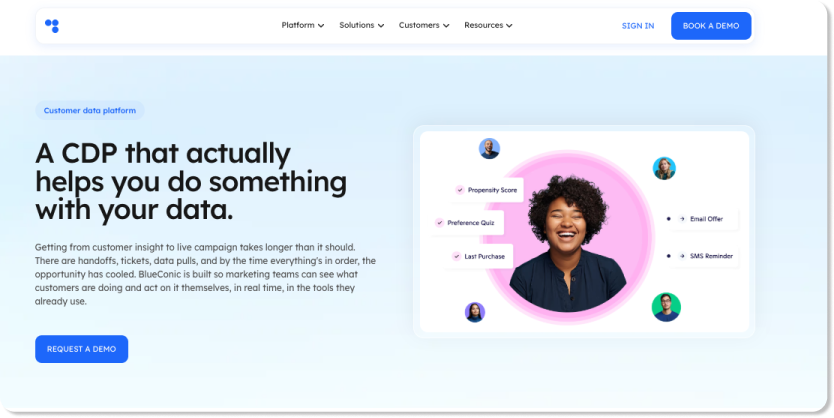
BlueConic is a customer data platform built for marketing teams that need to collect, unify, understand, and activate customer data without depending on IT for every campaign request. While many CDPs focus primarily on bringing existing data together, BlueConic helps brands collect new zero-party data directly from customers through interactive experiences, preference capture, surveys, forms, and other consent-based touchpoints.
That ability to gather declared customer preferences gives marketers a clearer understanding of what people want, not just what they have clicked, viewed, or purchased. BlueConic brings that zero-party data together with behavioral, transactional, and other first-party data to create persistent customer profiles that update in real time. As those profiles become richer, teams can build more relevant audiences, personalize customer journeys, and activate data across websites, mobile apps, email, advertising, and other channels.
BlueConic connects data collection, identity resolution, segmentation, activation, and AI-assisted workflows all into one platform, giving marketing teams a more practical way to turn customer data into growth.
Key benefits and strengths:
- Built-in zero-party data collection through interactive, consent-based customer experiences.
- Create comprehensive customer profiles that combine preference, behavioral, transactional, and lifecycle data.
- Real-time profile updates that help teams personalize experiences based on current customer behavior.
- Advanced segmentation capabilities that combine multiple data sources into real-time customer audiences.
- A marketer-friendly interface for building audiences and launching campaigns with less technical support.
- Strong support for marketing-led growth strategies that depend on fast access to actionable customer insights.
2. Tealium
Tealium is a customer data platform built for organizations that need strong data orchestration, governance, and real-time connectivity across a complex technology stack. It is often a good fit for larger teams that collect customer data from many sources, apply strict privacy and consent rules, and need trusted customer context to move across marketing, analytics, advertising, ecommerce, and data warehouse tools.
Tealium's platform unifies customer profiles in real time while giving technical teams centralized control over how data is collected, enriched, and shared. Its identity resolution, governance, and consent management capabilities make it especially useful for organizations operating in regulated or privacy-sensitive environments. For teams with the technical resources to manage a sophisticated CDP system, Tealium helps turn fragmented customer interactions into clean, governed, AI-ready data.
Key benefits and strengths:
- Real-time customer profile unification that supports immediate orchestration across ad platforms.
- Deep emphasis on data governance and consent management for highly regulated industries.
- Broad data connectivity that integrates with thousands of third-party tools and data warehouse systems.
- AI readiness through the delivery of high-quality, consented customer context to downstream systems.
3. Twilio Segment
Twilio Segment is a customer data platform that helps teams collect, clean, and activate customer data across a wide range of marketing, analytics, and customer engagement tools. It is widely recognized for its developer-friendly infrastructure, flexible data pipelines, and strong support for event data, making it a common choice for digital-first companies looking to build a scalable customer data system across websites, mobile apps, and APIs.
For teams already using Twilio systems, Segment can connect customer data more directly to engagement workflows. It also helps create a unified data layer between your data warehouse, marketing automation platform, analytics tools, and other business systems. While Segment may require more technical resources to manage than some competitors, its flexibility, scalability, and broad activation capabilities make it a strong option for companies handling large volumes of customer touchpoints.
Key benefits and strengths:
- Powerful data collection and integration capabilities for web and mobile apps.
- Unified profiles that provide real-time customer context for technical users.
- Broad activation across a wide variety of marketing and business intelligence tools.
- Advanced audience activation and personalization through the Segment Engage module.
4. Salesforce Data 360
Salesforce Data 360, formerly known as Data Cloud, is designed for enterprises that want to unify customer data across Salesforce products and connected business systems. It brings together data from marketing, sales, service, commerce, and other sources so teams can build a more complete customer view and use it within native Salesforce workflows.
This makes Salesforce Data 360 especially relevant for organizations that already rely heavily on Salesforce. The platform can connect customer relationship management (CRM) data with real-time engagement signals, support segmentation and activation for large-scale campaigns, and feed Salesforce AI and Agentforce workflows with more unified customer context. While it can be a powerful enterprise data and activation layer, it is generally most valuable for companies that have already invested heavily in Salesforce.
Key benefits and strengths:
- Native integration with Salesforce Marketing Cloud, Sales Cloud, and Service Cloud.
- A unified customer view that bridges the gap between different department silos and sales teams.
- Real-time segmentation and activation for large-scale marketing campaigns.
- Strong alignment with Salesforce AI tools for predictive analytics and automation.
5. Treasure AI

Treasure AI, formerly Treasure Data, is an enterprise customer data platform built for organizations with large, complex data environments. It helps teams bring together data from many different sources, including legacy systems, cloud platforms, transactional data, and behavioral signals, to create more complete customer profiles for analysis and activation.
Treasure AI has moved toward an “Agentic Experience Platform” model, with a stronger emphasis on AI-powered engagement, decisioning, and predictive customer modeling. It is often a good fit for global enterprises that need scalable data unification, strict security, and the ability to support more advanced analytics across the customer lifecycle. For organizations managing massive volumes of customer data, Treasure AI offers a powerful way to turn fragmented information into usable customer intelligence.
Key benefits and strengths:
- Enterprise-scale data unification for brands with highly complex data environments.
- A comprehensive customer profile created by merging transactional data and behavioral signals.
- Real-time decisioning tools that help teams take immediate action on customer behavior.
- Strong focus on AI-oriented engagement and predictive customer modeling.
Key features to look for in a customer data platform
The best CDP for your business is not necessarily the one with the most features or marketing tools. Instead, it is the platform that helps you collect, unify, and activate data to support your specific business goals. You should look for a balance of data quality, usability, and activation capabilities that empower your marketing and IT leaders to work together.
1. Unified customer profiles and identity resolution
A modern CDP must bring data from multiple sources into persistent customer profiles. This process includes identity resolution, in which the platform links known and anonymous identifiers to reduce duplicate profiles. By accurately recognizing customers across every touchpoint, you can build better customer segmentation and deliver more relevant marketing campaigns.
2. First-party and zero-party data collection
You should prioritize a customer data platform that helps your brand collect consented, relevant data directly from customer interactions across multiple channels. This includes first-party behavioral data and zero-party customer data, such as preferences or interests shared through quizzes and surveys. These data collection methods are essential for privacy-conscious marketing and reducing your reliance on third-party data.
3. Segmentation, analytics, and AI readiness
Your team needs the ability to build sophisticated audiences based on lifecycle stage, purchase history, and intent signals. Strong analytics and measurement tools help you understand growth opportunities and customer value. Your customer data platform must provide the well-organized data required to make AI tools and marketing automation capabilities effective and trustworthy.
4. Real-time activation and integrations
Unified data only creates value when you can use it. Your CDP should connect seamlessly with your existing technology stack, including email, advertising, and e-commerce systems. Real-time activation ensures that you can use accurate customer profiles to improve the customer experience exactly when it matters most.
5. Data governance, privacy controls, and usability
The best CDPs balance strict data governance with high levels of usability for marketing teams. Today's organizations need strong consent management and access controls to satisfy IT and compliance requirements. At the same time, the interface should be approachable enough for marketers to launch campaigns and act on insights without waiting for technical support from a data management platform specialist.
How to choose the right CDP for your business
Selecting a CDP is one of the most significant technology decisions your organization will make, and choosing the right customer data platform involves more than comparing technical specifications. You need a solution that aligns with your day-to-day operational reality while supporting your long-term strategic vision. Because a CDP sits at the center of your tech stack, your choice will determine how effectively your marketing, IT, and data teams can collaborate to drive growth.
1. Start with your business goals
Define the specific outcomes you want to improve, such as e-commerce conversion, subscription growth, or customer loyalty. Different goals require different strengths. For example, a focus on acquisition efficiency might prioritize ad platform integrations over deep service-cloud connectivity.
2. Identify your most important activation use cases
You should decide how your team will actually use the data once it is unified. Consider examples like real-time website personalization, ad suppression for existing customers, or abandoned cart campaigns. Having these use cases defined early helps you evaluate whether a platform can truly deliver on its promises.
3. Decide how marketing, IT, and data teams will share ownership
Collaborative ownership is the foundation of customer data platform success. You should consider who will build segments and who will manage the technical integrations. Some platforms are better suited to technical teams, while others, like BlueConic, are designed to give marketers greater independence without compromising data governance.
4. Review your existing tech stack
The right CDP must connect with the tools you already use, including your marketing automation platform, CRM, and data warehouse. Whether you prefer a native ecosystem fit or a flexible, best-of-breed approach, ensure the integration process is straightforward and supports your data ingestion needs.
5. Consider scalability and long-term flexibility
Your platform needs to support your current needs while leaving room for future growth. Look for a CDP that can handle increasing data volumes and evolving privacy requirements. The ability to manage complex data at scale while maintaining profile accuracy is vital for long-term success.
How BlueConic helps marketing teams turn CDP data into growth
BlueConic is built for organizations that need to turn customer data into measurable marketing outcomes. Instead of keeping data locked in technical silos, it provides a direct way for marketing teams to unify profiles and activate personalized experiences. This approach transforms the CDP from a storage tool into a dynamic customer data engine.
Why BlueConic is a premier choice for growth:
- Unified customer profiles: It creates persistent profiles that merge behavioral, transactional, and preference data.
- Real-time updates: Profiles are enriched instantly as customers interact with your brand, ensuring you always have accurate customer profiles.
- Zero-party data focus: You can collect declared preferences directly from customers using built-in Experiences.
- Marketer-friendly access: It empowers marketing teams to build segments and launch campaigns without constant data requests to IT.
- Growth-focused workflows: BlueConic connects data capture and identity resolution directly to activation and AI-assisted workflows.
BlueConic allows you to focus on smarter engagement and stronger personalization without adding unnecessary operational complexity to your team.
Choose a CDP that turns customer data into action
The best CDPs of 2026 do more than centralize information; they help you build trust and drive engagement. By choosing a platform that prioritizes unified profiles, privacy, and real-time activation, you can ensure your brand stays ahead of changing consumer expectations. Your final choice should depend on your business goals, your technical resources, and the specific use cases that will drive the most value for your customers.
Book a demo with BlueConic today to see how our platform can help you unify profiles, collect zero-party data, activate first-party data, and create more relevant customer experiences.
Frequently asked questions
What is the best CDP in 2026?
The best CDP depends on your specific business goals, tech stack, and technical resources. BlueConic is a premier choice for organizations that want to empower marketing teams to unify and activate first-party data more directly.
What features should a good CDP have?
A high-quality CDP should include unified customer profiles, reliable identity resolution, and the ability to collect first-party and zero-party data. You should also look for advanced segmentation, real-time activation, and strong data governance controls.
How do you compare CDP vendors?
You should compare vendors based on their ability to support your specific activation use cases and their fit with your existing technology stack. Evaluate their identity resolution methods, their approach to data privacy, and how easily your team can generate actionable insights. The best choice is the one that supports your workflow, not just the one with the longest feature list.

Kayte Grady is the Content Director at BlueConic, specializing in customer data, personalization, and AI. Her work focuses on breaking down how modern technology works and how real people can actually use it. A former social worker turned marketer, Kayte earned her BA from Purdue University, where she learned to write clearly and edit ruthlessly. That background shapes how she approaches content, starting with people first and supported by technology. An outspoken champion of ADHD professionals, Kayte has found growth, camaraderie, and kindred spirits in tech—despite her never-ending devotion to the paper calendar.