
How BlueConic Recovers More Carts While Protecting Margin
70% of carts are abandoned. Learn how BlueConic recovers more shoppers with signal-based interventions—not automatic discounts

Key takeaways
- BlueConic detects cart abandonment in real time and can intervene while the shopper is still on site, before intent decays and recovery requires heavier incentives.
- Most cart recovery programs fail because they treat every abandonment the same: a timed email with a coupon.
- The structural problem is that a time-based trigger can't distinguish between a distracted shopper, a price-sensitive buyer, and someone who already purchased from a competitor.
- Signal-based recovery matches the intervention to the barrier. The shopper who needs a product recommendation gets one. The shopper who needs reassurance gets social proof. The discount fires only when the profile confirms price is the actual obstacle.
70% of online shopping carts are abandoned. You already knew that. What you might not have calculated is what your recovery program is actually costing you. The real expense is the margin you're giving away on the carts you do recover.
The real cost of "send a coupon after two hours"
Most cart recovery programs follow the same script: A shopper adds something to their cart, leaves, and a timer starts. An email arrives with a discount, usually 10 or 15 percent off. Sometimes the shopper comes back and buys. More often, one of three things happens:
- The shopper was already going to return and you just handed them a discount they didn't need
- The shopper left for a reason the coupon doesn't address
- The shopper has learned that abandoning a cart is the fastest way to get a deal
Baymard Institute data shows the top reasons shoppers abandon carts haven't changed in years. 39% leave because extra costs at checkout are too high, 21% because delivery is too slow, 19% because they don't trust the site with their payment information.
A percentage-off coupon that arrives two hours later solves none of those problems because the email fires on a timer, not on a signal. The system doesn't know if the shopper abandoned because they got distracted, because the price felt wrong, because they wanted to compare options on another site, or because they found what they needed from a competitor five minutes later. The same message goes to all of them.
Meanwhile, the economics are getting worse. McKinsey data shows 49% of consumers plan to delay purchases, and 47% of apparel shoppers actively wait for promotions before buying. In that environment, a recovery email with a discount code doesn't just fail to solve the problem. It reinforces the behavior you're trying to prevent.
By the time a recovery email lands two hours later, the moment has already cooled.

What a signal-based recovery play does differently
A signal-based approach to cart recovery starts with a different question: why did this specific person leave, and what would actually bring them back?
Not all abandonments are the same. A shopper who spent twelve minutes comparing two products and left without adding either to cart is different from one who loaded a full cart on mobile and got interrupted by a phone call. The first needs help choosing, the second needs a reminder, and neither needs a coupon.
The better model reads the behavioral signals available at the moment of abandonment:
- How deep into the product page did the shopper go?
- How many sessions have they had this week?
- Did they engage with reviews or sizing information?
- What does their purchase history suggest about price sensitivity?
Those signals determine whether to intervene at all, and if so, what kind of intervention has the best chance of recovering the cart.
The shopper who was comparing products gets a recommendation that expands their options. The one deep in reviews gets social proof that closes the confidence gap. And the one who added items and left mid-checkout gets a simple reminder that their cart is waiting.
The discount is still available. It just fires last, not first.
That distinction matters for margin. When every recovery attempt starts with an incentive, you erode profitability on the carts you do recover while doing nothing for the carts where price wasn't the issue. When the intervention matches the barrier, recovery rates improve, and discount dependency drops.
How BlueConic runs the Cart Abandonment Recovery Growth Play
Here's what changes when you run cart recovery through BlueConic instead of a standard email workflow.
What BlueConic reads
Cart behavior events flow into the customer profile the moment they happen: add-to-cart, cart updates, checkout initiation, session end without purchase. Those events sit alongside the rest of the customer profile: browsing history across sessions, email engagement patterns, purchase history, loyalty status, and declared preferences from earlier interactions. The system knows who abandoned the cart, what their history looks like, and what signals point to why.
What BlueConic builds
Each abandoner gets scored across multiple dimensions. Is this a first-time visitor or a returning customer? Have they abandoned before, and did they come back? Are they engaging with price-related content like sale pages or comparison tools? How deep was their product engagement before they left? The profile distinguishes between a distracted shopper with high purchase intent and a price-sensitive browser who's waiting for a better offer.
How BlueConic acts
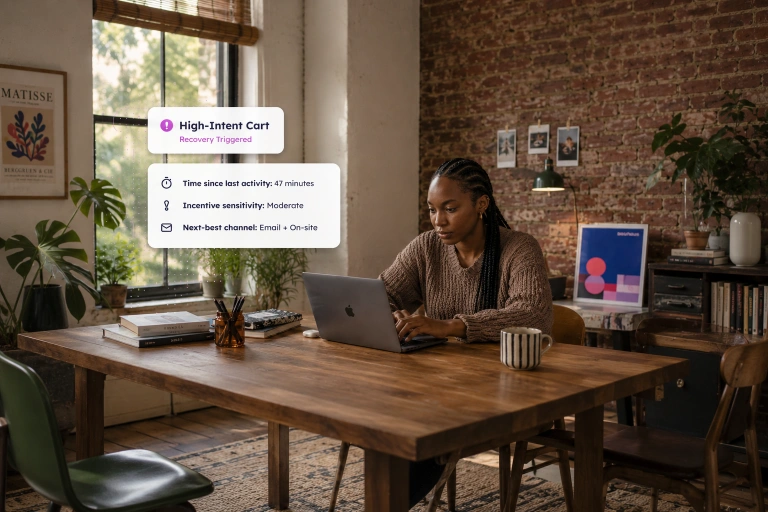
If the shopper is still on site, a Dialogue can surface immediately with a product recommendation for the undecided, a reminder of what's in their cart for the distracted, or a shipping threshold nudge for someone close to free shipping.
If the shopper has already left, the recovery sequence extends across available channels: email, web push, retargeting ads, and SMS. The Decisioning Agent evaluates which channel is most likely to bring this specific person back, based on their historical responsiveness or whether an incentive is warranted at all.
A high-intent shopper who left mid-checkout after a phone call probably doesn't need 15% off. A price-sensitive first-time visitor browsing sale items probably does. The system evaluates the profile and selects the intervention most likely to recover the cart while protecting margin: a reminder, a product recommendation, free shipping, or a discount — in that order of preference.
What the marketer controls
Marketers define the guardrails: maximum discount depth, eligible products, channel preferences, frequency caps, and business rules that govern when incentives are appropriate. Within those constraints, the Decisioning Agent handles the scoring, the channel selection, and the timing.
What happens on purchase
The moment an order event enters the profile, suppression fires across every active recovery channel simultaneously. No recovery email arrives after checkout. No retargeting ad follows a completed purchase. Suppression operates at the profile level, covering every channel at once, which eliminates the trust-damaging experience of getting a "come back" message for something you already bought.
What improves over time
Every recovery outcome feeds back into the model. The system retrains on actual results, learning which combinations of signal, channel, and incentive drive incremental recovery versus subsidizing purchases that would have happened anyway.

Primary Metrics to track with Abandoned Cart Recovery
The question you want to answer is twofold but simple: How many carts are you recovering? How many of those recoveries required a discount to get there? That second number is what separates a recovery program that works from one that just buys conversions back.
Two other things change over time: you recover more revenue per abandoned cart because the right intervention lands more often, and you give away fewer discounts because the system learns which shoppers actually need one and which ones just need a well-timed nudge.
Most teams should see clear movement within 30 to 90 days of the play going live. Here's what the math looks like:
100,000 monthly carts × $100 AOV × 70% abandonment = 70,000 abandoned carts worth $7M. Recover just 10% of those — 7,000 additional orders — and that's $700,000 in monthly revenue you were already losing.
Start with one trigger, not a full overhaul
You don't need to rebuild your entire recovery program on day one. Start with one high-volume abandonment trigger, like shoppers who added to cart and left within 60 seconds of checkout, and run the signal-based approach against that segment.
Measure two things: recovery rate compared to your current flow, and the percentage of recoveries that required a discount to convert.
BlueConic's recovery play launches from preconfigured templates and works alongside your existing ESP and ad platforms. The first trigger can go live in weeks, and most teams see clear results within the first billing cycle.
If software doesn't move a metric you're accountable for, why are you signing a 12-month commitment?
See the full Abandoned Cart Recovery play
This post is part of a series on Growth Plays, BlueConic's outcome-focused approach to turning customer data into revenue action.

Brittany Gulla is a growth and product marketing leader with extensive experience working across B2B and B2C businesses at various stages. Passionate about crafting brand and product stories that align with data-driven growth tactics in order to fuel business expansion. Brittany specializes in focusing on messaging, website positioning, and AI-driven strategies. Previously, she helped launch a global B2B agriculture tech brand at Resonant Technology and grew revenue to $6M annually at Bow Wow Labs, Inc. She also drove major account growth and branded campaigns at Mashable. Brittany excels in data-driven strategies, customer acquisition, and omni-channel marketing to fuel business success.