
What is a Growth Play?
A Growth Play is a pre-built, outcome-focused use case that activates your customer data to hit a specific business goal. Here's what that means and how it works.
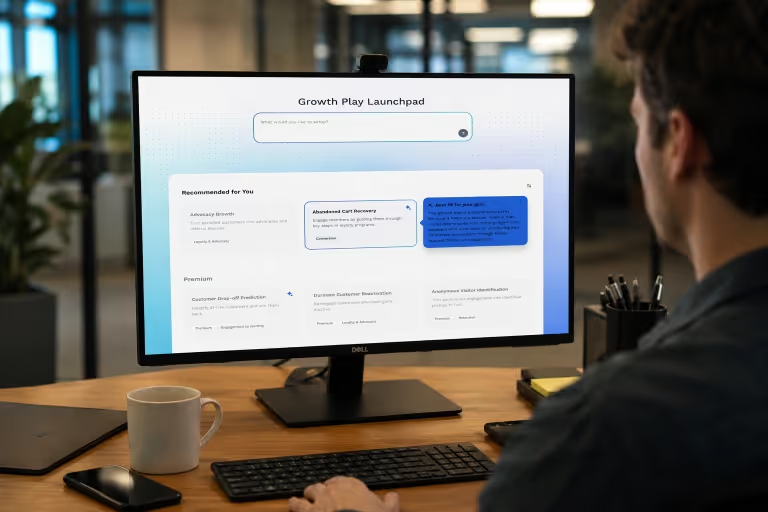

Key takeaways:
- A Growth Play is a pre-built customer data use case designed to help businesses improve a specific metric, such as conversion, retention, or customer acquisition.
- Growth Plays use existing customer data and marketing tools to trigger personalized actions across channels like email, ads, websites, and mobile apps.
- Each Growth Play focuses on a defined business outcome and includes the data signals, decision logic, activation methods, and measurement framework needed.
- Businesses can activate individual Growth Plays independently, allowing teams to test and measure results within 30 to 90 days before expanding to additional use cases.
A Growth Play is a ready-to-run use case built around a specific business goal. It’s not a platform feature, not a campaign, and certainly not a six-month implementation. You pick the metric you need to move, activate the play, and start seeing results within 90 days.
If software doesn't move a metric you're accountable for, why are you signing a 12-month commitment?
That's the question Growth Plays are built around.
You've probably seen the term somewhere in the BlueConic orbit. Here's what it actually means for your business, and how to find the one built for the goal you're trying to hit this quarter.
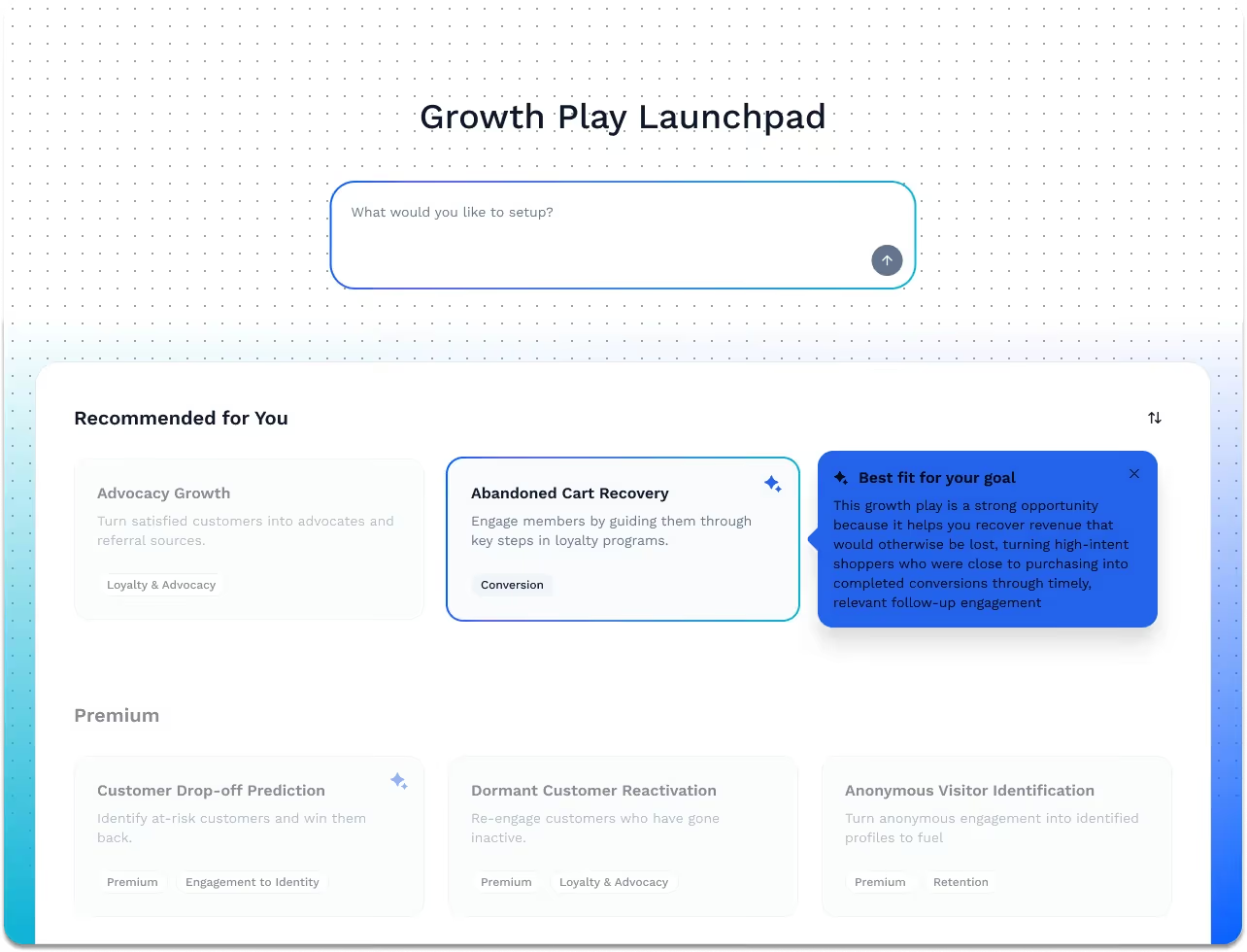
The definition, unpacked
Think of a Growth Play as a packaged answer to a specific growth problem. You're not buying a toolkit and figuring out what to build. You're choosing a business result, and the play gives you the data signals, the decisioning logic, and the activation paths to get there. Here's what makes them work:
Focused on what matters to you
Each play is self-contained. You activate one at a time, starting with whatever growth challenge is most urgent. You don't need to roll out a full platform strategy before the first play delivers results.
Organized around the metrics you own
Every play is organized around something you're already accountable for: conversion rate, cart recovery revenue, repeat purchase frequency, customer retention. The play exists to move that number, and that's how you measure whether it's working.
Connected to the data you already have, wherever it lives
Growth Plays activate the customer data you already have: behavioral signals, transaction history, declared preferences, loyalty status. And because BlueConic connects to your data warehouse, your ESP, your ad platforms, and your commerce tools, the data stays where it is. No copying, no migration, no waiting for an engineering team to pipe everything into a new system before you can act on it.
Designed for results in 90 days
You'll know whether a play is delivering value before you've committed to anything beyond the first one. Short cycle, clear proof point, then decide what's next.
Growth Plays are not a feature inside a CDP, and they're not a campaign you set up once and forget. They're also not a full platform implementation that takes months of engineering to get running. A Growth Play is a focused path from growth challenge to measurable business impact, designed to prove value fast.
Why the Growth Play model exists
The way most marketing technology gets sold and implemented follows a pattern that everyone recognizes, and nobody loves.
- You buy a platform
- Get handed a set of tools
- Your team spends months figuring out what to do with them
And then... internal alignment takes longer than anyone expected. Stakeholders can't agree on where to start. Six months later, ROI is still unclear, and someone is asking whether the investment was worth it.
That's a structural problem with the "here's the platform, figure out how to use it" model. When the path from purchase to impact is undefined, complexity fills the gap, and complexity kills momentum.
Growth Plays invert that model. Instead of starting with technology and working backward to a business problem, you start with the business problem and work forward to a proven path for solving it.
Each play defines the outcome, the signals it uses, the actions it takes, and the metrics that tell you whether it's working.
The difference is the approach and the technology. BlueConic's real-time customer profiles, AI decisioning, and cross-channel activation were built to support this model. The platform captures live customer context, determines the right action, and fires it across whatever channel the customer is in. Growth Plays organize all of that around the outcomes you actually care about.
How to start with the goal you need to hit
Forget personas for a moment. Forget which team you sit on. The better question is: what metric is under the most pressure this quarter?
Growth Plays are organized around business outcomes, not product features. Find your goal below, and you'll see which plays are built to move it.
The 13 Growth Plays
Each BlueConic Growth Play targets a specific stage of the customer revenue lifecycle. They're organized into three categories: Identity and Audience Building, Commerce Growth, and Retention and Loyalty.
Identity and Audience Building
These plays solve the upstream problem most brands face before anything else works well: too much anonymous traffic, too little usable customer data. Better identity data makes every other play more precise.
1. First-Party Audience Building
Most brands know less about their customers than they think. 80-90% of site visitors stay anonymous, which means for every dollar you spend driving traffic, you can directly reach and retarget maybe 10 to 20 cents of that demand through owned channels. The rest leaks.
First-Party Audience Building identifies high-engagement anonymous visitors and delivers contextual experiences, like product matchers, quizzes, and preference centers, that give visitors a reason to identify themselves. When they do, their full behavioral history merges into the identified profile immediately, and that profile activates across your ESP, ad platforms, and on-site personalization in real time.
From there, progressive enrichment captures declared preferences over time, so profiles get deeper without asking for everything upfront. Every play downstream gets better data to work from.
→ How BlueConic builds first-party audiences
2. Intent-Based Targeting
Not all traffic is equal, and "visited recently" is not a proxy for intent. Someone who browsed once last week and someone who's viewed the same product three times, opened two emails, and has high predicted LTV are not the same audience. But most retargeting programs treat them identically.
Intent-Based Targeting builds a unified intent score from behavior across your full customer profile: on-site activity, email engagement, loyalty status, purchase history. It activates the highest-intent audiences across your retargeting channels and suppresses converted customers the moment a purchase hits their profile, across every channel at once. You stop funding low-intent impressions and start concentrating spend where purchase probability is actually high.
→ How BlueConic powers intent-based targeting
Commerce Growth
These plays cover the revenue motions closest to active buying: acquisition efficiency, first-purchase conversion, cart recovery, order value, and repeat purchase. Most brands already run versions of these use cases today, but often through disconnected tools with separate logic per channel. Running them from one real-time customer profile means decisions compound across interactions rather than starting fresh each time.
3. First-Purchase Acceleration
You're paying to drive traffic, but most of it leaves without buying. The first purchase is the hardest conversion to earn, and the window is getting shorter. Discovery increasingly happens on platforms brands don't control: TikTok Shop, social commerce, AI-driven search. When shoppers do arrive on your site, many are in a decision mode that might last one session.
First-Purchase Acceleration identifies engaged pre-purchase visitors in real time and delivers the right nudge during the session: a product recommendation for someone still deciding, social proof for a comparison shopper, a targeted offer for someone who's price-sensitive. Because it works from the full behavioral profile, not a simple exit-intent rule, the intervention matches the visitor, not just the moment.
→ How BlueConic accelerates first purchase
4. Abandoned Cart Recovery
Cart abandonment isn't a mystery. 70% percent of carts get left behind, and most brands respond the same way: wait a few hours, send an email, offer a discount. By then, intent has cooled, and you've already started training your customers to expect an incentive every time they hesitate.
The Abandoned Cart Recovery play detects abandonment in the moment and can intervene immediately, on-site before the shopper leaves, or across email, push, SMS, and retargeting ads if they're already gone. It determines whether an incentive is actually needed or whether a reminder is enough, so you're not giving away margin on shoppers who would have come back anyway.
When a purchase happens, suppression fires across every channel instantly so no one gets a recovery email after they've already checked out.
→ How BlueConic recovers abandoned carts without defaulting to discounts
5. Order Value Expansion
When acquisition costs are rising, and conversion rates are flat, you can't just buy your way to more revenue. You have to get more value from the demand you're already converting. Most "frequently bought together" widgets show the same recommendations to everyone. A first-time buyer researching skincare and a loyal customer who just repurchased their usual routine are not the same shopper, but they often see the same upsell.
Order Value Expansion pulls the full customer profile into the recommendation:
- What they've browsed
- What they've bought before
- What category they prefer
- Their price sensitivity
Then, it surfaces the add-on or bundle most likely to land for that specific person, at the moment they're actively in a purchase decision. Recommendations update in real time as the shopper moves through the session.
→ How BlueConic increases order value in real time
6. Smart Replenishment and Upselling
For products with a natural consumption cycle, like skincare, supplements, pet food, and household staples, the repeat purchase is predictable. Most brands still handle it with a fixed-interval reminder: 30 days after purchase, send an email. That works until it doesn't. Customers who use a product faster get the reminder too late. Customers who stock up get it too early. Either way, some of them have already reordered from a competitor.
Smart Replenishment predicts each customer's individual reorder window based on their actual purchase cadence, not a product average. When a customer approaches their window, the play triggers through whatever channel they're most responsive to, with the right message: a simple reminder, a subscription offer, an upgrade, or a bundle. If a product is out of stock, the reminder suppresses and routes to an alternative instead.
→ How BlueConic drives replenishment and upsell at the right moment
7. Lookalike Audience Expansion
Your best customers share patterns. The problem is, ad platforms never see them clearly. They build lookalikes from pixel fires and shallow customer lists, which means you end up paying to acquire people who look like your average customer, not your best one.
Lookalike Audience Expansion builds your seed audience from the full first-party profile: purchase frequency, average order value, engagement depth, declared preferences. It scores your database against that model and pushes high-precision seeds to Meta, Google, TikTok, programmatic, and retail media simultaneously. When conversions come back, the model retrains on actual revenue outcomes, not proxy signals. And customers who've already converted get suppressed automatically, so you stop paying to reacquire them.
→ How BlueConic builds lookalike audiences from your best customers
8. Vwam: AI Shopping Assistant
Some customers know what they want. Others need to be guided there. Vwam is an AI-powered shopping assistant that engages customers in a real conversation about what they're looking for, recommends the right product, and feeds every declared preference back into their profile. That means every future interaction, whether it's an email, a product page, or a retargeting ad, is informed by what the customer actually said they care about. It's not just a chatbot. It's a data capture moment disguised as a helpful conversation.
→ How BlueConic guides shoppers from question to confident purchase
9. AI Discovery Optimization
Customers are increasingly making purchase decisions inside AI assistants, asking tools like ChatGPT and Perplexity to compare products, find deals, and narrow options. Most brands have no visibility into whether their products are showing up in those conversations, or whether the pricing and offers being surfaced are even accurate.
AI Discovery Optimization gives AI assistants direct access to your current product catalog, pricing, and active promotions through a dedicated discovery endpoint. Instead of letting assistants scrape outdated information or guess at your inventory, you control what they see, how it's structured, and how it's measured. As your offers change, what assistants recommend updates automatically. The result: your products show up in AI-driven purchase decisions with the right information, turning a channel you can't see into one you can measure and grow.
→ How BlueConic powers AI discovery optimization
Retention and Loyalty
These plays cover what happens after the first purchase: churn prevention, dormant customer reactivation, loyalty progression, and advocacy. What they all have in common is that timing determines the outcome. The difference between catching a disengaging customer two weeks early versus two weeks late is often the difference between a retained relationship and a reacquisition cost.
10. Customer Drop-Off Prediction
Customers don't churn all at once. They slow down first: visits get less frequent, email engagement drops, purchase intervals stretch. Most brands don't catch it until someone who hasn't bought in 90 days gets dumped into a winback campaign with a 20% off code. By then, re-engagement costs more and converts less.
Customer Drop-Off Prediction scores churn risk continuously against the full customer profile, using behavioral signals, purchase frequency, loyalty activity, and engagement patterns across channels. It catches the early signs before a customer is officially dormant. When someone crosses a defined risk threshold, the play determines whether to intervene at all, what kind of message makes sense, whether an incentive is warranted, and which channel they're still paying attention to.
→ How BlueConic predicts customer drop-off before it happens
11. Dormant Customer Reactivation
Your dormant customer list isn't just one segment. Some of those people are genuinely done. Some would come back with the right prompt. Some would come back anyway and don't need a discount. Most winback programs treat all of them the same, burning margin on the ones who didn't need the incentive while underinvesting in the ones most likely to respond.
Dormant Customer Reactivation builds a reactivation propensity model from historical purchase behavior, lifetime value, engagement patterns, and past responsiveness to outreach. High-propensity customers get prioritized and receive tailored interventions matched to what they cared about before they went quiet, delivered through channels they're still using. Low-propensity customers get deprioritized so you stop wasting budget on a dead end.
→ How BlueConic reactivates dormant customers before you lose them for good
12. Loyalty Program Progression
Most loyalty programs are good at tracking points. They're not good at driving behavior. Customers earn, occasionally check their balance, and maybe advance a tier eventually, but the program isn't doing anything to accelerate that. Tier benefits don't show up when a customer is actively browsing. Progress isn't visible at the moment it could actually motivate a purchase.
Loyalty Program Progression pulls loyalty data (points balance, tier status, purchase history) into the real-time customer profile alongside behavioral signals. It then triggers interventions when they'll actually move the needle: "You're 150 points from Gold" while a customer is on a product page, double-points offers on the categories they already buy, milestone celebrations at the right moment. Activation runs across web, mobile, email, and push from the same intelligence, so the experience stays consistent wherever the customer is.
→ How BlueConic moves customers through loyalty stages
13. Advocacy Growth
Your most satisfied customers are your most underused growth channel. Referral programs usually underperform for the same reason: they ask everyone at the same time with the same incentive. A static "refer a friend" link in the account menu doesn't distinguish between a customer who just had a great experience and one who's been quietly disengaging for two months.
Advocacy Growth scores advocacy likelihood from behavioral signals, transactional history, loyalty tier momentum, and sentiment data. It triggers referral prompts when satisfaction is actually at its peak: right after a purchase confirmation, following a loyalty milestone, post-delivery, after a positive review. The incentive is personalized to what's most likely to motivate that specific customer. You get more referrals from customers who were already ready to give them, and the referred customers tend to stick around longer.
→ How BlueConic turns satisfied customers into growth
How Growth Plays work in practice
The structure is the same regardless of which play you're running, and it follows four steps that apply whether you're recovering abandoned carts or reactivating dormant customers.
Step 1. Identify the problem
Who has it, where in the customer journey it's happening, and what signal tells you it's happening.
For a commerce team, that might be "cart abandonment is at 70% and rising." For a retention team, it might be "purchase intervals are stretching for our mid-tier loyalty members." For an acquisition team, it might be "our lookalike audiences are bringing in one-time buyers, not repeat customers."
Step 2. Define the outcome
The specific metric you're trying to move, with a timeframe. Not "improve retention."
Something like "reduce churn among mid-tier loyalty members by 5% within 90 days" or "increase cart recovery rate by 10% without increasing discount depth."
Step 3. Activate the play
The data signals, the customer segments, and the experience or action that fires.
A cart recovery play detects abandonment in real time, evaluates whether a reminder or an incentive is the right intervention, and triggers across email, on-site, push, or retargeting based on what the shopper is most likely to respond to.
A first-party audience-building play identifies high-engagement anonymous visitors and delivers a contextual experience (a product quiz, a preference center) that gives them a reason to share their email.
The mechanics vary by play, but the pattern is consistent: read the signal, decide the action, fire across the right channel.
Step 4. Measure
What moved, in what timeframe, and what to optimize next.
Every play is tied to a business outcome, not an engagement metric. For example, cart recovery measures recovered revenue and discount dependency, not email open rates and lookalike expansion measures ROAS improvement and CAC reduction, not audience size.
Measurement feeds back into the play so it gets smarter over time: which interventions are driving incremental lift, which ones are subsidizing behavior that would have happened anyway, and where to focus next.
Growth Play examples
Curious about what it looks like in practice? Here are three Growth Play examples across different business goals.
Example 1: First-Party Audience Building
A beauty brand running First-Party Audience Building notices that 87% of its site traffic is anonymous. So, it deploys a skincare quiz on its highest-traffic product pages. Visitors who engage get personalized product recommendations in exchange for their email.
Within 60 days, the brand converts 12% of quiz participants into known, consented profiles. Those profiles immediately feed into the brand's lifecycle programs, suppression lists, and lookalike audiences, reducing paid reacquisition and improving personalization across every channel.
Example 2: Abandon Cart Recovery
A retailer running Abandoned Cart Recovery detects a cart abandonment 30 seconds after the shopper stops interacting. The system evaluates the shopper's profile:
- Returning customer
- High lifetime value
- Not discount-sensitive
It triggers an on-site reminder with the carted products before the session ends, no discount needed. If the shopper leaves anyway, a follow-up email fires two hours later with the same products and a free shipping nudge.
The shopper completes the purchase that evening. Revenue recovered, margin intact.
Example 3: Smart Replenishment
A supplement company running Smart Replenishment has a 90-day vitamin product. But not every customer uses it on the same cycle.
The play builds an individual reorder prediction for each customer based on their actual purchase cadence. Customers who tend to reorder at 75 days get a reminder at 70. Customers who buy in bulk every 120 days get a different message at 115.
The supplement company sees a 15% lift in repeat purchase rate and stops losing customers to Amazon reorders that arrive because their own reminder came a week too late.
What you need to get started
The most common question about Growth Plays is whether it's a big lift. The answer is designed to be no.
- Start with one play, not all 13. Pick the metric under the most pressure and run the play built to move it. You don't need to activate the full library to see results. One play, one outcome, one proof point.
- Launch in hours, not months. Growth Plays are built from pre-configured logic and your existing customer data. You're not building a custom implementation from scratch. You set what the business needs, and coordinated agents run your growth strategy across every customer and channel, without your team manually pushing each decision forward.
- Work with the tech stack you already use. Growth Plays don't replace your ESP, your ad platforms, your loyalty system, or your commerce tools. They sit on top of your customer data and coordinate decisions across the tools you already use. Your email platform still sends the email. Your ad platform still runs the ad. The play makes both smarter by feeding them better audiences and better timing.
- Measure results within 30 to 90 days. Every play is tied to a specific business metric with a defined measurement approach. You'll know whether it's working before you've committed to anything beyond the first play.
- Expand once the first play proves value. Once the first play proves value, adjacent plays reinforce it. Better identity data improves commerce play precision. Commerce signals sharpen retention predictions. Retention insights improve acquisition quality. The plays are designed to compound, but you don't need to plan for all of them up front. Start, prove, expand.
See BlueConic Growth Plays in action
The metric under the most pressure this quarter isn't waiting for your stack to be perfect or your team to align on a six-month roadmap with a 12-month software commitment. It needs to move now, with the data you already have, through the channels you're already running.
That's what Growth Plays are built for. One play, one outcome, measurable results within 90 days. You don't need to activate all 13 to see value. You need to pick the number that matters most and run the play designed to move it.
Find your goal above, explore the play built to hit it, and see what 90 days looks like for your business.

Brittany Gulla is a growth and product marketing leader with extensive experience working across B2B and B2C businesses at various stages. Passionate about crafting brand and product stories that align with data-driven growth tactics in order to fuel business expansion. Brittany specializes in focusing on messaging, website positioning, and AI-driven strategies. Previously, she helped launch a global B2B agriculture tech brand at Resonant Technology and grew revenue to $6M annually at Bow Wow Labs, Inc. She also drove major account growth and branded campaigns at Mashable. Brittany excels in data-driven strategies, customer acquisition, and omni-channel marketing to fuel business success.