
How BlueConic Turns "Maybe" Into the First Purchase
Most first-purchase strategies default to discounts. Learn how BlueConic reads behavioral signals to deliver the right intervention before the moment closes.
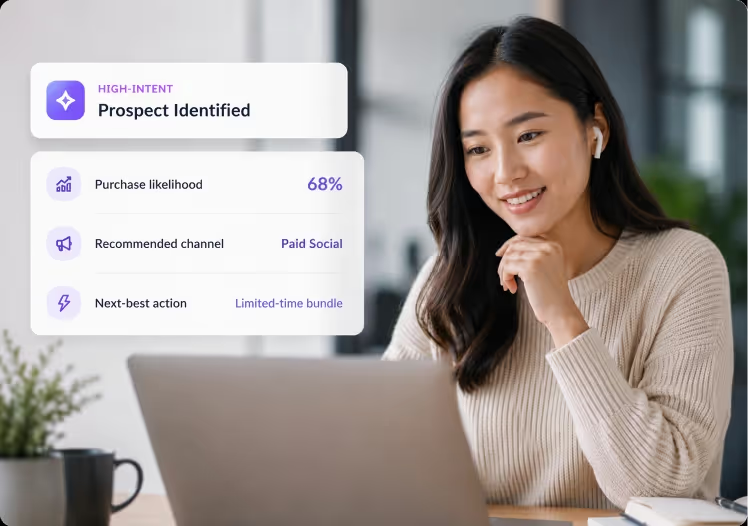

A potential customer has been back on your site four times this week. They just spent twelve minutes on the same product page. TL;DR? They're not browsing anymore. They're deciding. But nothing in your stack is built to figure out why they haven't clicked purchase yet. So the system does what systems do when it can't: it picks the one lever it can pull fast enough. A discount. For everyone.
But the customer who needed to see that you carry their size in two other colorways? They left anyway.
The one who was comparing you against a competitor? A coupon didn't answer their question.
The one who was genuinely ready to buy? You just trained them to wait for an offer next time.
The why behind the first purchase (or lack thereof) is the whole question. And it's answerable. But only if you have a complete enough profile and a decisioning system that can evaluate it and act before the moment closes.
The data on first-time visitors
A returning customer gives you something to work with. The decisioning gets easier the more someone has bought from you.
A first-time visitor gives you almost nothing.
What you have is behavioral signals from this session, maybe a few prior visits, and whatever you can infer from how they're moving through the site right now.
That's it.
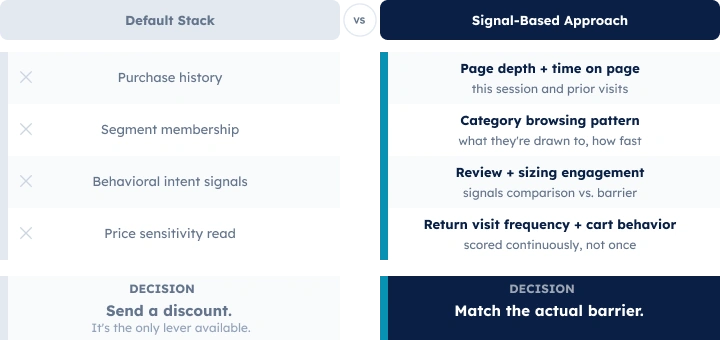
The problem is the decision you need to make — what to show this specific person to get them over the line — requires knowing something about why they haven't bought yet. And the tools most teams rely on for that decision were built to work with transaction history, segments built from purchase behavior, or audiences defined by what people have already done. When none of that exists yet, they default to the one intervention that doesn't require knowing anything: typically, a discount.
The cost of defaulting to discounts
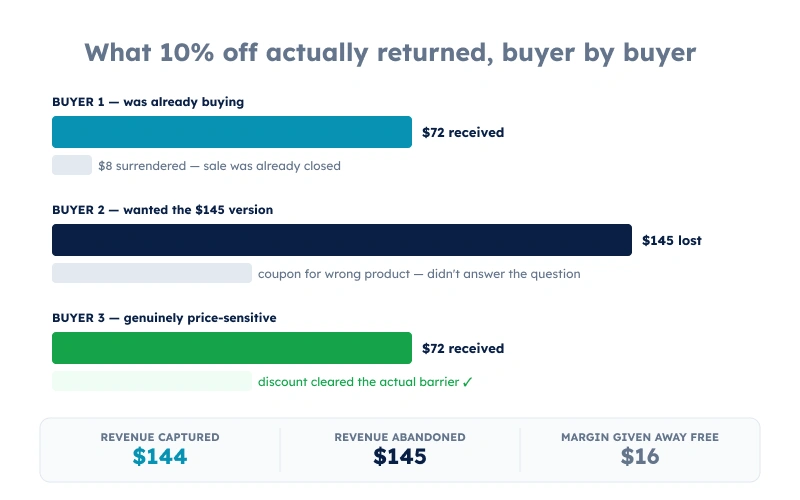
Run the math on a single discount campaign. Take three purchase visitors. All get the same 10% off.
The first was buying anyway. They had their credit card out. Your $80 product just got 10% cheaper for no reason. That's $8 you handed back on a sale you already had.
The second wanted the $145 version. They've been on that page twice. You sent them a coupon for the $80 product they were never going to buy. They don't convert because your discount told her you weren't paying attention.
The third was price-sensitive. The discount worked. They bought. That's the one that shows up in the recovery report as a win.
One conversion out of three. Eight dollars surrendered on a sale you already had. $145 lost. A higher-value customer who left because the offer felt generic.
That's what the default costs.
What a signal-based approach does differently
A signal-based approach reads how deep a visitor is going, how often they're returning, and what details they're engaging with, and determines when those signals are strong enough to act on, and holds back when they aren't.
Intervention matches the barrier
Once the signal crosses a threshold, the intervention matches what the behavior is actually pointing at. The visitor anchored to one product gets a recommendation that expands their options. The one moving through reviews gets social proof that closes the gap. The one with clear purchase intent and no obvious barrier gets a reminder, not an offer.
The discount is still in the toolkit. It just isn't the first move anymore.
BlueConic's First-Purchase Acceleration Growth Play
BlueConic calls this the First-Purchase Acceleration Growth Play. It's built specifically for the pre-purchase visitor — someone who is engaged, identifiable, and hasn't bought yet.
What BlueConic reads
The play starts with BlueConic's Listeners, which track behavioral signals across every session:
- Product page depth and time on page
- Category browsing patterns across visits
- Return visit frequency
- Review and sizing engagement
Those signals feed into a real-time profile that scores each visitor on three dimensions:
- Purchase readiness
- Product affinity
- Discount sensitivity
The profile updates continuously as behavior changes.
How the BlueConic Decisioning Agent acts on it
When a visitor's signals cross a threshold, the BlueConic Decisioning Agent takes over. It evaluates the full profile autonomously and selects the intervention most likely to convert this specific visitor:
- A product recommendation if affinity signals point to a better fit
- Social proof if review engagement suggests comparison behavior
- An incentive only if the profile indicates price is actually the barrier
It also determines channel and timing. If the visitor is still on site, a Dialogue surfaces the intervention in session. If they've left, the play extends to web push or retargeting ads using the same profile intelligence. Email and SMS aren't part of this play — these are pre-purchase visitors your brand doesn't have contact information for yet.
The marketer's role
Marketers control the guardrails: maximum discount depth, eligible products, brand and compliance rules. Within those guardrails, the Decisioning Agent makes the calls.
Every outcome feeds back into the profile and the model, so the play gets more accurate with every conversion cycle.
What KPIs move with First-Purchase Acceleration
The primary metric is first-purchase conversion rate.
How many known non-buyers actually convert, and how quickly.
That number should move within 30 to 90 days of the play going live on your highest-traffic non-buyer segments.
Two secondary metrics also move as a result.
- First-order AOV climbs because the play routes visitors to the right product rather than defaulting to a discount on whatever they were already looking at.
- The rate at which you're giving away margin on conversions that didn't need an incentive drops, because the Decisioning Agent only fires an offer when the profile actually supports it.
The number worth watching alongside all of this: what percentage of your non-buyer interventions resulted in a conversion without a discount? That's the clearest signal that the play is working the way it's supposed to.
Why the first purchase is worth solving
The first purchase is the hardest one. It's the moment where you have the least data, the shortest window, and the most to prove. Getting it right sets the trajectory for everything that comes after.
A customer who converts because the experience actually matched where they were in their decision is a different customer from one who bought because a coupon showed up at the right time.
That's what a signal-based approach to first-purchase conversion actually changes. Not just the rate. The relationship.
To go deeper on how BlueConic runs this Growth Play, visit First-Purchase Acceleration.

Kayte Grady is the Content Director at BlueConic, specializing in customer data, personalization, and AI. Her work focuses on breaking down how modern technology works and how real people can actually use it. A former social worker turned marketer, Kayte earned her BA from Purdue University, where she learned to write clearly and edit ruthlessly. That background shapes how she approaches content, starting with people first and supported by technology. An outspoken champion of ADHD professionals, Kayte has found growth, camaraderie, and kindred spirits in tech—despite her never-ending devotion to the paper calendar.