
How BlueConic Builds Lookalike Audiences Like Your Best Customers
Platform-native lookalikes find people who resemble your average customer. Learn how BlueConic targets prospects more likely to buy and stay.


Key takeaways:
- Platform-native lookalike audiences optimize for similarity to your customer list, but similarity and value are different things.
- When you seed ad platforms with a flat customer list or pixel data, the algorithm finds more people who look like your average buyer, including one-time discount shoppers and low-LTV customers.
- A value-based lookalike starts with a different question: who are your best customers, and what signals define them?
- That seed, built from purchase frequency, engagement depth, and predicted lifetime value, tells the platform to find people who resemble the customers actually worth acquiring.
You spent $400,000 on paid acquisition last month. Your ROAS dashboard says it worked. But look closer at who you actually acquired: how many of those new customers will buy again without a coupon? How many will still be active in six months?
Most lookalike audiences can't answer that question because they weren't built to ask it.
The lookalike problem
Every ad platform offers lookalike audiences, and every marketing team uses them. Meta builds one from your customer list. Google builds one from your converters. TikTok builds one from your pixel data. Each platform finds people who resemble whatever you gave it.
The problem is what you gave it.
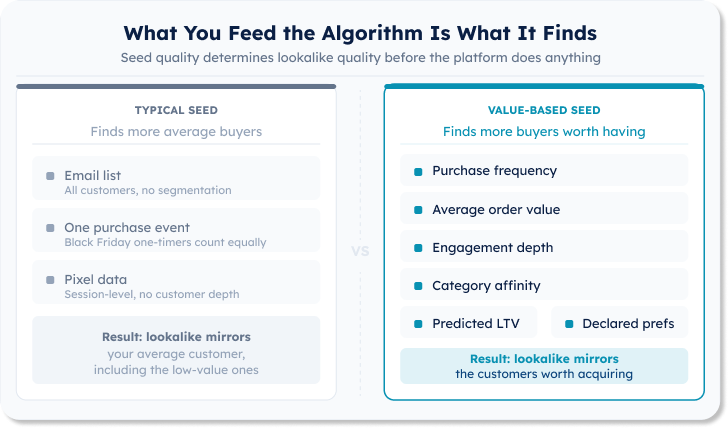
Most teams seed lookalike audiences with a flat customer list or a pixel-based conversion audience. That list includes your best customers and your worst ones. The repeat buyer who spends $300 every quarter sits in the same seed as the one-time discount shopper who bought a $19 item on Black Friday and never came back. The platform treats them equally because it has no way to tell the difference.
So the lookalike finds more people who look like your average customer. Some will be great. Many will behave exactly like the low-value buyers who diluted your seed in the first place.
The platform did its job. You gave it the wrong starting point.
This gets more expensive every quarter. As AI search reduces organic click-through rates and privacy changes weaken platform targeting signals, paid acquisition carries more of the growth burden. The quality of who you acquire matters more when every impression costs more. And platform algorithms can only optimize against the signals you give them.
What a value-based lookalike does differently
A value-based lookalike starts by defining what "high value" actually means for your business, then builds the seed from those customers only.
That definition might be:
- Purchase frequency above a certain threshold
- Average order value in the top quartile
- Repeat purchase behavior within 90 days
- A combination of all three weighted by what matters most to your growth targets
The point is that the definition comes from your business strategy, not from whatever the ad platform can infer from a pixel fire.
Once you've defined your high-value customers, you score your full database against that definition. The model pulls in customers who match and filters out everyone who doesn't. What goes to the ad platform is a concentrated signal of your best buyers, not a diluted average of everyone who ever converted.
The lookalike audience the platform builds is also anchored to value, not just similarity. It finds people who resemble the customers you actually want more of — repeat buyers and high-AOV shoppers — instead of finding more people who look like a one-time purchaser.
That same score runs across every platform simultaneously. Meta, Google, programmatic, retail media networks — all working from the same definition of "high value" instead of each platform building its own version from whatever signals it can see.
And the model improves over time. When conversions come back, you can measure which acquired customers actually became high-value buyers and retrain the model on real revenue outcomes, not proxy metrics like click-through rate or cost per acquisition.
How BlueConic runs the Lookalike Audience Expansion Growth Play
Here's what changes when you build lookalike audiences through BlueConic.
How BlueConic defines "high value" audiences
You set the criteria that matter to your business:
- Purchase frequency
- AOV thresholds
- Engagement depth
- Repeat purchase behavior
- Predicted lifetime value
- Or whatever combination reflects who you actually want more of
BlueConic's AI Workbench trains a model against your full customer database using those criteria, scoring every profile on how closely they match.
What goes into the high-value scorecard
The score draws from the complete customer profile, including:
- Behavioral signals like browsing patterns and category engagement
- Transactional data like purchase history and order value trends
- Preferences customers have shared through on-site interactions
That depth is what separates a BlueConic-built audience from a flat customer list. The platform receives a concentrated signal of your best buyers, built from data it could never see on its own.
Where BlueConic activates
One scored audience definition pushes to Meta, Google, programmatic DSPs, and retail media networks in a single motion. Every platform works from the same high-value definition instead of each building its own lookalike from partial signals.
How suppression protects your budget
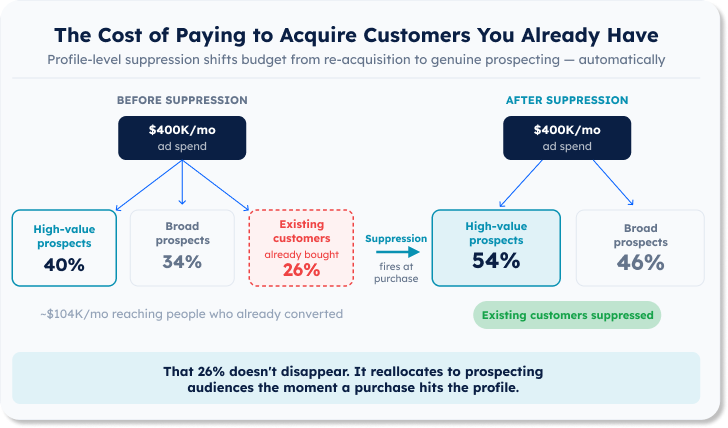
Customers who have already bought get removed from every prospecting audience the moment a purchase hits their profile. No more paying to show acquisition ads to people who converted yesterday. Suppression fires at the profile level, across every active channel, simultaneously.
And the moment a purchase hits a customer's profile, suppression pulls them from every prospecting audience automatically.
How the model improves
Conversion data flows back into the scoring model automatically. The system evaluates which acquired customers actually became repeat buyers and which ones churned after one purchase, then retrains the seed on actual revenue outcomes. Over time, the lookalike gets sharper because the definition of "high value" keeps getting validated against real results.
What you control
You define the value criteria, the platforms, the budget allocation rules, and the suppression logic. The model handles the scoring and retraining within those guardrails.
What KPIs move with Lookalike Audience Expansion?
ROAS is the headline metric, and the question to track is straightforward: are you acquiring better customers, or just more of the same? But the numbers underneath tell the real story:
- CAC relative to the lifetime value of the customers you're acquiring
- First-purchase AOV from lookalike-sourced customers
- Repeat purchase rate among acquired cohorts within the first 90 days
Suppression savings show up quickly, too. When you stop paying to reacquire customers who already bought, that budget shifts to genuine prospects.
Here's what the math looks like at a typical spend level:
$400,000/month in paid acquisition × 26% average waste from poor targeting = $104,000/month in unproductive spend
Recover even 10% of that through better seed quality and suppression → $40,000/month back into productive prospecting, or $480,000 annually.
Most teams should see clear movement within the first 60 days of activating value-based seeds.
Start with one platform, one seed, one measurement window
You don't need to rebuild your entire paid acquisition strategy overnight.
- Pick the platform where you spend the most on prospecting.
- Build one value-based seed from your top-quartile customers.
- Run it alongside your existing lookalike for 30 to 60 days and compare: CAC, first-order AOV, and early repeat purchase signals.
Your existing customer data is all you need to build the first seed, and the audience activates alongside your current ad platforms. The first audience can be live in weeks.
See the full Lookalike Audience Expansion Growth Play
This post is part of a series on Growth Plays, BlueConic's outcome-focused approach to turning customer data into revenue action.

Brittany Gulla is a growth and product marketing leader with extensive experience working across B2B and B2C businesses at various stages. Passionate about crafting brand and product stories that align with data-driven growth tactics in order to fuel business expansion. Brittany specializes in focusing on messaging, website positioning, and AI-driven strategies. Previously, she helped launch a global B2B agriculture tech brand at Resonant Technology and grew revenue to $6M annually at Bow Wow Labs, Inc. She also drove major account growth and branded campaigns at Mashable. Brittany excels in data-driven strategies, customer acquisition, and omni-channel marketing to fuel business success.