
A Guide to Lifecycle Marketing
Learn what lifecycle marketing is, why it matters, and how to engage customers at every stage with data-driven strategies, best practices, and the right technology.


Customer journeys are no longer linear. Modern audiences are interacting with brands numerous times across multiple channels, devices, and touchpoints before ever making a decision. This complexity has made it harder than ever before to manage targeted campaigns and meet constantly shifting customer expectations, unless you use a lifecycle marketing strategy.
Lifecycle marketing is the strategic approach of using data-driven, personalized interactions to engage customers at every stage of their journey, from initial awareness to long-term customer loyalty. Adopting a lifecycle marketing strategy allow your to align your messaging, timing, and channels to provide a cohesive and positive customer experience.
This guide will break down the key stages, benefits, and best practices of lifecycle marketing, as well as the technology required to execute it successfully.
Key takeaways
- Lifecycle marketing focuses on the entire customer relationship rather than isolated transactions, leading to sustainable growth.
- Success depends on unifying data to create a single, persistent view of the customer across all stages.
- Coordinating messaging across email, web, and mobile ensures a consistent brand experience that builds trust.
- Utilizing a CDP allows marketing teams to automate and personalize lifecycle stages in real time.
What is lifecycle marketing?
Lifecycle marketing is a comprehensive strategy that uses customer data to deliver relevant, timely messaging at each stage of their journey. Rather than focusing solely on a single sale, this approach prioritizes the long-term health of the customer relationship for both potential and existing customers. Lifecycle marketing recognizes that a customer’s needs and expectations continually shift as they move from a prospect to a brand advocate.
Lifecycle marketing covers acquisition, onboarding, engagement, retention, and reactivation, and serves as the bridge between your marketing channels. For example, when you analyze data to see a customer browsing a specific category, your lifecycle marketing campaigns might trigger a personalized email or a targeted social media ad. By grounding every interaction in behavioral data, you ensure your brand remains responsive to real-time customer needs.
Why lifecycle marketing matters
Implementing an effective lifecycle marketing strategy does more than just organize your campaigns; it fundamentally changes how you interact with your target audience. Here is why it is essential for modern marketing teams:
- Improves customer experience: When you deliver consistent, relevant messaging, you build trust. Customers feel understood rather than targeted, which increases overall customer satisfaction.
- Increases customer lifetime value (CLV): By focusing on ongoing engagement, you encourage repeat purchases. This transforms one-time buyers into loyal customers who provide long-term revenue and higher lifetime value.
- Boosts conversion rates: Targeted communications delivered at the right moment often see higher engagement. Personalized offers based on a user's specific stage of their journey significantly improve campaign performance and engagement metrics.
- Reduces customer acquisition cost: Retention is often more efficient than acquisition. By retaining customers through proactive engagement, you lower your overall customer acquisition cost and improve marketing efficiency.
- Reduces churn: Lifecycle strategies allow you to identify at-risk customers by analyzing customer behavior. Proactive outreach can re-engage these users before they leave for a competitor.
The key stages of lifecycle marketing
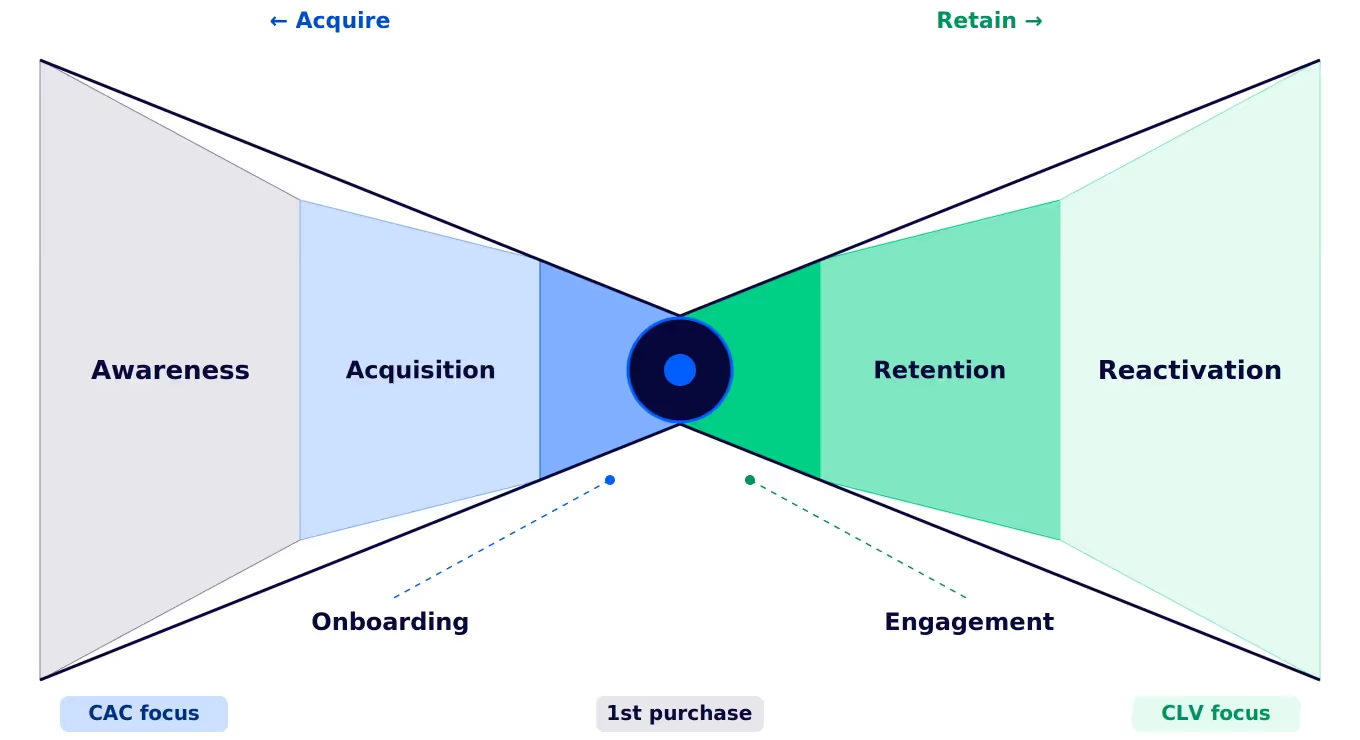
While lifecycle marketing provides a structured framework, real-world customer journeys are often fluid. Potential customers may skip stages or move backward based on their unique needs. Understanding these common stages of the customer helps you tailor your approach to meet them where they are.
Awareness stage
In the awareness stage, your goal is to engage potential customers who may not yet be familiar with your solution. You typically reach these audiences through educational content, search engine optimization, and social media ads. Focus on building brand visibility and establishing your organization as a helpful authority.
Acquisition
The acquisition stage focuses on converting prospects into customers. This is where you use targeted offers, paid ads, and lead capture strategies to drive that critical first purchase. Effective lifecycle marketing identifies these early wins as just the beginning of a larger conversation.
Onboarding
Once a purchase is made, the onboarding stage ensures the new customer quickly understands the value of your product and exceptional customer service. Welcome campaigns, guided product education, and personalized experiences help set the foundation for a long-term relationship.
Engagement
Engagement is about maintaining an ongoing interaction with your existing customers. By delivering relevant content, in-app messaging, and push notifications, you keep your brand top-of-mind. This stage is where you deepen the customer relationship through consistent, ongoing value.
Retention
Retention efforts are designed to encourage repeat purchases and turn satisfied customers into brand advocates. You might implement a loyalty program, referral programs, or exclusive perks based on customer lifecycle management data. Engaging customers at every stage of their loyalty helps maximize their value.
Reactivation
When customers become inactive, reactivation strategies help bring them back. Win-back campaigns and targeted incentives can remind them of your value and encourage them to engage once again. Successful lifecycle marketing identifies these lulls and responds automatically.
How lifecycle marketing works
Implementing lifecycle marketing requires a repeatable, data-driven process. Here is how most successful organizations manage customer journeys:
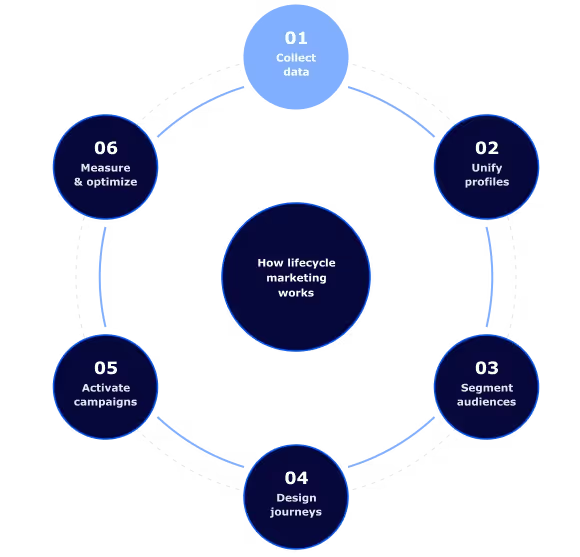
- Collect customer data: Gather behavioral, transactional, and declared data across all touchpoints in a privacy-conscious way.
- Unify profiles: Create a single, persistent view of each customer using a customer data platform (CDP) to eliminate data silos.
- Segment audiences: Group your customers into specific customer segments based on shared behaviors, attributes, and their current lifecycle stage.
- Design journeys: Map out the specific messaging and targeted communications that will guide customers from one stage to the next.
- Activate campaigns: Deliver personalized messages across email, web, mobile, and paid ads in real time.
- Measure and optimize: Use valuable insights from performance data to continuously refine your marketing strategies.
Common lifecycle marketing challenges
Despite the clear benefits, many organizations struggle to execute lifecycle marketing efforts effectively. Recognizing these hurdles is the first step toward overcoming them.
- Data silos: Fragmented data across different systems prevents a holistic view of the customer, leading to disjointed experiences.
- Lack of real-time insights: If your data is delayed, you cannot respond to customer actions when they are most relevant.
- Channel fragmentation: Using disconnected tools for email, social, and customer relationship management (CRM) systems makes it difficult to maintain a cohesive customer experience.
- Limited personalization: Without unified data, your messaging often stays generic, which fails to resonate with customers at specific stages.
- Scalability issues: Manual processes simply cannot support the complexity of managing thousands of individual customer journeys.
Lifecycle marketing best practices
To build a successful lifecycle marketing strategy, focus on creating a foundation that is both flexible and data-rich.
- Start with zero- and first-party data: Build your strategy around the data you own to ensure accuracy and compliance.
- Focus on the customer journey: Align your campaigns with real customer behaviors rather than relying on internal assumptions.
- Personalize at scale: Leverage automation to deliver relevant content to every individual, regardless of your audience size.
- Use real-time triggers: Set up your systems to respond immediately to customer actions, such as a cart abandonment or a high-value page view.
- Align teams and channels: Ensure that every department is working from the same customer data.
How technology enables lifecycle marketing
Traditional marketing tools, such as basic Email Service Providers (ESPs) or legacy CRM systems, often operate in isolation. This creates a "batch and blast" mentality that is the opposite of effective lifecycle marketing. To truly engage customers at every touchpoint, you need a technology stack that supports fluidity and real-time response.
A lifecycle marketing strategy requires a platform with capabilities that include identity resolution, unified profiles, and cross-channel activation. Lifecycle marketing managers need to know that the person opening your email is the same person browsing your mobile app five minutes later.
Modern solutions, like CDPs, provide the necessary foundation. By unifying data from every source and making it available for real-time action, a CDP enables you to move away from static campaigns and toward dynamic, ongoing engagement.
Why BlueConic is built for lifecycle marketing
BlueConic is a purpose-built platform designed to power lifecycle marketing through unified, actionable customer data. Its features enable you and your team to move beyond fragmented measurement and toward a comprehensive strategy.
Key capabilities include:
- Real-time data collection: Capture behavioral and declared data the moment it happens to better understand customers early in their journey.
- Unified customer profiles: Maintain a single, persistent view of each customer, ensuring that your segmentation is always aware of their current lifecycle stage.
- Advanced segmentation: Build dynamic audiences based on complex behaviors, allowing you to target customers with surgical precision.
- Activation across channels: Deliver timely, personalized experiences across web, mobile, email, and social using Experiences.
- Marketer-friendly interface: Empower your team to launch and optimize campaigns without waiting for heavy IT support.
Success in lifecycle marketing depends on having accurate, accessible, and actionable data. BlueConic provides the infrastructure to turn those data points into meaningful customer relationships and increase customer lifetime value.
Turning lifecycle marketing into a growth engine
Lifecycle marketing is evolving from a series of scheduled campaigns into an always-on, data-driven engagement model. Businesses that successfully connect their data, insights, and activation processes are the ones that create sustainable growth.
BlueConic's Customer Growth Engine powers this process, allowing you and your team to create coordinated strategies that create repeat buyers and loyal advocates. By prioritizing the customer's needs at every stage, you build a foundation for long-term success.
Ready to turn your customer data into meaningful engagement at every stage? Book a demo today to discover how BlueConic can help you activate lifecycle marketing at scale.
Frequently asked questions
What is the difference between CRM and lifecycle marketing?
Customer relationship management, or CRM, typically refers to the technology and processes used to manage individual customer data and sales pipelines. Lifecycle marketing differs from CRMs because it is a broader strategy that leverages data to deliver personalized, stage-aware experiences across the entire customer relationship, from initial discovery to advocacy.
What are the stages of the lifecycle of marketing?
While customer paths vary, the core stages include awareness (building visibility), acquisition (converting prospects), onboarding (driving initial value), engagement (maintaining interaction), retention (fostering loyalty), and reactivation (re-engaging inactive users).
What is the difference between a customer journey and lifecycle marketing?
A customer journey is the path a customer takes from awareness to purchase. Lifecycle marketing is the strategy and set of tactics a business uses to influence and support that journey at every stage.
How does lifecycle marketing improve customer retention?
By using customer interactions to trigger personalized outreach, lifecycle marketing ensures customers feel valued after their initial purchase. This ongoing relevance reduces churn and encourages repeat customers.
Can lifecycle marketing be automated?
Yes. In fact, effective lifecycle marketing requires automation to deliver personalized messages at scale. However, that automation must be fueled by unified, real-time data to remain effective.
