
Giving Enterprise AI Hands: The CDP Goes Agent-to-Agent
Discover how BlueConic's Agent-to-Agent (A2A) capabilities let enterprise AI agents find assets, recommend strategies, and build audiences.


For the past two years, enterprise AI has mostly been about conversation. Generative AI gave marketing teams a voice: drafting email copy, summarizing campaign results and answering questions in a chat window.
But when it comes to getting things done, a person is still often the go-between. An AI agent working in Claude, ChatGPT, or a company's own AI applications might spot that VIP churn is rising, but someone still has to open the customer data platform, check the customer fields, build complex audience rules, and create the audience.
Generative AI gave marketing a voice. Agentic AI gives marketing hands.
With BlueConic's new Agent-to-Agent (A2A) capabilities, those external AI agents can work directly with specialized agents inside BlueConic. They can ask BlueConic for growth strategy recommendations, find what already exists, and build audiences using real customer data and configurations, without anyone switching tools.
Together with Model Context Protocol (MCP), A2A makes these capabilities accessible through the AI tools and workflows your organization is already adopting.
Key takeaways
- Enterprise AI agents can work directly with BlueConic agents. A2A lets external agents delegate tasks to specialists familiar with your customer data.
- Three agents make marketing work easier. Design builds audiences, Search finds existing assets, and Growth Play Advisor recommends strategies.
- Open standards, built-in safeguards. A2A and MCP enable interoperability, while data validation and permissions help maintain control.
Meet Your New Specialist Agents
BlueConic's A2A implementation introduces three specialized agents, each designed to handle a different part of the work marketers do in their CDP.
- The Design Agent: Builds and updates audiences (segments) from a plain-language request, such as "customers who abandoned their cart".
- The Search Agent: Finds what already exists in your BlueConic environment (segments, listeners, dialogues, connections and profile properties) from a plain-language question, such as “listeners updated last week by user X”. It translates your request into a structured query and returns exact counts read straight from the index.
- The Growth Play Advisor Agent: Recommends growth strategies based on your current BlueConic setup, including configured connections and listeners. It might suggest use cases such as Abandoned Cart Recovery or Dormant Customer Reactivation based on the capabilities available in your environment.
Together, these agents can support different steps in a growth initiative. An external AI agent could consult the Growth Play Advisor about a retention opportunity, use Search to find relevant assets, and delegate audience creation to Design. That means less time spent navigating existing configurations and more opportunities for marketing teams to put their customer data to work.
Accurate by Design: No Guessing Before It Writes
Every BlueConic environment is different. And when AI is creating real marketing assets, those differences matter.
A general-purpose AI model might confidently suggest using a property called last_purchase_date when the actual property in your environment is order_recency_ts.
Or it might assume that cart abandonment is defined the same way across every business.
BlueConic's Design Agent is built to avoid that kind of guesswork. Before writing segment rules, it validates requests against the live profile property catalog. If a request is ambiguous, the agent asks for clarification. For example, imagine asking it to build an audience of customers who abandoned their carts. The agent might respond:
"Did you mean the boolean profile property cart_abandoner, or the date property cart_abandoned_at within the last 30 days?"
Once the ambiguity is resolved, the agent can continue building the audience using the properties that actually exist.
This is an important distinction between generating a plausible answer and creating something that needs to work inside a real marketing environment. The Design Agent understands the available properties and asks questions when the business definition isn't clear. Marketers can delegate the configuration work while retaining control over the audience definitions that determine who gets targeted.
Open, Not Locked In
Your enterprise AI strategy shouldn't depend on which vendor happens to hold your customer data.
Whether your team uses Claude, ChatGPT, Amazon Bedrock, LangGraph, Databricks, or an internally built agent, the goal is the same: give AI access to the knowledge and capabilities it needs to get useful work done.
That's why BlueConic supports two complementary open standards: Model Context Protocol (MCP) and Agent-to-Agent (A2A).
Model Context Protocol (MCP) connects AI agents to tools and information. It allows an agent to access supported BlueConic capabilities, such as exploring profile properties or retrieving information about existing marketing assets.
Agent-to-Agent (A2A) enables collaboration between agents. An external enterprise agent can delegate work to a specialized BlueConic agent, which handles the domain-specific reasoning and execution associated with the task.
Think of MCP as giving an AI agent a reference book and a set of tools. A2A is more like asking a specialist colleague to take on a task.
Both approaches have a role to play.
MCP provides direct access to tools and information. A2A allows agents to collaborate with specialists that understand how to perform particular tasks inside BlueConic.
Together, they give organizations more flexibility to incorporate BlueConic into compatible AI environments without tying their AI strategy to a single vendor's ecosystem.
You Stay In Control
Giving AI agents the ability to create and modify marketing assets requires clear safeguards. BlueConic's A2A implementation includes several controls designed to help organizations manage how external agents interact with their CDP.
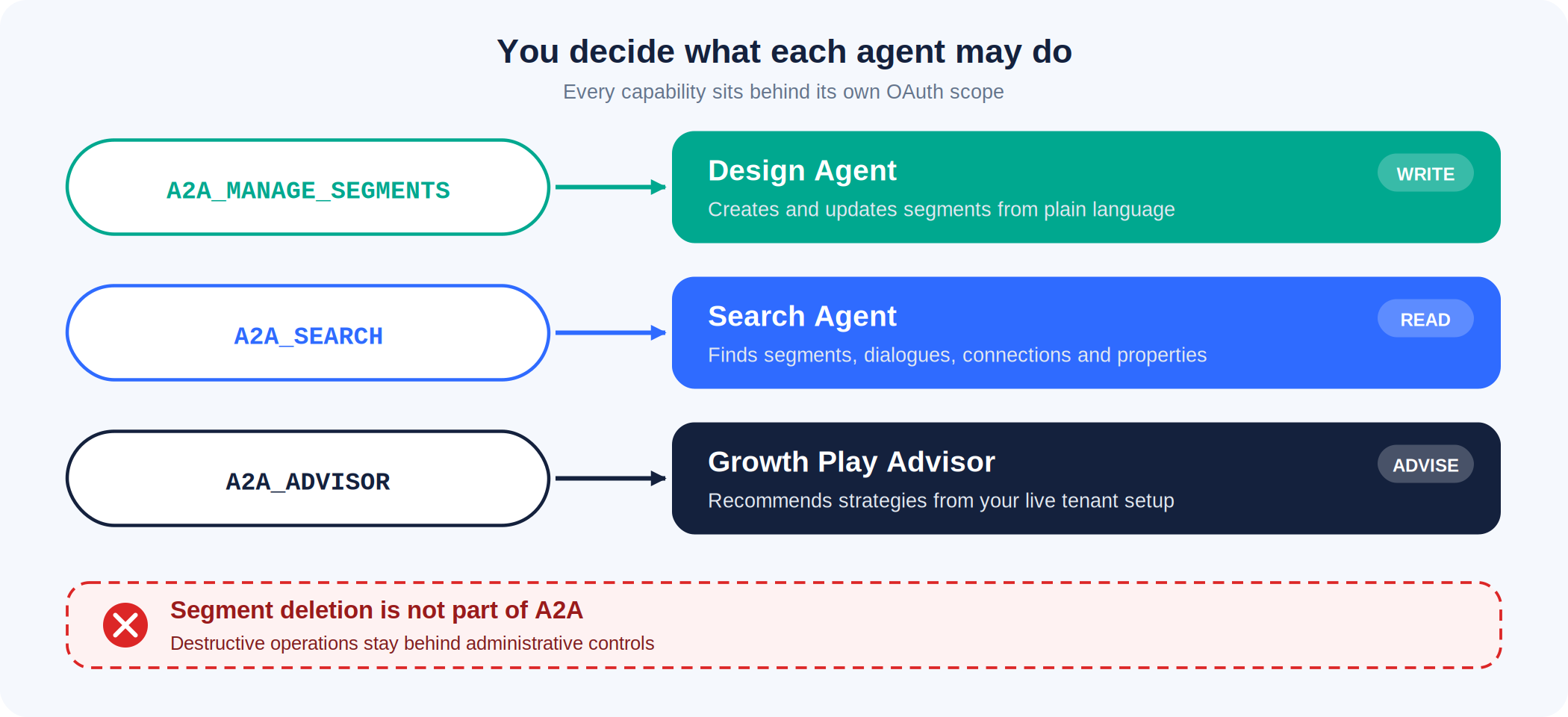
- You choose what each agent may do: Finding things, getting advice and changing audiences each need their own permission. You decide which outside systems can only read and which can also write.
- It can never delete your segments: Agents can create and update segment definitions, but segment deletion is deliberately left out of A2A. Destructive actions stay behind administrative controls.
- Your agent confirms writes: BlueConic checks permissions but does not ask a person to confirm each change. Your agent confirms with its user before it delegates a write. A person can review, change or delete any segment that an agent creates.
- Long tasks don't get lost: Deep analysis takes time. Requests hand back a first response within 30 seconds so your tools don't time out, while the task keeps running. Its progress is kept for up to seven days, so an agent can start a task on Monday and pick it up on Friday without starting over or running it twice.
From Insights to Action
The next chapter of agentic marketing will depend on how well AI agents can work with the systems that know your customers. With A2A, BlueConic brings its customer intelligence, specialized expertise, and marketing capabilities into that collaboration, helping teams turn growth ideas into actionable audiences with less manual work.
Ready to explore A2A?
BlueConic's A2A capabilities are available in private preview. To request access or learn more, contact your BlueConic account team or request a demo.
Frequently asked questions
What is Agent-to-Agent (A2A) in BlueConic?
Agent-to-Agent (A2A) is an open protocol that allows external enterprise AI agents to delegate tasks to specialized agents inside BlueConic. These agents can search existing marketing assets, recommend growth strategies, and create or update customer segments using the data and configurations available in a customer's BlueConic environment.
What's the difference between A2A and MCP?
Model Context Protocol (MCP) allows AI agents to access tools and information in BlueConic. Agent-to-Agent (A2A) allows an AI agent to delegate tasks to specialized BlueConic agents that handle domain-specific reasoning and execution. The two standards complement each other, supporting different ways for enterprise AI to interact with BlueConic.
What can BlueConic's AI agents do?
BlueConic offers three specialized agents through A2A. The Design Agent creates and updates customer segments from natural-language requests. The Search Agent discovers existing segments, listeners, dialogues, connections, and profile properties. The Growth Play Advisor recommends relevant growth strategies based on the customer's configured connections and listeners.
How does BlueConic ensure AI-generated audiences are accurate and secure?
BlueConic's Design Agent validates segment requests against the live profile property catalog and asks clarifying questions when a request is ambiguous. Access to A2A capabilities is governed by separate OAuth scopes, and segment deletion is not supported through A2A. The calling agent is responsible for confirming write actions with its user.
Can BlueConic's A2A capabilities work with Claude, ChatGPT, or custom AI agents?
BlueConic's A2A capabilities are designed to work with compatible enterprise AI environments and agent frameworks, including workflows involving Claude, ChatGPT, Amazon Bedrock, LangGraph, Databricks, and custom-built agents. Integration depends on the capabilities and configuration of the external environment. A2A is currently available in private preview and must be enabled for each BlueConic tenant.

Paul Rütter is the Director of Technology at BlueConic with expertise in software engineering, artificial intelligence, and machine learning. He focuses on building technology that helps businesses put customer data to work, with a particular interest in how AI agents can make complex marketing capabilities more accessible and actionable.