
5 Customer Retention Strategies to Retain and Sustain Your Audience
Discover 5 effective customer retention strategies to reduce churn, build loyalty, and encourage repeat purchases, with real-world examples.


As a marketer, it's essential to not only focus on acquiring new customers but also retaining your existing ones. Customer retention is the key to a successful e-commerce business as it helps increase revenue, reduce customer churn, and build customer loyalty.
In this blog post, we'll explore customer retention strategies that will help you keep your existing customers happy and satisfied, and show you some real-life examples.
Key takeaways
- Customer retention helps businesses reduce churn, encourage repeat purchases, and increase customer lifetime value.
- Positive customer experiences and loyalty programs give customers more reasons to keep coming back.
- Collecting customer feedback and engaging on social media can help strengthen customer relationships.
- Personalized messaging and marketing automation help businesses connect with customers at the right moments.
- Customer data and predictive analytics can help identify at-risk customers and improve retention strategies.
What is customer retention?
Customer retention refers to the efforts businesses make to maintain a strong and positive relationship with their current customers. The goal is to keep customers satisfied with your products or services so that they continue to do business with your company.
Having a solid customer retention strategy is critical for the success of any business. It helps to increase revenue by driving repeat purchases and reducing churn rates. When customers are happy and satisfied with their experience, they are more likely to make repeat purchases and recommend the business to others, which can also help attract new customers.
Why is customer retention important?
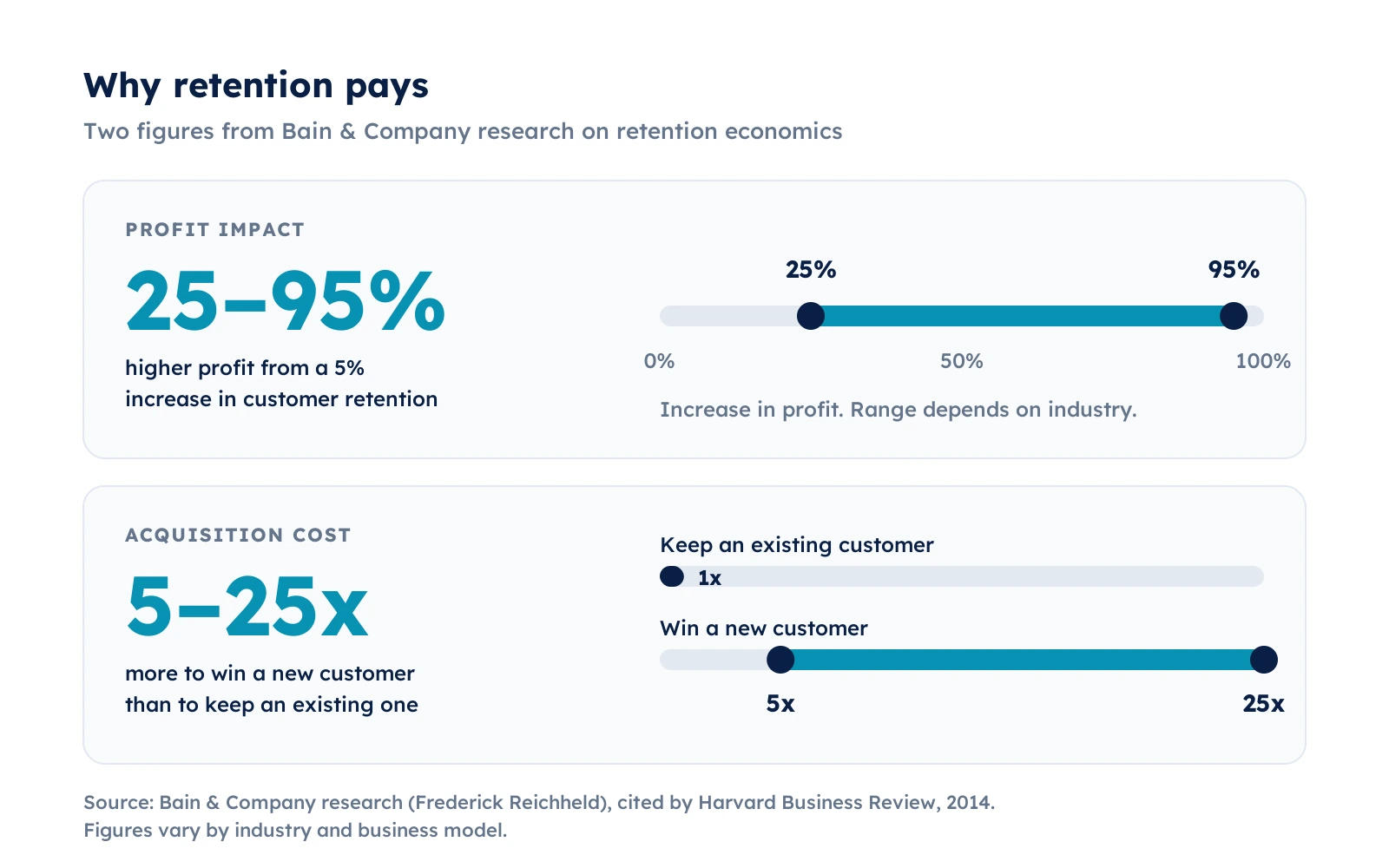
Acquiring a number of new customers can be a costly process, often requiring significant resources for marketing strategies, advertising, and sales efforts. According to a study by Harvard Business Review, “acquiring a new customer is anywhere from five to 25 times more expensive than retaining an existing one.” Therefore, focusing on customer retention is not only a more cost-effective approach but can also provide a higher return on investment.
Take into account the research conducted by Bain & Company's Fred Reichheld, the creator of the Net Promoter Score. His research shows that even a 5% boost in customer retention rates can increase profits, more than 25% to be exact. This underscores the importance of focusing on customer retention strategies as a key component of any business growth and profitability plan.
Building customer loyalty is another critical aspect of customer retention. When customers feel loyal to a brand, they are more likely to continue doing business with them, even in the face of competition. Loyal customers are also more likely to recommend the brand to others, becoming advocates and promoting the business through word-of-mouth marketing.
Having a robust strategy for customer retention is essential for businesses, as it leads to revenue growth, lower customer churn, and enhanced brand loyalty. Such a strategy allows companies to concentrate on nurturing positive relationships with their existing customers and encouraging repeat purchases, instead of expending resources on first-time customer acquisitions.
How to improve customer retention: 5 proven customer retention strategies
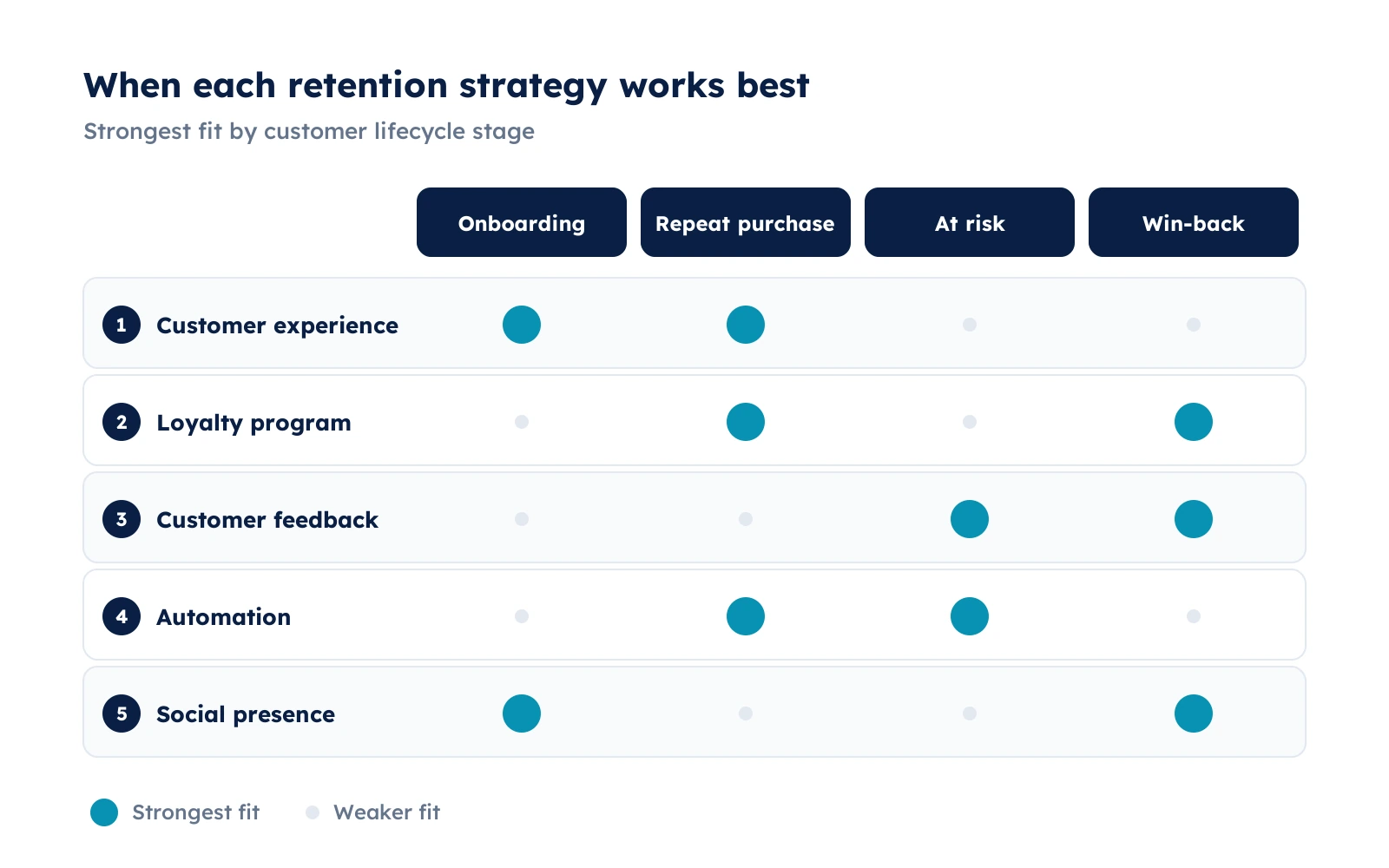
Let’s take a look at strategies brands can implement and optimize today:
1. Improve the customer experience
One of the most effective ways to retain customers is to provide them with an excellent customer experience. This includes offering personalized support, addressing their concerns and customer feedback, and providing a seamless customer journey from onboarding to purchase. According to a study, a whopping 86% of buyers are willing to shell out more money for a top-notch customer experience. This goes to show how crucial it is to prioritize customer satisfaction and offer an exceptional experience to your customers.
2. Offer a customer loyalty program
Implementing a customer loyalty program is a tried-and-true strategy for retaining customers and increasing customer lifetime value. Such programs incentivize customers to keep coming back to your business by offering them rewards and perks for their loyalty. This not only strengthens their relationship with your brand but also encourages them to make repeat purchases, ultimately boosting your bottom line.
One of the keys to success with a customer loyalty program is making it easy for customers to participate and redeem their rewards. This can be achieved through mobile apps, loyalty cards, or other digital platforms that provide a seamless user experience. Additionally, it's important to track and measure the effectiveness of your loyalty program using metrics like customer retention rate, repeat purchase rate, and customer lifetime value. This allows you to refine your program over time and ensure that it's delivering the desired results.
3. Collect customer feedback
Customer reviews and feedback are essential to understand customer expectations and preferences. It helps businesses identify areas of improvement and make necessary changes to keep customers satisfied.
4. Use automation
Automation can help streamline processes and save time, making it easier for businesses to provide personalized customer support and follow up with customers. It can also help businesses identify and address customer needs in a short period of time, reducing customer churn and increasing customer satisfaction.
One of the most common ways businesses use automation is through email marketing. Automated email campaigns are a great way for businesses to communicate with customers. These campaigns can be triggered by actions such as buying something, subscribing to a newsletter, or leaving items in an online shopping cart. The emails are tailored to each customer's needs and interests, helping to keep them interested in the business.
5. Create a strong social media presence
Social media is an excellent tool to boost customer engagement, build customer relationships, and increase brand awareness. Businesses can use social media platforms to showcase new products, run promotions, and offer incentives. According to a study, if a brand delivers a positive experience on social media, 71% of consumers are more inclined to recommend it to others.
Examples of effective customer retention strategies
What are effective ways to increase customer retention? Take a look at how three businesses used BlueConic to encourage repeat purchases, reduce churn, and build stronger relationships with their customers.
How a retailer increased repeat purchases with personalized marketing
Even customers who join a loyalty program don't always stick around. One retailer with more than 20 million loyalty members discovered that many of its customers were at risk of churning within a year of their first purchase. Using BlueConic, the retailer developed personalized marketing campaigns to engage these customers at key moments, such as birthdays and membership anniversaries. By testing different messages, the company found that its best-performing campaigns generated six times higher engagement and four times more purchases compared to a holdout group. This goes to show how personalized communication throughout the customer journey can encourage repeat purchases and help businesses get more value from their loyalty programs.
How VodafoneZiggo reduced customer churn with predictive analytics
Sometimes, the best way to retain a customer is to address a problem before they decide to leave. That's the approach telecommunications provider VodafoneZiggo took when looking for ways to improve customer retention. Using BlueConic, VodafoneZiggo combined customer profiles with predictive churn scores to identify customers who were most likely to leave. These customers were then automatically directed to online support specialists who could help address their concerns. The strategy resulted in a 4.53% reduction in customer churn compared to a control group. By identifying at-risk customers and offering support at the right time, VodafoneZiggo was able to improve customer satisfaction and retain more of its existing customers.
How The Post and Courier reduced subscriber churn by 40%
Customer retention isn't always about offering more rewards or discounts. Sometimes, it's about reaching customers with the right message at the right time. That's exactly what The Post and Courier, a South Carolina newspaper, accomplished using BlueConic. The publisher identified subscribers at risk of churning, including those approaching their renewal dates, those without automatic renewal, and those with failed credit card payments. Using this information, The Post and Courier delivered personalized, real-time messages encouraging subscribers to take action and maintain their subscriptions. The result was a 40% reduction in subscriber churn, demonstrating how timely, relevant communication can help businesses strengthen customer relationships and keep their existing customers engaged.
How customer data helps improve retention
The better you understand your customers, the easier it becomes to keep them coming back. Customer data provides valuable insights into purchasing habits, preferences, and behaviors, helping businesses create more relevant experiences and build lasting relationships. By collecting and analyzing customer data, businesses can:
- Identify at-risk customers: Recognize changes in purchasing behavior or engagement that may indicate a customer is about to leave.
- Create targeted customer segments: Group customers based on their interests, purchase history, and behaviors to deliver more relevant marketing messages.
- Personalize customer experiences: Use customer insights to recommend products, tailor offers, and deliver timely communications across channels.
- Anticipate customer needs: Identify opportunities to proactively engage customers with helpful content, offers, or support before they disengage.
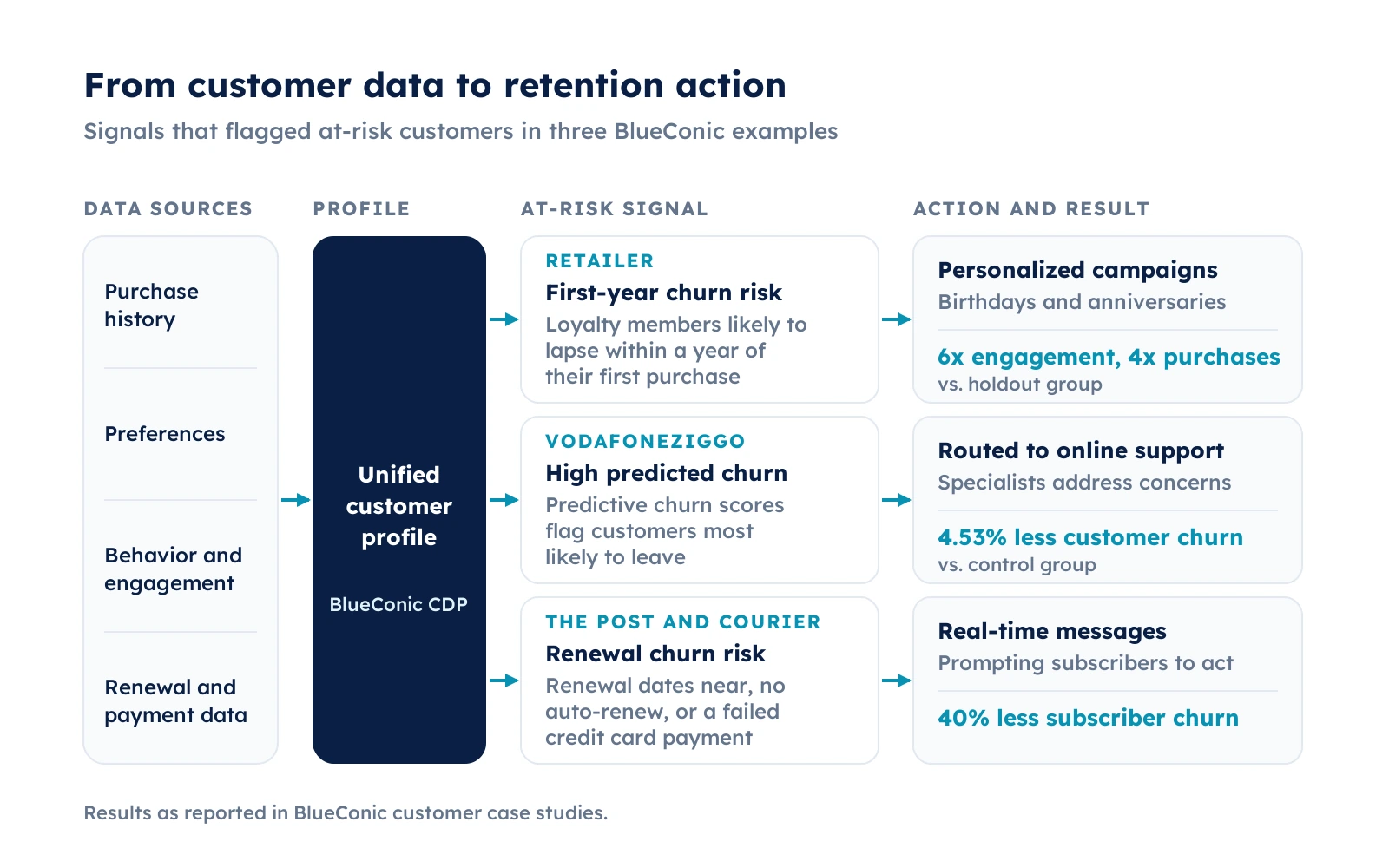
A customer data platform (CDP) like BlueConic brings data from multiple sources together into unified customer profiles, making it easier to put these insights into action. Rather than relying on disconnected information, businesses can create personalized experiences throughout the customer journey that strengthen loyalty, encourage repeat purchases, and improve customer retention.
Looking for more ways to improve customer retention?
Ready to improve your customer retention rate? BlueConic brings your customer data together into unified profiles, so you can spot at-risk customers and reach them at the right moment. Request a demo today and see how BlueConic can help you retain your existing customers and attract new ones.
Frequently asked questions
What are five effective strategies for retaining customers?
Five effective customer retention strategies include improving the customer experience, offering loyalty programs, collecting customer feedback, using marketing automation, and maintaining a strong social media presence. Together, these strategies help businesses build stronger customer relationships, encourage repeat purchases, and reduce churn.
How does the 80/20 rule apply to customer retention?
The 80/20 rule, also known as the Pareto Principle, suggests that roughly 80% of a business's revenue may come from just 20% of its customers. While the exact percentages vary, the idea highlights the importance of retaining loyal, high-value customers. By understanding their preferences and delivering personalized experiences, businesses can strengthen these relationships and increase customer lifetime value.

Kayte Grady is the Content Director at BlueConic, specializing in customer data, personalization, and AI. Her work focuses on breaking down how modern technology works and how real people can actually use it. A former social worker turned marketer, Kayte earned her BA from Purdue University, where she learned to write clearly and edit ruthlessly. That background shapes how she approaches content, starting with people first and supported by technology. An outspoken champion of ADHD professionals, Kayte has found growth, camaraderie, and kindred spirits in tech—despite her never-ending devotion to the paper calendar.