
How BlueConic Turns Anonymous Traffic Into Owned Audiences
Anonymous visitors are costing you more than you think. Learn how BlueConic turns unknown traffic into rich customer profiles you can target, personalize, and convert.

Key takeaways:
- BlueConic identifies anonymous visitors and builds richer profiles with every visit, turning declared data and behavioral signals into unified profiles you can activate across every marketing channel with First-Party Audience Building.
- Most identity capture strategies fail because they collect email addresses without capturing meaningful preference data or connecting that data to real-time personalization and activation systems.
- Effective audience-building plays exchange value for identity by using quizzes, diagnostics, recommendations, and other interactive experiences that help visitors while generating structured first-party data.
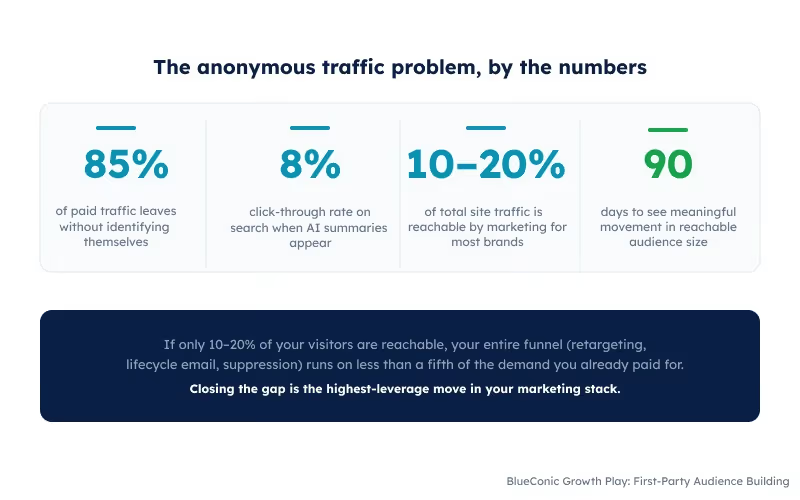
You spent $50,000 last month driving traffic to your site. 85% percent of those visitors left without telling you who they are, and next month you'll pay to find some of them again without even realizing it.
That's the economics of anonymous traffic: you fund the demand, but you can't reach the people who showed up.
The pop-up problem runs deeper than conversion rates
The standard response to anonymous traffic is some version of a pop-up: "Sign up for 10% off your first order." It captures an email address. Sometimes it works. But it creates two problems that compound over time.
First: It trains visitors to expect a discount before they've demonstrated any purchase intent. You're subsidizing an email address instead of earning a relationship.
Second: It captures identity without capturing anything useful about the person. You know their email. You don't know what they care about, what they were looking at, or what would actually move them toward a purchase.
The deeper structural issue is that most identity capture happens in isolation from everything else.
- The pop-up tool doesn't talk to the customer profile.
- The profile doesn't update until a batch job runs.
- The personalization engine can't act on information that arrived thirty seconds ago.
So even when someone does identify themselves, the experience they get on the next page looks identical to what a stranger would see.
Meanwhile, the sources driving traffic are fragmenting.
More visitors arrive from social commerce, AI-generated search summaries, and marketplace referrals. These visitors are less likely to appear in your CRM, less likely to return organically, and harder to identify through passive tracking. The window you have to learn who they are is often a single session. AI search alone is accelerating this: Pew Research found people click on a traditional search result just 8% of the time when an AI summary appears, compared to 15% when it doesn't.
Fewer visitors are arriving through channels where you can tag and track them. If nothing happens during that session, the opportunity resets to zero.
Identity capture should earn data, not just collect it
The better approach starts with a different assumption: identity capture should deliver value to the visitor, not just extract data from them.
Instead of interrupting a browsing session with a generic email gate, you create moments where identifying yourself is the natural next step because you get something useful in return. A skincare brand shows a product matcher that helps a visitor find the right moisturizer for their skin type. A pet food company surfaces a nutrition quiz that recommends the right formula based on breed and age. A home goods retailer offers a style diagnostic that narrows a 4,000-SKU catalog down to fifteen relevant products.
These interactions accomplish two things at once:
- They give the visitor a reason to share their email and preferences voluntarily.
- They generate structured data about what that person actually wants, data that feeds personalization, segmentation, and targeting from the moment it arrives.
(And you don't have to ask for everything up front.)
Progressive enrichment starts after the first visit
After the first identification, you keep learning about the person over time, triggered by what they do next.
For example:
- A returning visitor who starts browsing a new category sees a short preference question relevant to that category.
- A customer who just made their first purchase gets a quick follow-up asking how they'd like to hear from you.
Each interaction adds a layer to the profile without requiring anyone to fill out a form.
The result is a profile that gets richer with every visit, built from what customers tell you directly rather than what you guess from their clicks.
What does it feel like when you skip this step?
You end up with a database full of email addresses and almost nothing else. Your "personalized" campaigns go out based on one purchase or one page view because that's all you know. A customer who bought running shoes six months ago gets served running shoe ads forever because you never learned they actually came to your site looking for hiking gear. You're not personalizing, you're just repeating what you already saw.
BlueConic captures identity, merges history, and activates profiles in real time
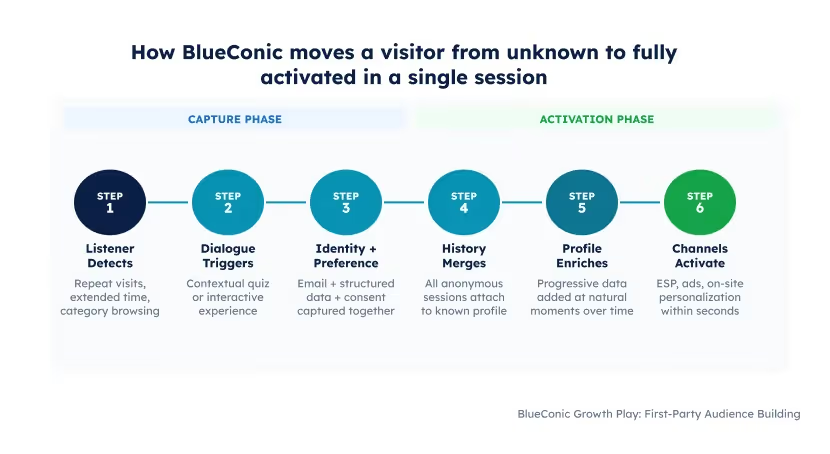
BlueConic's Listeners detect when an anonymous visitor shows meaningful engagement: repeat visits, extended time on product pages, category browsing across sessions. When those signals cross a threshold, the system triggers a contextual interactive experience through Dialogues, BlueConic's on-site experience layer.
The experience matches what the visitor is doing. Someone browsing protein supplements sees a goal-based recommendation quiz. Someone exploring nursery furniture sees a registry-style checklist that narrows options by budget and room size. The experience captures an email address alongside structured preference data, and records consent in the same interaction.
The merge is the differentiator
Here's the part most tools miss: the visitor's entire anonymous browsing history merges into the newly identified profile through BlueConic's identity resolution the moment they identify themselves.
Every product page they viewed, every category they browsed, every session they had as an unknown visitor attaches to a known, addressable profile. That profile activates across your ESP, ad platforms, and on-site personalization within seconds, not after the next batch sync.
From there, BlueConic runs progressive enrichment. Based on lifecycle stage, purchase history, or missing profile attributes, the system triggers additional Experiences at natural moments.
A loyalty program member who hasn't specified communication preferences gets a quick preference capture after their next purchase. A visitor who just entered a new product category sees a brief quiz relevant to that category. Each response updates the profile in real time and immediately sharpens how every downstream channel treats that person.
The marketer controls which experiences run, when they trigger, what data they capture, and what consent they require. BlueConic handles the targeting logic, the trigger timing, the identity merge, and the profile activation.
No other CDP combines native interactive experience creation, real-time identity resolution, and immediate cross-channel activation in a single system, which is what makes this play operational in weeks rather than months.
How anonymous-to-known profiles improve every channel you already run
The number to watch is simple: how many of your visitors can you actually reach again? For most brands, the answer is somewhere between 10–20% of total site traffic. The rest is invisible to your marketing. This play exists to close that gap, and you should see meaningful movement within 90 days.
The effects compound from there:
- When you know who's already in your funnel, you stop wasting ad dollars showing acquisition campaigns to people who've already bought.
- When your audience profiles include real preferences instead of just an email address, the audiences you send to ad platforms for prospecting perform better because they're built from richer, more specific customer data.
- When your lifecycle campaigns can segment on what customers told you they care about, not just what pages they happened to visit, conversion rates climb.
One surface, one experience, proof before you scale
Start with one high-traffic page or category where anonymous engagement is already strong. Build one interactive experience that delivers genuine value to the visitor while capturing identity and at least one structured preference. Measure two things: conversion rate on the experience itself, and the downstream activation rate of the profiles it creates.
You don't need to redesign your site or rebuild your data infrastructure. BlueConic's interactive experiences launch from click-to-clone templates and activate alongside your existing stack. The first play can go live in weeks, and most teams see visible results within six weeks of launching on their first high-traffic surface. Prove the approach works, then expand to additional pages and categories.
If software doesn't move a metric you're accountable for, why are you signing a 12-month commitment?
See the full First-Party Audience Building play
This post is part of a series on Growth Plays, BlueConic's outcome-focused approach to turning customer data into revenue action.

Brittany Gulla is a growth and product marketing leader with extensive experience working across B2B and B2C businesses at various stages. Passionate about crafting brand and product stories that align with data-driven growth tactics in order to fuel business expansion. Brittany specializes in focusing on messaging, website positioning, and AI-driven strategies. Previously, she helped launch a global B2B agriculture tech brand at Resonant Technology and grew revenue to $6M annually at Bow Wow Labs, Inc. She also drove major account growth and branded campaigns at Mashable. Brittany excels in data-driven strategies, customer acquisition, and omni-channel marketing to fuel business success.