
How BlueConic Revives Dormant Customers (No Blanket Discounts)
Your dormant customer list isn't one segment. Learn how BlueConic scores lapsed customers by reactivation likelihood, matching the best intervention to every person.

Key takeaways:
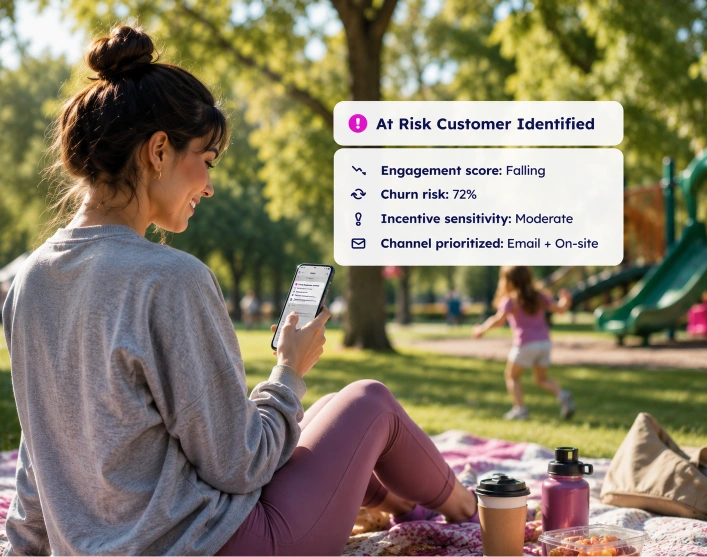
- BlueConic builds a reactivation propensity model that scores dormant customers by likelihood to return, so you invest in the ones worth pursuing and stop wasting budget on the rest.
- Most winback programs fail because they treat dormant as one segment: same email, same discount, same timing for every lapsed customer.
- Effective reactivation matches the intervention to the person. A lapsed loyalty member gets a tier reinstatement offer. A category-loyal buyer gets a new in your category message. The discount fires only when the profile confirms price sensitivity.
- When dormant customers have stopped engaging on their primary channel, the system finds them where they are still active, across ads, SMS, push, social, and on-site.
You have 300,000 customers who have not purchased in six months. Your winback campaign sends all of them the same email: We miss you. Here is 20% off. A few come back, most do not open it, and a meaningful share of the ones who do return would have come back without the discount.
You just handed away margin on sales you already had.
Why dormant customers aren't one segment
The standard reactivation playbook is a time-based trigger. A customer crosses a dormancy threshold, 90 days, 120 days, 180 days, and the system fires a winback email with a discount attached. The logic is simple: if someone has not bought in a while, give them a reason to come back.
The problem is that has not bought in a while describes very different people with very different likelihoods of returning.
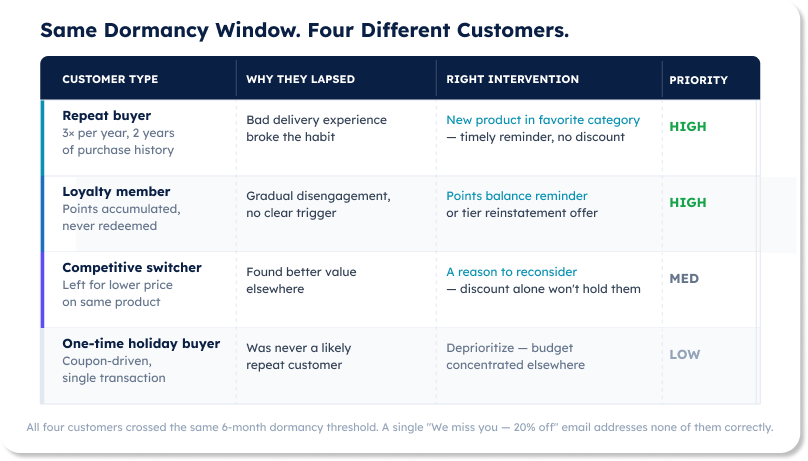
Consider four customers who all lapsed six months ago:
- The first is a repeat buyer who purchased three times a year for two years and stopped after a bad delivery experience.
- The second is a loyalty member who accumulated points but never redeemed them and gradually disengaged.
- The third bought once during a holiday sale because of a coupon and was never going to become a regular customer.
- The fourth switched to a competitor after finding a better price on a product you both carry.
The same we miss you email goes to all of them.
- The repeat buyer would probably come back with a well-timed reminder about a new product in her favorite category.
- The loyalty member might respond to a points balance reminder or a tier reinstatement offer.
- The one-time holiday shopper was never your customer to begin with, and spending on them is pure waste.
- The competitive switcher needs a reason to reconsider that has nothing to do with a coupon.
MarTech benchmarks show acquiring a net-new customer costs 5 to 16 times more than reactivating an existing one, yet most reactivation programs spend indiscriminately across the entire dormant pool, burning budget on customers who will not return while under-investing in the ones who would respond to a targeted prompt.
Reactivation works when the model scores before the message
The better approach starts before any message fires: scoring each dormant customer on their likelihood to re-engage.
A reactivation propensity model evaluates what you already know about each lapsed customer.
- How many times did they buy before going quiet?
- What was their lifetime value?
- Did they engage with previous outreach, or has every winback email gone unopened?
- Were they a seasonal buyer who might return on a natural cycle?
- What product categories did they care about, and have you released something new in that space?
Those signals separate the dormant pool into groups that require fundamentally different treatment.
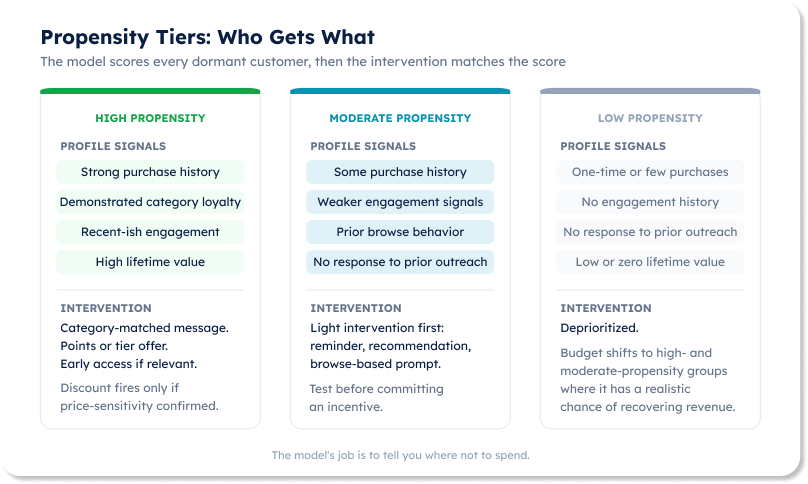
High-propensity customers: the ones with strong purchase history, demonstrated category loyalty, and recent-ish engagement, get prioritized. They receive interventions matched to what they cared about before they went quiet: a new arrival in their preferred category, a reminder of accumulated loyalty points, early access to a collection that matches their historical preferences.
Moderate-propensity customers: those with some purchase history but weaker engagement signals, get tested with lighter interventions before any incentive enters the picture: a reminder, a relevant product recommendation, a prompt tied to something they previously browsed. The discount fires only if the profile confirms the customer has historically responded to price-based offers.
Low-propensity customers: one-time buyers with no engagement history and no response to prior outreach, get deprioritized. The budget shifts away from them and concentrates where it has a realistic chance of generating recovered revenue.
The channel matters as much as the message. If they stopped opening emails three months ago, more emails will not bring them back. A dormant customer who is still active on social might respond to a paid social touchpoint. One who still has your app installed might respond to a push notification. The system needs to find each customer on a channel where they are still paying attention, not default to the one channel where engagement already died.
How BlueConic runs the Dormant Customer Reactivation play
Here is what changes when you run reactivation through BlueConic instead of a standard ESP winback flow.
What BlueConic reads
The play starts with the full customer profile: purchase history, order frequency, lifetime value, product categories purchased, loyalty status, email engagement patterns, on-site behavior, and response to prior outreach. Connections pull transactional and engagement data from your commerce platform, ESP, loyalty system, and app analytics.
That profile tells you why each customer matters and what they cared about before they went quiet.
What BlueConic builds
BlueConic's AI Workbench—a built-in AI tool that helps marketers predict customer behavior and identify the best actions to drive results—trains a reactivation propensity model against your dormant customer base. The model scores each inactive customer based on historical purchase frequency, lifetime value, recency of last engagement across any channel, product categories purchased, seasonal patterns, past response to winback outreach, and historical discount sensitivity.
The output is a scored dormant pool. The model prioritizes high-propensity customers and deprioritizes low-propensity ones, so your budget concentrates on the recoverable segment.
What BlueConic triggers
For high-propensity customers, the Decisioning Agent—an AI-powered tool that determines the best message, offer, or experience for each customer based on their individual profile and behavior—selects the intervention most likely to drive re-engagement based on the full profile.
A customer with strong product affinity gets a new in your category message.
A lapsed loyalty member gets a points reminder or tier reinstatement offer.
A customer whose browsing history suggests evolving interests gets a relevant product recommendation.
An incentive fires only when the profile confirms the customer has historically responded to price-based offers.
The system activates across the broadest channel mix: email, SMS, push, paid social, display ads, and on-site personalization if the customer returns organically. Because dormant customers have stopped engaging through their primary channel, the system routes each person to the channel where they are still active.
What the marketer controls
Marketers define the guardrails:
- Dormancy definition
- Maximum incentive depth
- Eligible products
- Channel preferences
- Frequency caps
- Cost ceiling benchmarked against acquisition cost
Within those constraints, the Decisioning Agent handles the scoring, the intervention selection, the channel routing, and the timing.
What happens over time
Every reactivation outcome feeds back into the propensity model. Did the customer return? Was an incentive required? Which channel drove re-engagement? Which message type converted? The system retrains on actual results, learning which combinations of customer profile, intervention type, and channel produce incremental recovered revenue versus wasted spend. Each cycle sharpens the model.
What KPIs move with Dormant Customer Reactivation
The primary metric is cost per reactivated customer compared to your acquisition cost benchmark. If reactivation costs more than acquisition, you are solving the wrong problem. Reactivation rate matters too, but efficiency is the number that proves the model is working.
Two secondary metrics move alongside:
- The share of reactivations that required a discount drops over time as the model learns which customers respond to non-incentive interventions.
- Repeat purchase rate among reactivated customers tells you whether you are recovering lasting relationships or buying one-time transactions back.
Most teams should see clear movement within 60 to 90 days of the play going live.
How to start with Dormant Customer Reactivation
Pick one dormancy window, such as customers who have not purchased in 120 to 180 days, and run the propensity model against that segment. Deploy a targeted intervention for the high-propensity group and measure two things: reactivation rate compared to your current winback flow, and the percentage of reactivations that required a discount to convert.
BlueConic's reactivation play works alongside your existing ESP and ad platforms. You can train the first propensity model and activate the first reactivation segment in weeks, and most teams see measurable results within the first billing cycle.
See the full Dormant Customer Reactivation Growth Play
This post is part of a series on Growth Plays, BlueConic's outcome-focused approach to turning customer data into revenue action.

Brittany Gulla is a growth and product marketing leader with extensive experience working across B2B and B2C businesses at various stages. Passionate about crafting brand and product stories that align with data-driven growth tactics in order to fuel business expansion. Brittany specializes in focusing on messaging, website positioning, and AI-driven strategies. Previously, she helped launch a global B2B agriculture tech brand at Resonant Technology and grew revenue to $6M annually at Bow Wow Labs, Inc. She also drove major account growth and branded campaigns at Mashable. Brittany excels in data-driven strategies, customer acquisition, and omni-channel marketing to fuel business success.