
How BlueConic Powers Media Targeting With the Full Picture
Learn how BlueConic builds a unified intent score that makes every media dollar smarter—and stops wasted spend before it happens.

Key takeaways:
- Ad platforms are confident in their read on intent, but they're working from a fraction of the signals that actually define it.
- A unified intent score built from behavioral, transactional, and declared data gives every platform a complete picture to work from.
- Profile-level suppression eliminates wasted spend on converted customers across every channel at once, not channel by channel after a batch sync.
- The more this BlueConic Growth Play runs, the smarter it gets. Every conversion outcome feeds back into the intent model and sharpens the next decision.
Your media budget made four decisions about the same customer yesterday.
It targeted her as a new prospect in Meta.
Retargeted her on display after she browsed.
Served her an acquisition ad on Google after she already bought.
She was annoyed. And the next time she needs what you sell? She'll start somewhere else.
None of those platforms did anything wrong. Each made the best decision it could with what it had. They were each optimizing against their version of her, but none of those versions added up to the real person.
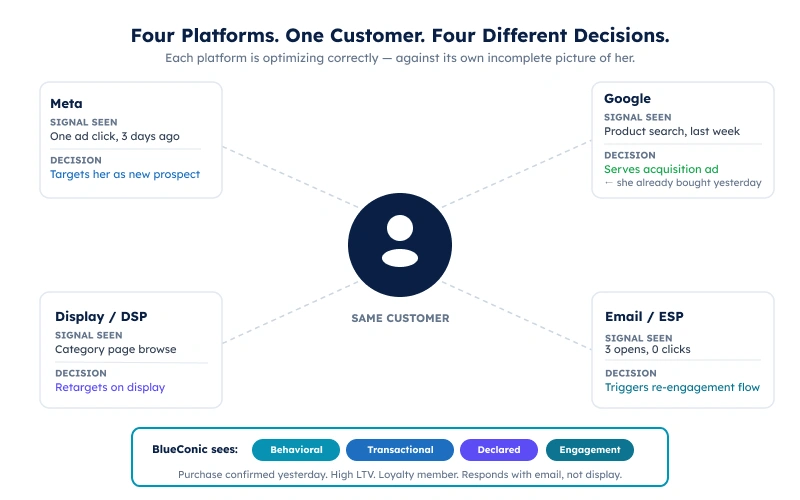
TL;DR? Every platform is working from an incomplete picture. And your budget is funding all of them at once.
What ad platforms don't know about your customers
Every platform you're running has its own definition of intent, built entirely from what it can see. Meta builds it from ad interactions. Google from search. Your DSP from web browsing patterns. Each one is certain of its read, but none of them have seen what you've seen.
What lives in your stack that no platform can access:
- Who made a purchase
- Who came back to your site 3x this week
- Who opened every email (but never clicked)
- Who spent twenty minutes in a category and left without adding anything to a cart
That data exists. It's simply not where the decisions are being made. The intent each platform acts on is just a fraction of the real signal.
How unified intent scoring changes targeting
A complete intent signal starts with a different data set than any single platform has access to.
- Ad clicks
- Search behavior
- On-site engagement
- Email interaction
- Purchase history
- Loyalty status
- Declared preferences
- Cross-channel activity
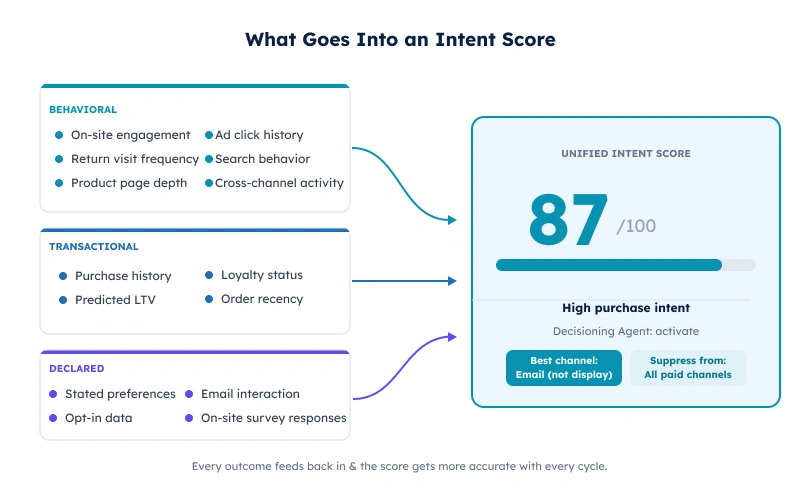
These activities are combined into a single score for each unique customer, reflecting where they actually are in their decision-making.
Three things no platform-native intent model can do on its own
1. It identifies who has genuine purchase intent across every signal you have.
Example: The customer who searched, came back to your site twice, opened an email, and has a high predicted LTV looks very different from the customer who clicked one ad. A unified score tells you that.
2. It suppresses at the profile level.
Example: The moment a purchase happens, that customer is removed from every active targeting audience simultaneously — not channel by channel, not after the next batch sync. The decision happens once and propagates everywhere.
3. It determines which channel carries the message.
Example: Not every high-intent customer should get a Meta ad. Some are more responsive to email. Some are better reached through display. A unified score evaluates which channel is most likely to convert this specific customer and allocates resources accordingly, rather than leaving each platform to compete for the same person independently.

How BlueConic's Intent-Based Targeting Growth Play works
BlueConic calls this the Intent-Based Targeting Growth Play. It's built for the moment between interest and purchase—when a customer is in market but hasn't converted yet, and your media spend is trying to find them.
What goes into the intent score
BlueConic's Listeners—the real-time behavioral tracking layer that detects and records on-site activity as it happens—capture behavioral signals across every on-site session in real time.
Connections pull engagement and transactional data from your ESP, commerce platform, CRM, and loyalty system. Together, they feed a unified intent score that reflects the full picture:
- Product page depth and return visit frequency
- Email engagement (opens, clicks, and recency)
- Purchase history and loyalty status
- Declared preferences from on-site interactions
- Ad interaction history across channels
How the score becomes a media decision
When a customer's intent score crosses a threshold, the Decisioning Agent—the AI layer that evaluates the full customer profile and autonomously determines the next best action—evaluates the full profile autonomously and determines two things:
- Whether to target or suppress
- Which channel carries the message
High-intent customers who haven't converted get pushed to ad platforms such as Meta, Google, programmatic DSPs, and retail media networks as targeted audiences. The moment a purchase happens, suppression fires at the profile level across every active channel simultaneously.
No batch sync. No channel-by-channel update.
The role of marketing
The marketer controls which intent thresholds trigger activation, which channels to push to, and suppression rules.
Within those guardrails, the Decisioning Agent handles channel allocation, evaluating where this type of profile has historically converted best and directing spend accordingly.
Every outcome feeds back into the intent model, so the score gets more accurate with every cycle.
What moves when Intent-Based Targeting runs
The primary metric is ROAS. How much revenue are you generating for every dollar of media spend? That number should move within 30 to 90 days of the play going live across your active ad platforms.
Two secondary metrics move as a result:
- CPA drops because the intent score filters out low-signal audiences before spend ever reaches the platform.
- Wasted spend on converted customers falls because suppression fires at the profile level, the moment a purchase happens across every active channel, simultaneously.
Intent data that reflects the whole customer
Every platform optimizes for intent. The variable is what it's working from. A platform fed a complete score, built from behavioral, transactional, and declared data across every channel, makes fundamentally different decisions than one working from its own slice.
That's what changes when this play runs.
Not which platforms you use. What they know when they decide.
To go deeper on how BlueConic runs this Growth Play, visit Intent-Based Targeting.
This article is part of a series on Growth Plays, BlueConic's outcome-focused approach to turning customer data into revenue action.

Kayte Grady is the Content Director at BlueConic, specializing in customer data, personalization, and AI. Her work focuses on breaking down how modern technology works and how real people can actually use it. A former social worker turned marketer, Kayte earned her BA from Purdue University, where she learned to write clearly and edit ruthlessly. That background shapes how she approaches content, starting with people first and supported by technology. An outspoken champion of ADHD professionals, Kayte has found growth, camaraderie, and kindred spirits in tech—despite her never-ending devotion to the paper calendar.