
The Cost of the Wrong Ask: How Publishers Can Get More Revenue From Every Reader Visit
Learn how publishers can increase revenue from reader visits by making better decisions about paywalls, registrations, newsletters, and engagement.


Two people land on the same article.
One has been reading your publication for months, visits a few times a week, and regularly opens your newsletters. The other clicked through from social media and has never been to your site before.
Both hit the same paywall.
There’s a good chance the regular reader is ready for a subscription offer. But asking someone to pay on their very first visit? You may have lost them before they even had a chance to appreciate what you offer.
And these days, you have fewer chances to get that relationship started.
Google Search referrals to publishers fell 40% year over year between July 2025 and July 2026, according to Chartbeat data cited by the Reuters Institute. That’s roughly twice the decline recorded the year before.
With search traffic shrinking, the readers who keep coming back to your site matter more than ever.
Of course, you want to convert more of those visits into subscriptions. But what about the readers who aren’t ready to pay? A registration, newsletter signup, or even another article could be worth more than showing them a paywall they’ll just click out of.
So how do you figure out what each reader is likely to do next, and which action is worth the most? Here are five places to start.
1. Find out where your paywall is costing you readers
Say 3% of readers who encounter your paywall subscribe. That sounds like a helpful benchmark until you start looking at who’s actually converting.
You could have frequent visitors subscribing at a healthy rate while first-time readers leave almost immediately. The average doesn’t really tell you much about the difference, or how much advertising revenue you might be giving up along the way. Start here:
- Pull your paywall data for the past 30-90 days
- Compare first-time visitors vs. returning readers
- For each group, figure out how often readers encounter a paywall and which ones subscribe
- Determine if the results change when you separate search, social, and direct traffic
You’ll also want to see what happens after someone encounters an offer. How many leave without reading another article? Do they return within the next week or month? And among people who repeatedly hit the paywall, how many eventually subscribe?
If you have a metered paywall, check where readers are in their article allowance when they subscribe. You might find that regular readers of premium coverage convert after two or three articles (even though your meter allows five). And for readers who keep hitting the limit without subscribing, look at whether another offer, like free registration, gets a better response.
It’s also key to pay attention to segments with substantial traffic and consistently low conversion. They give you a place to investigate whether the current rule is doing more harm than good.
For instance, you might discover that first-time visitors arriving from social media rarely subscribe and frequently abandon the article when they hit the paywall. What happens if you let some of them finish reading?
Keep a randomly assigned control group on the existing paywall experience and give the test group access to another article before asking them to subscribe.
Compare subscription starts, advertising revenue, and return visits between the two groups. If delaying the paywall brings in more ad revenue but fewer subscriptions, look at the net difference before deciding whether to change the rule.
2. Give readers another reason to come back
Your local sports newsletter might be an easier sell to someone who returns every week for game coverage than a paid subscription to the entire publication.
That’s a big opportunity, especially when you have readers who engage regularly but show little interest in subscribing. You already know something about what brings them back, so you have a reasonable place to start testing a different offer.
Registration is also worth looking at. A free account can make it easier to identify returning readers and connect their activity across visits, especially when registration gives them something useful in exchange.
Hearst Newspapers saw a 5.9x increase in email captures from non-subscribers after changing how it selected reader offers. Account registrations actually performed better than newsletter signups at generating qualified leads and subsequent engagement.

For your own publication, the difference between those outcomes is worth measuring. Here’s how to do it:
Find a group of engaged, anonymous readers who haven’t been responding to subscription offers. Randomly assign eligible readers to a registration prompt or a newsletter invitation, with a control group continuing to receive the existing experience.
The first result you’ll get is the conversion rate for each offer. Keep following those readers for another 30-60 days, though, because the initial signup only tells part of the story.
You want to know how many returned, what they read, and whether they eventually subscribed. Also include the advertising revenue from those additional visits where you can measure it.
Consider what you’re offering in exchange for the action. A politics newsletter makes sense when someone is following a developing election story, but if that person already receives your politics emails, another newsletter prompt isn’t going to accomplish much.
Their recent activity and existing relationship with your publication should inform which offers are even eligible.
There’s no reason to keep promoting a signup someone has already completed, and there’s little value in celebrating registrations if those readers never come back. The key is choosing the next best action.
3. Make sure competing goals aren’t working against each other
Subscription, advertising, and audience development teams can all have different priorities for the same reader.
Take someone who visits several times a week and has dismissed two subscription offers. Your subscription rules may still classify them as highly engaged, but another paywall could be a poor use of that visit. A registration prompt may have a better chance of working, assuming they haven’t already created an account.
Before comparing offers, sort out the eligibility rules. Suppress acquisition offers for known subscribers, stop asking registered readers to create accounts, and consider a cooldown period for people who’ve recently dismissed a prompt.
That should take care of the obvious conflicts.
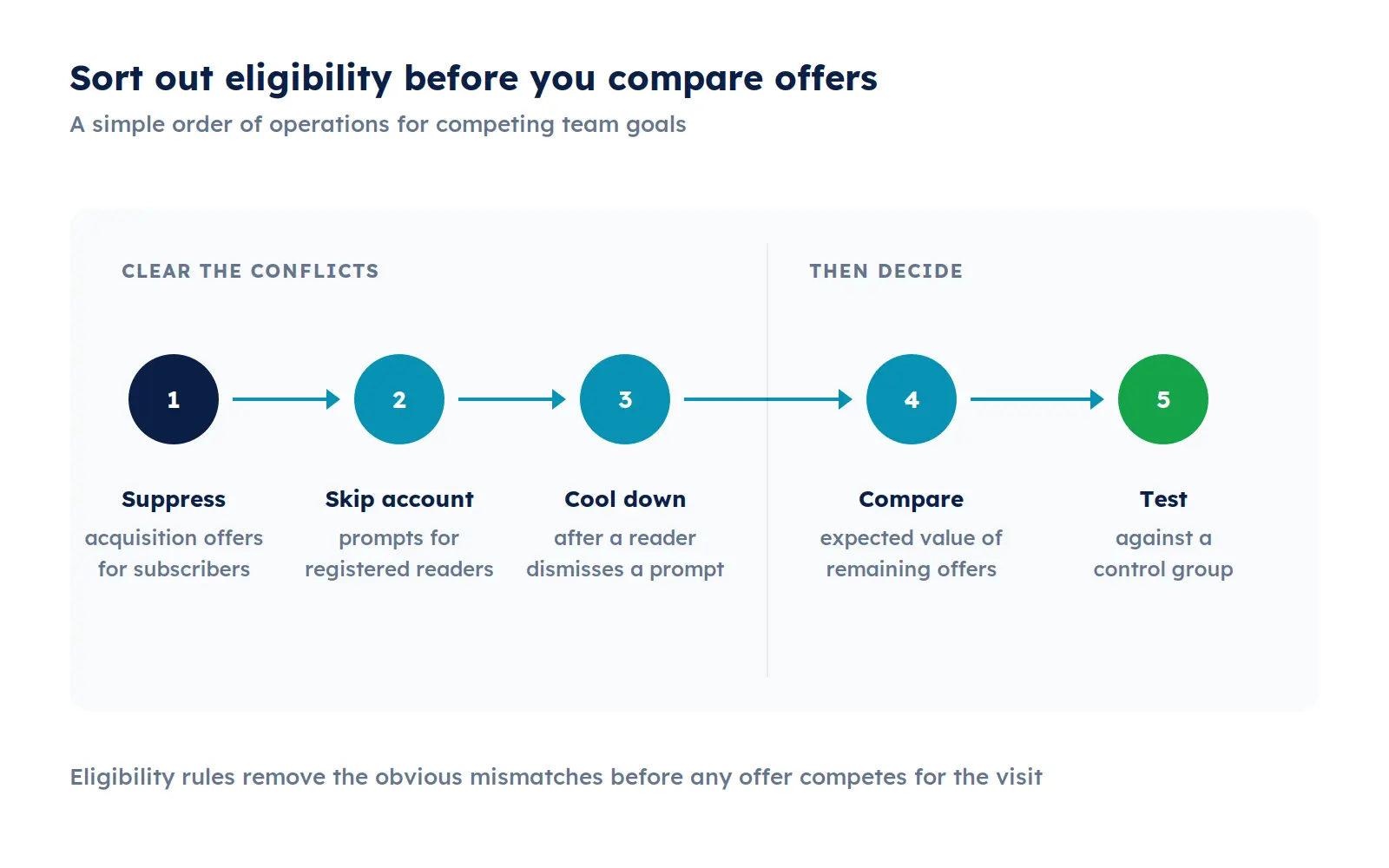
The more interesting decision is what to show when several actions are still possible.
Compare what each action is worth
Let’s say you’re evaluating subscription and registration prompts for frequent readers who haven’t subscribed.
Your historical data gives you these estimates:
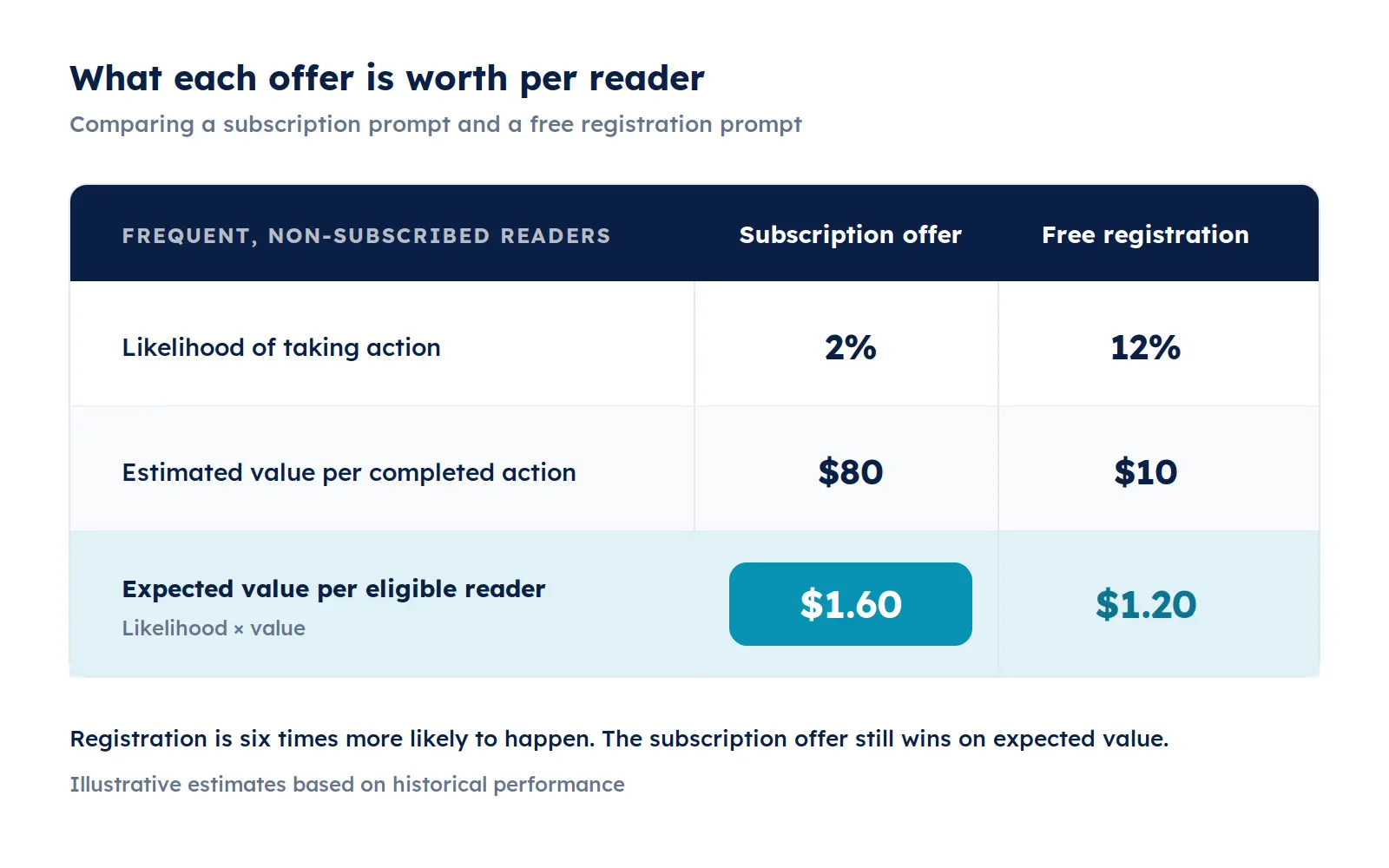
Registration is six times more likely to happen, yet the subscription offer has a higher estimated value.
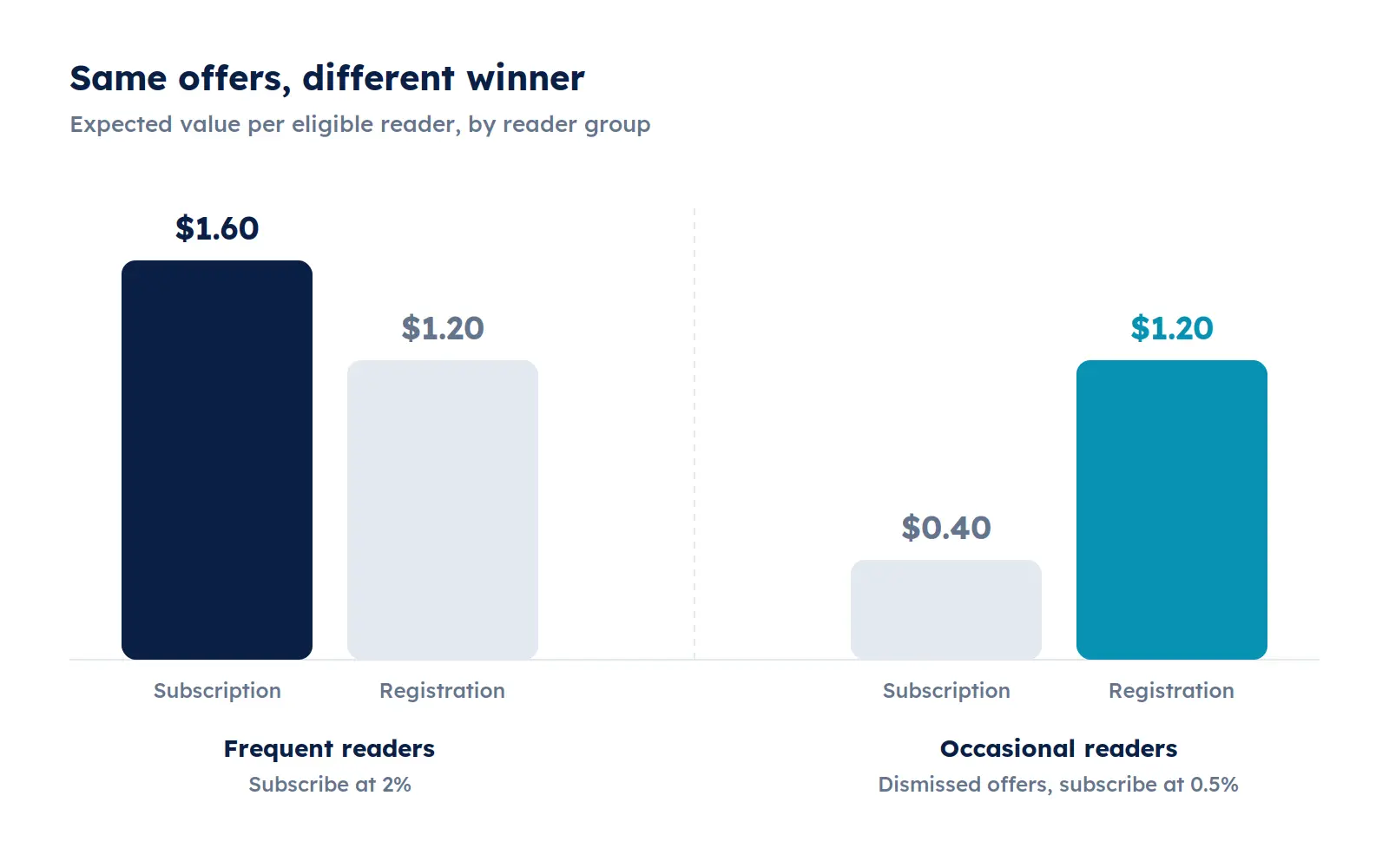
Now look at occasional readers who’ve repeatedly dismissed subscription offers. If their likelihood of subscribing is only 0.5%, the expected value of the subscription offer drops to $0.40 per reader. Assuming registration still converts at 12%, its estimated value remains $1.20.
The priority changes, even though the actions and their assumed values haven’t.
You’ll need to be careful about how you arrive at those dollar amounts. For subscriptions, use expected contribution after acquisition costs and churn. Registration value is harder to pin down because much of it comes later, through additional visits, advertising revenue, and eventual paid conversions.
And don’t forget what happens when someone declines the offer. A paywall can end a visit that would otherwise have generated more ad impressions.
These calculations help you decide what to test, but they don’t establish how much incremental revenue an offer will produce, since some readers would have subscribed or registered anyway. That requires comparing the outcome against a control group receiving a different experience.
You can use historical performance to establish initial priorities for your largest reader groups. The difficulty comes when you try to account for everything else you know about an individual.
A reader who visited three times this week and dismissed a subscription offer yesterday is different from someone with the same visit frequency who’s been opening your newsletters for months. Add content interests, subscription history, referral source, and activity during the current session, and your decision rules can get complicated quickly.
At some point, maintaining more segments and thresholds becomes a project of its own.
This is where predictive decisioning can help. With access to first-party reader data, a model can estimate the likelihood and expected value of eligible actions using more of the reader’s individual context. The publisher still controls the available actions and the business outcomes being optimized, while testing determines whether the decisions are producing additional value.
4. Test whether showing fewer paywalls makes you more money
Hearst Newspapers reduced its paywall stop rate by 17% while increasing subscription starts by 7% to 38% across its test markets.
The company tested its approach against its previous targeting model using a 50/50 split. In markets where paywalls had historically been strict, Hearst could give more readers free access without losing subscription volume. Markets with looser paywalls saw opportunities to increase subscriptions by identifying readers who were more likely to convert, while preserving advertising revenue.
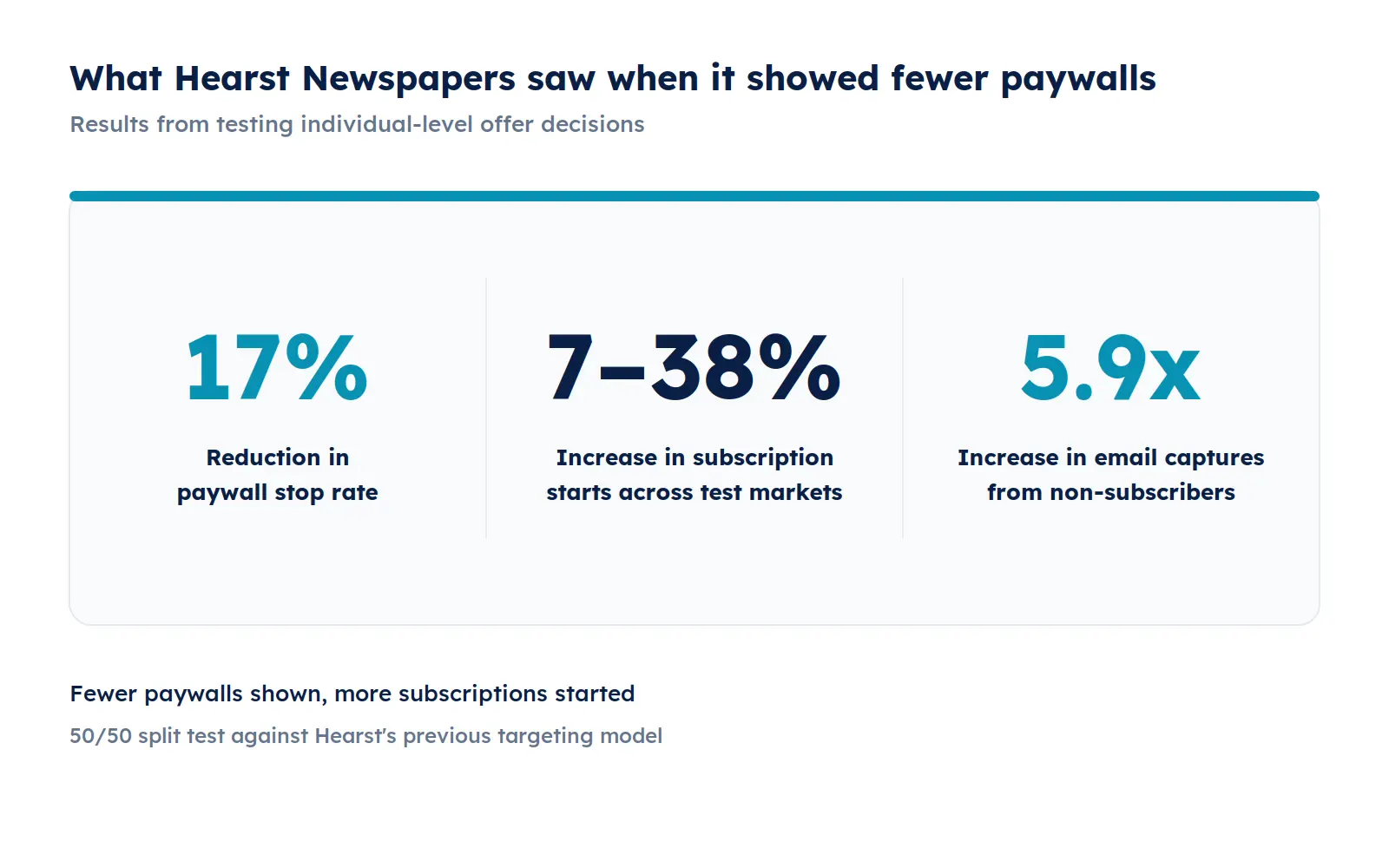
That makes a useful case for testing paywall exposure rather than assuming more subscription prompts will produce more subscriptions.
Start with a group of readers where you suspect your current rules are underperforming. You could delay the paywall for first-time visitors arriving from social media, for example, or test an earlier subscription offer among frequent readers of premium content.
Keep the existing experience as your control and change only the decision you’re trying to evaluate.
Before launching, agree on the primary commercial outcome and the measures that will tell you whether the change is helping or hurting elsewhere.
Subscription starts and incremental contribution per eligible reader are useful primary measures. You’ll also want advertising revenue, registrations, article consumption, and return visits so you can understand the tradeoffs.
Be careful about interpreting paywall conversion rates on their own. If fewer readers see a paywall, the conversion rate among those who do might increase even as total subscription starts fall.
The same caution applies to engagement. More pageviews are encouraging, but you still need to establish whether the additional advertising revenue and future reader value justify any subscriptions you gave up.
Run the experiment long enough to collect meaningful results, keeping the experience consistent throughout. If you operate multiple properties or markets, examine the results separately before assuming that a change working in one location should apply everywhere.
The decision to expand a test should come down to its incremental contribution and the other outcomes your publication needs to protect.
5. Let new reader behavior change the next ask
Someone registers for a free account on Monday, but your audience segments don’t refresh until Friday.
For the next four days, they keep seeing registration prompts.
That’s a straightforward problem to fix once your systems can recognize the completed registration. Other changes in reader behavior require a little more judgment.
For example, a reader’s subscription potential can change pretty quickly, especially when there’s major news or an ongoing story bringing them back more often. But if your targeting still relies on last month’s activity, you are easily missing that shift.
It’s worth looking at how often your reader data refreshes and whether or not your offers reflect what’s actually happened since the last update.
Engagement signals need a different approach. Five articles in one afternoon may just mean someone is researching a topic, while a sustained increase in visits over several weeks is likely more meaningful.
You can dig into this by identifying readers whose weekly visit frequency has increased over the past 30 days. Compare their subsequent subscription rates with similar readers whose activity hasn’t changed, accounting for differences in their starting engagement.
If increased frequency reliably predicts conversion, test whether showing those readers a subscription offer earlier improves results.
Declining engagement deserves your attention, too.
Someone who usually visits daily but hasn’t returned in several weeks may respond better to a relevant editorial recommendation than a subscription prompt. But you probably don’t want to change their entire experience because they missed a couple of newsletters.
Use the reader’s normal activity as context when deciding whether a change is significant.
You’ll also need to watch for rules that respond too aggressively. If a small increase in visits moves someone into a high-intent segment, only to move them back out a few days later, they could end up bouncing between different offers.
Set thresholds that reflect sustained behavior and review them against actual conversion results.
As you incorporate more signals, it becomes increasingly difficult to manage every combination through static rules. Individual-level decisioning can evaluate updated reader context when choosing among eligible actions, without requiring someone to manually define a new segment for each behavior change.
Whatever approach you use, keep measuring what happens after the decision. A reader receiving a more relevant offer doesn’t automatically mean the publication is earning more from that interaction.
Start with one decision you can improve
Look for a reader group that encounters subscription offers frequently but rarely converts. Compare what those visits currently contribute through subscriptions and advertising, then choose another action worth testing.
Keep your existing experience as the control, and measure what changes when you make a different ask.
The results should help you decide where to adjust your current rules and where more individualized decisions could make a meaningful difference.

Kayte Grady is the Content Director at BlueConic, specializing in customer data, personalization, and AI. Her work focuses on breaking down how modern technology works and how real people can actually use it. A former social worker turned marketer, Kayte earned her BA from Purdue University, where she learned to write clearly and edit ruthlessly. That background shapes how she approaches content, starting with people first and supported by technology. An outspoken champion of ADHD professionals, Kayte has found growth, camaraderie, and kindred spirits in tech—despite her never-ending devotion to the paper calendar.