
The Job Behind Black Friday Discount Strategy Effectiveness
Black Friday discount strategy effectiveness isn't exclusively about depth. See which tactics protect margin, grow baskets, and actually change buyer behavior.


Black Friday is a discount event. There's no point pretending otherwise.
Shoppers show up expecting a deal, and retailers give them one. In DHL's global ecommerce research, 71% of Black Friday shoppers said discounts and savings motivate them to participate. Exclusive deals and limited-time offers weren't far behind.
So the question isn't whether discounts work. It's what they work for.
A promotion can lift conversion and still give away more margin than necessary. It can drive a huge sales weekend and bring in customers who never buy again. Or it can clear inventory, increase basket size, acquire valuable customers, and make the economics of November considerably better.
That's what makes Black Friday discount strategy more complicated than picking a percentage and adding a countdown clock.
Key takeaways
- A bigger Black Friday discount doesn't guarantee better results.
- Every Black Friday discount should have a job. Measure it against the outcome it was meant to drive.
- Different discounts drive different outcomes. For example, sitewide sales boost volume, thresholds lift basket size, and bundles add value without deeper markdowns.
- Black Friday now spans weeks, not days. The longer the sale, the greater the risk of training shoppers to wait.
- Revenue isn't enough. As part of your strategy for Black Friday marketing, measure conversion, average order value, margin, inventory sell-through, acquisition cost, and repeat purchases
What makes a Black Friday discount strategy effective
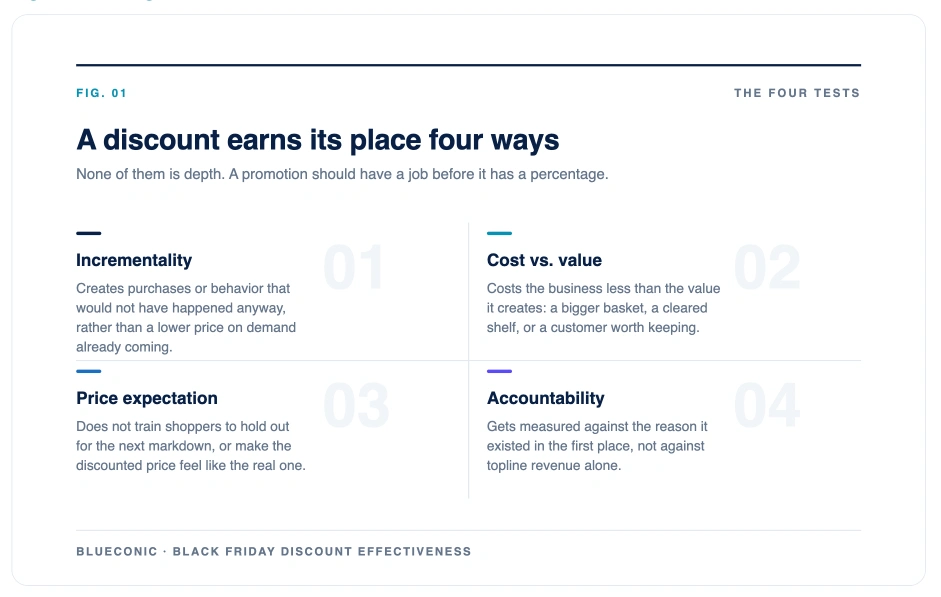
An effective Black Friday discount does four things.
- Creates behavior that wouldn't have happened otherwise, not just a lower price on purchases that were already coming
- Costs the business less than the value it creates, whether that's a bigger basket, a cleared shelf, or a customer worth keeping
- Doesn't train shoppers to wait for the next markdown
- Gets measured against the reason it existed, versus against revenue alone
Depth isn't on that list. That's the part most Black Friday planning gets backward.
Black Friday discount depth doesn't equal effectiveness
Every Black Friday planning meeting eventually lands on the same question: how deep do we go? It's the wrong question to lead with.
A 40% discount will probably attract more attention than 10%. That doesn't automatically make it the better promotion.
The real question is what happened because of the additional discount.
- Did it create purchases that otherwise would not have happened?
- Did shoppers buy more?
- Did it help move inventory the business genuinely needed to clear?
- Did it simply make purchases that were already likely to happen less profitable?
There's some evidence that retailers themselves aren't endlessly pushing discount rates higher. On Black Friday 2025, average U.S. online discounts peaked at 28%, essentially flat from the previous year, even as online spending continued to grow, according to Salesforce data reported by Retail Dive.
And discount depth varied sharply by category. Electronics peaked around 29%, toys around 30%, televisions around 24%, and furniture around 19%.
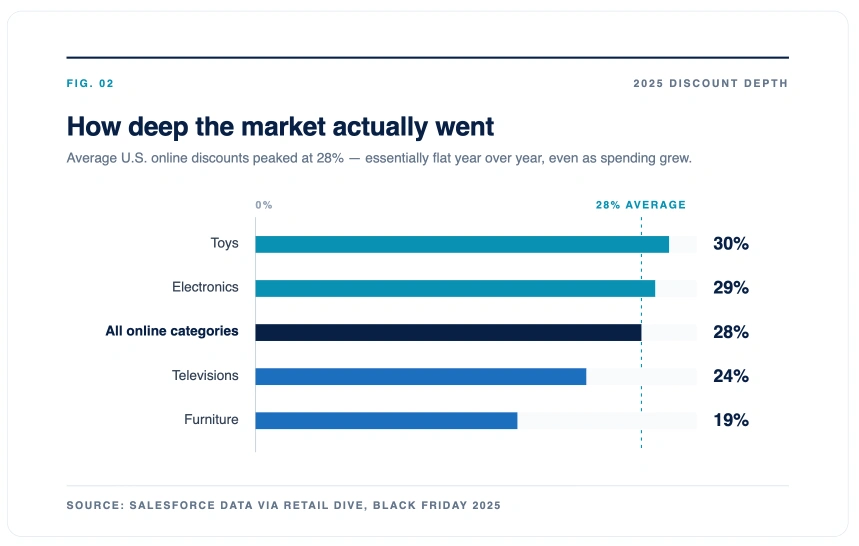
That's the more useful way to think about Black Friday discount effectiveness: not "how big should the discount be" but "how much incentive does this promotion need to accomplish its job."
Sometimes the answer really is a deep markdown. If you have seasonal inventory you need off the books, a 50% discount can be economically smarter than carrying that inventory into January. But if the goal is profitable growth, customer acquisition, or a larger basket, there are more levers to work with.
That's the first test. The rest of this comes down to which tactic clears it.
Sitewide discounts win on simplicity
There is a reason "20% off everything" survives every Black Friday deck. It's easy.
The customer instantly understands the offer. Marketing can communicate it consistently across email, paid media, social, the website, stores, and every other holiday touchpoint. There are no complicated thresholds to calculate or exclusions to decipher. During an already noisy shopping period, simplicity has value.
The downside is just as straightforward: every qualifying purchase receives the same margin concession. The loyal customer who had already decided to buy gets 20% off. So does the first-time shopper comparing five competitors. So does the customer buying a product with limited inventory that might have sold without an incentive.
Sitewide promotions are blunt, not bad. For retailers whose goal is broad reach, rapid conversion, or moving a large amount of inventory quickly, blunt can be exactly right. It passes the first two tests easily: incremental reach and simplicity of cost. It's weakest on the third: because every customer gets the same margin concession, it spends more than it needs to on shoppers who were already going to buy.
For everyone else, it's worth asking whether every product and every customer needs to be treated the same way.
How thresholds grow basket size
Thresholds flip the sitewide model on its head. Instead of giving every customer the same discount, you set a bar. The bigger the basket, the bigger the reward. That single shift changes what the customer is optimizing for.
Instead of 20% off everything, a retailer might offer:
- 10% off $100
- 15% off $150
- 20% off $200
Or free shipping over $75. Or spend $150 and get a $25 gift.
The important difference is that the customer has to create more value in the transaction to unlock more value from the retailer. That can make tiered promotions particularly useful when the goal is increasing average order value, units per transaction, or attach rate.
A shopper with $86 in their cart may expand the order to cross a $100 threshold. Someone buying one product may choose a bundle because the overall deal becomes more attractive. The offer isn't just reducing the selling price. It is shaping the basket.
Of course, thresholds can go wrong too. Set one too high, and it stops motivating anyone. Set it barely above the retailer's normal average order value, and shoppers may earn the incentive without meaningfully changing their behavior. The right threshold should make the customer stretch a little without making the reward feel unreachable, and the additional basket value still has to cover the economics of whatever they unlock.
Why bundles beat a straight markdown
A Black Friday offer doesn't have to be a markdown. A markdown gives every customer the same thing: a lower price. These give you more room to be specific about what you're actually trying to accomplish.
Retailers can create perceived value through:
- Product bundles
- Buy-one-get-one offers
- Gifts with purchase
- Free shipping
- Bonus loyalty points
- Member-only perks
- Early access
- Exclusive products or inventory
These approaches don't eliminate promotional cost. A free product still costs something. Free shipping isn't actually free. Bonus points eventually get redeemed. But the economics can be very different from cutting the selling price of the core product, and they can help the promotion do more than drive conversion.
A bundle can introduce customers to another product category. A spend threshold can grow the basket. Bonus loyalty points can create a reason to come back. An exclusive gift can create urgency without teaching customers that the product itself should cost less.
Major retailers already mix these mechanics into Black Friday. In 2025, retailers including Target and Lowe's used limited giveaways alongside their traditional holiday offers to drive early store traffic, according to Retail Dive.
For CPG brands, there's yet another layer here. Bundles, gifts, sampling, loyalty rewards, and brand-funded promotions can create value without requiring the retailer to absorb the entire cost through a straightforward markdown.
Different customers need different offers
Black Friday promotion planning usually starts with the offer. But it can also start with the customer.
A new customer, loyal customer, and lapsed customer may all be shopping during the same weekend for very different reasons. A first-time shopper may need a clear incentive to take a chance on an unfamiliar retailer. A loyal customer may respond just as well to early access, free shipping, member-only inventory, bonus points, or another benefit attached to a relationship they already value. A lapsed customer may justify a stronger incentive if the promotion genuinely changes behavior and brings them back.
It means deciding where a discount has a specific job to do, not building a different coupon for every visitor. Customer status, purchase history, loyalty activity, previous promotional response, category affinity, and other signals can help retailers distinguish between audiences instead of making eligibility synonymous with "everyone on the internet."
And what happens after the first purchase matters too. Black Friday acquisition gets expensive quickly if every newly acquired customer needs another deep offer to buy again.
The promotion calendar starts early
The name has stayed the same. The calendar hasn't.
Retailers increasingly start holiday promotions days or weeks before Thanksgiving, and major sales events now stretch across much of November. Amazon's 2025 Black Friday and Cyber Monday event, for example, ran for 12 days, from November 20 through December 1. Black Friday is really just the loudest week inside a much longer holiday shopping season, one where the same shopper might be researching in October and still comparing prices in mid-December.
That creates another strategic question: what happens to the offer over time? A retailer can launch the main promotion early, offer loyalty members first access, hold the best offer for Black Friday itself, change promoted categories throughout the month, extend the sale through Cyber Monday, or introduce new offers rather than continually deepening the original one.
What gets risky is unintentionally teaching customers that waiting always pays. If the offer gets better every few days, the shopper who bought early may feel penalized while everyone else learns not to take the first promotion seriously.
And the economics are becoming harder for some sellers to ignore. In 2025, some Amazon merchants reduced or skipped Black Friday promotions as tariffs and platform fees squeezed their ability to fund aggressive markdowns. Spreetail, which works with roughly 120 brands, told Modern Retail that participation among the sellers it worked with was down sharply.
That tension is likely to stay familiar: shoppers expect a compelling deal while retailers still have to make the math work.
How discounts reset price expectations
This is where Black Friday strategy starts extending beyond November.
Discounts don't automatically damage a brand. Customers understand that Black Friday is promotional. A retailer offering 25% off for one major sales event isn't suddenly incapable of charging full price in January.
The risk grows when deep promotions become predictable enough that the discounted price starts to feel like the real price. Customers learn. If a product routinely moves from $150 to $100, paying $150 becomes harder to justify. If the best promotion always arrives at the end of November, waiting starts to feel rational.
The impact also depends heavily on the brand. A value retailer built around deals has very different pricing expectations from a prestige beauty brand, premium apparel company, or luxury retailer. In the latter categories, preserving full-price demand can matter as much for positioning as it does for margin.
That is why "does discounting hurt brand perception" has no useful yes-or-no answer. The better question is what expectation this promotion creates about when the customer should buy from us again, and at what price.
That's also where Black Friday tactics run into a bigger question: whether the discount is solving a pricing problem at all, or masking something else about what the customer hasn't decided yet.
Black Friday success costs more than discounts
Black Friday makes topline metrics look exciting. Revenue rises. Conversion rises. Orders pile up.
Then come the costs. There's the discount itself, obviously. But also paid media, shipping subsidies, fulfillment, customer support, fraud, returns, and, in acquisition-heavy strategies, the cost of winning the customer in the first place.
Returns are particularly easy to underweight when sales are flying. In NRF's 2025 holiday research of more than 500 senior retail leaders at large retailers, 80% said the average shopper returned at least $51 in merchandise during the previous holiday season, while 75% reported increases in holiday fraud.
That's why Black Friday effectiveness should be measured against the reason the promotion existed in the first place. If the goal was conversion, look at incremental conversion, not simply total conversion. If it was basket growth, measure AOV, units per transaction, or attach rate. If it was inventory, measure sell-through. If it was acquisition, look beyond first-order revenue to acquisition cost, margin, repeat purchase, and the value of those customers after November. If it was profitability, measure profit.
Simple, but surprisingly easy to lose sight of when Cyber Weekend dashboards start turning green.
How to measure Black Friday promotion success
Most Black Friday recaps start and end with revenue. That's the wrong scoreboard. Here's the one that actually tells you whether the promotion did its job:
- Conversion: Did the offer generate incremental conversion versus what would likely have happened otherwise?
- Basket: Did shoppers spend more or purchase additional items?
- Margin: How much incremental gross profit did the promotion generate after the cost of the incentive?
- Inventory: Did the event improve sell-through where the business needed it?
- Acquisition: How much, including the discount, did the retailer pay to acquire a new customer?
- Retention: Did those customers purchase again after the event?
- Loyalty: Did the promotion deepen an existing customer relationship or simply subsidize a purchase?
The hardest question is also the most useful: how many of these purchases would have happened anyway? No retailer gets a perfect answer, but holdout groups, historical baselines, customer-level analysis, and promotion testing get considerably closer than assuming every transaction that happened during a sale happened because of the sale.
This is where all four tests get answered honestly, not assumed. Measuring this way is also the fastest route to a real answer on whether a shopper's hesitation was ever about price.
What are the most effective Black Friday discount strategies?
There isn't just one effective Black Friday discount strategy. There are many options:
- Sitewide discounts can be highly effective when reach and conversion are the objective.
- A tiered offer can be better when the goal is increasing basket size.
- Bundles and gifts with purchase can create value without reducing the price of every item.
- Targeted offers can make sense when a specific audience needs an incentive to change behavior.
- Deep category markdowns can be exactly right when inventory has to move.
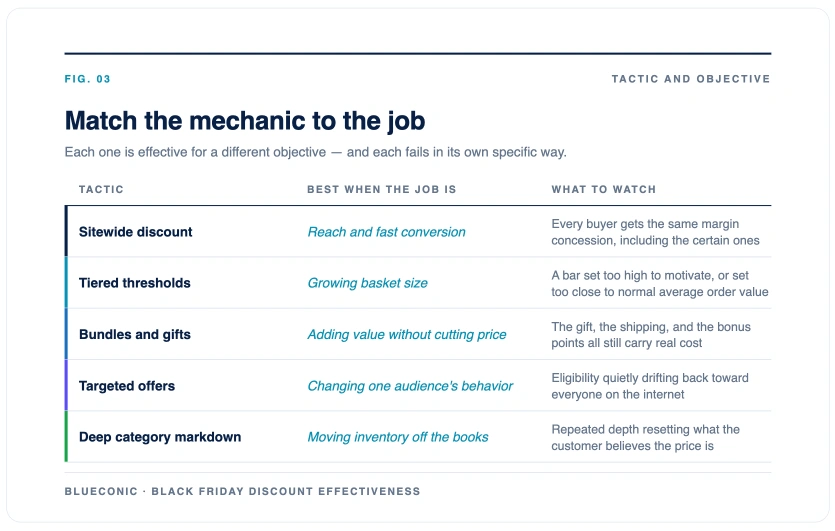
Three-column table pairing five Black Friday discount tactics with the objective each suits best and the failure mode to watch for.
The common thread is that the promotion should have a job before it has a percentage. That's the actual answer to whether a Black Friday discount strategy is effective. Not how deep it goes. Whether it passes those four tests.
Black Friday shoppers are going to look for deals. Retailers should give them good ones. The opportunity is to know what the business is buying in return.
FAQs
What is the most effective Black Friday discount strategy?
The most effective Black Friday strategy is whichever one matches the retailer's actual objective, not the deepest discount.
Sitewide discounts work best for reach and fast conversion. Tiered thresholds work best for growing basket size. Bundles and gifts with purchase work best when the goal is adding value without cutting price. Targeted offers work best when a specific audience needs an incentive to change behavior.
How deep should Black Friday discounts be?
The right depth for any single Black Friday discount depends on category economics, inventory position, and what the discount is meant to accomplish. Most retailers land between 20 and 30 percent, with average U.S. online discounts peaking around 28 percent in 2025.
Can deep Black Friday discounts hurt a brand?
Yes, Black Friday discounts can hurt a brand when they become predictable enough that customers start waiting for them. The risk is highest for brands that depend on full-price demand, like prestige or luxury retailers, and lowest for brands already positioned around deals.
How can retailers maximize profit during Black Friday?
Retailers can maximize Black Friday profit by matching the promotion to the objective, controlling discount depth, using thresholds or bundles to increase basket value, accounting for fulfillment and returns, and measuring whether promotional customers continue buying after the event.

Kayte Grady is the Content Director at BlueConic, specializing in customer data, personalization, and AI. Her work focuses on breaking down how modern technology works and how real people can actually use it. A former social worker turned marketer, Kayte earned her BA from Purdue University, where she learned to write clearly and edit ruthlessly. That background shapes how she approaches content, starting with people first and supported by technology. An outspoken champion of ADHD professionals, Kayte has found growth, camaraderie, and kindred spirits in tech—despite her never-ending devotion to the paper calendar.