
2026 Ecommerce Holiday Trends for a Shopper You Can't Fully Track
Seven ecommerce holiday trends for 2026 covering AI discovery, blended shopping, and how marketers can turn customer signals into real guidance this peak season.
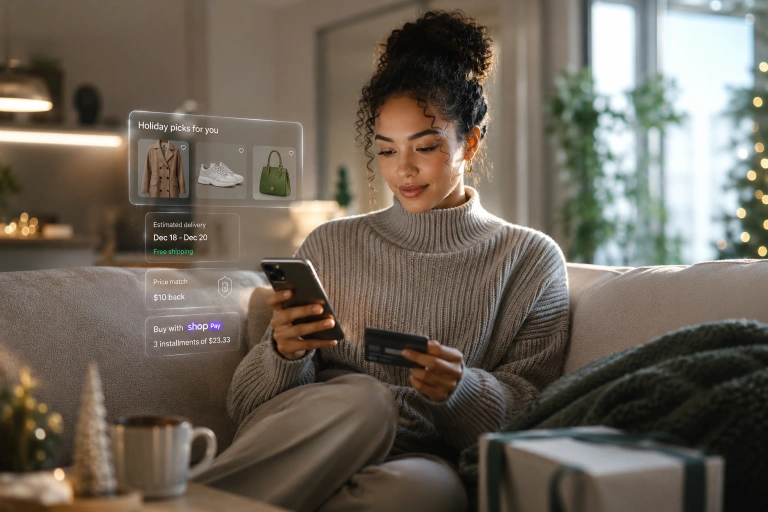

Holiday shopping is getting harder to contain in a neat, tidy, predictable season.
Consumers are starting earlier. They're researching across more places. They're weighing value more carefully. AI is entering the discovery. And the line between an ecommerce purchase and an in-store purchase is getting harder to draw.
None of that means holiday demand is weakening. Current 2026 research points to a more complicated picture: many shoppers still expect to spend at roughly the same level as last year.
What's changing is how they get to the purchase.
For retailers, ecommerce brands, and CPG marketers, that matters because the holiday season is creating more signals, across more moments, before a customer converts.
Here are seven ecommerce holiday trends shaping how that happens in 2026.
Key takeaways:
- Holiday shopping is starting earlier and happening across more channels.
- Shoppers increasingly expect brands to make choosing easier, not just offer more options.
- Retailers can create better experiences by connecting the customer signals they already have.
2026 Ecommerce Holiday Trends
1. The holiday shopping season is starting earlier, and stretching longer
Black Friday and Cyber Monday still matter. But they’re increasingly sitting in a much longer consideration period.
Shoppers are researching earlier and comparing products ahead of major promotional moments. They’ve also started spreading purchases across more of the fall. Similarweb's 2026 holiday research found that more than half of surveyed consumers expect to begin planning their holiday purchases earlier this year.
The shift for marketers here is intent starts showing up sooner.
A customer may browse the same category several times in September, return to a few products in October, engage with a promotional email in early November, and finally buy during Cyber Week. Each interaction adds a little more context.
Tracking behavior shouldn't just start when a customer enters a "holiday campaign." Browsing frequency, category interest, product affinity, loyalty activity, past purchases, and repeated visits all signal that someone is moving toward a seasonal purchase.
The opportunity is to recognize that momentum before every brand in the category starts shouting about Black Friday.
2. Shoppers are redefining what "value" means
Price still matters. It would be hard to argue otherwise.
But value during the holidays is broader than the size of the discount. It can mean free shipping. Faster delivery. Easy returns. A loyalty benefit. Better quality. A bundle that saves time. Confidence that a gift is actually right for the person receiving it.
Those priorities won't be identical for every shopper. For example:
- A first-time visitor comparing retailers might respond to pricing
- A loyal customer potentially values convenience or early access
- Someone shopping on December 20 may be fore more likely to care about delivery certainty than saving another 10%
Broad promotional strategies become blunt instruments here.
TL;Dr: When every customer gets the same message about "value," your brand is assuming everyone is solving the same problem. They aren't.
The more useful question is: what does value mean for this customer right now? That doesn't always require sophisticated prediction. The signals are often already there in purchase history, category behavior, loyalty status, browsing patterns, or the kinds of offers someone consistently engages with.
Discounting isn't the problem. Treating it as the only lever to complete the cart is.
3. AI is part of holiday product discovery and research
Ask-First Commerce is here to stay. Consumers are using AI tools to generate gift ideas, compare products, narrow large assortments, research deals, and answer questions before making a purchase.
With a 50% of shoppers using an AI assistant at some point in their buying journey, (a 67% year-over-year increase), Salesforce predicts AI chat agents will originate 20% of holiday ecommerce traffic in 2026. At the same time, 47.1% of U.S. digital shoppers say they haven’t used AI to shop and aren’t interested, according to an April 2026 survey from Bizrate Insights and EMARKETER.
Both things can be true. AI-assisted shopping is growing quickly without becoming universal.
The near-term shift isn't autonomous agents buying everything for consumers. It's AI as another layer of consideration before a shopper ever reaches your site. A shopper may arrive on your site after already asking an AI assistant which products fit a specific need, how two options compare, which brands are best reviewed, what to buy within a certain budget, and what the tradeoffs are.
By the time that person reaches an owned channel, they may already know quite a bit. The first interaction you can see may be nowhere near the beginning of the decision. Say a shopper lands on a product page after an AI assistant already narrowed their options to two brands. Repeating category basics wastes that visit. A direct comparison against the specific alternative they were weighing, or a fast answer to the one tradeoff question AI likely surfaced, actually moves them forward.
4. Product discovery is spreading across more places
AI isn't replacing search, social, marketplaces, retailer sites, creators, or stores. It's joining them.
A shopper might see a product on TikTok, search it on Google, compare it on Amazon, ask an AI assistant about alternatives, check local inventory on a retailer's site, and then walk into a store. (A long journey, but the potential is there.) From an organizational POV, those touchpoints belong to entirely different teams. From the customer's? They're all part of one decision.
That's the reality marketers have to plan around: you won’t see the entire journey. Some research happens in environments the brand doesn't control. Some happens anonymously. Some leaves no usable signal at all.
Trying to reconstruct a perfect end-to-end path is the wrong ambition. The better question to ask is: what can you do with the interactions you do see?
When someone lands on your site, do you recognize they've been browsing the same category for two weeks?
When a known customer moves from an app to ecommerce, does that context stick around?
When a loyal customer visits a store, is their previous relationship with the brand still meaningful?
The journey may be fragmented. The experience doesn't have to feel that way.
5. Personalization is moving from more recommendations toward better shopping guidance
For years, ecommerce personalization has meant recommendations: you looked at this, so here are six more things you might like. During the holidays, that often isn't enough.
Holiday shoppers often shop outside their usual categories. They’re often buying for someone else, sorting through too many options, and trying to figure out what will actually work… all with a deadline looming. The hardest part is making the right choice.
A gift finder, for example, that asks a few smart questions:
- Who you’re shopping for
- Your budget
- The occasion
This method cuts forty options down to four andis genuinely useful.
So is a comparison view that shows the handful of differences that actually matter. The same goes for recommendations shaped by what a shopper has bought before, what they’ve told you they like, what’s in stock nearby, or how they shop with the brand. All of that makes choosing easier than another generic “popular products” module.
The strongest holiday personalization doesn't feel like personalization at all. It feels like the brand understands what the shopper is trying to do, and uses just enough context to make the next decision easier.
6. Ecommerce and physical stores are becoming part of the same holiday purchase
Calling something an "ecommerce sale" or an "in-store sale" tells only part of the story now.
A customer can research online, check inventory from a phone, visit a store, compare reviews while standing in the aisle, make the purchase there, and manage loyalty benefits digitally. Or they might discover a product physically and complete the purchase online later. These kinds of hybrid behaviors are expected to account for a significant share of holiday retail spending in 2026.
Many retailers still organize customer data more cleanly than customers organize their lives. Ecommerce lives in one system. Loyalty lives in another. Store transactions live somewhere else. Mobile engagement sits with another team. The customer simply expects the retailer to know they're the same person.
Closing that gap starts with connecting the interactions the retailer already has. And it can make a meaningful difference even without perfect visibility into everything a shopper did before purchasing.
That's a small distinction with a real payoff. The competitive advantage isn't knowing every step of the journey. It's wasting fewer of the signals you already own.
7. Loyalty is becoming another layer of the holiday shopping experience
Holiday loyalty is usually talked about in terms of points, rewards, and member discounts. But during the holidays, some of its biggest value comes from simply making shopping easier.
For a known customer, that might mean early access to inventory, free shipping, faster checkout, more relevant offers, easier pickup, or recommendations that actually reflect how they shop. Those things matter more when people are already juggling price, availability, convenience, and time.
There’s also value after the season ends. Holiday traffic brings a wave of high-intent shoppers into a retailer’s world, often for a very short window. Loyalty gives brands a way to carry some of that relationship forward, using what they learned from a customer’s purchases, preferences, and engagement to make the next interaction more relevant.
That makes loyalty less of a holiday tactic in itself and more of a way to connect the holiday purchase to what comes next.
How marketers can respond to 2026 holiday shopping trends
The holiday journey may be getting more fragmented, but retailers still have plenty of room to make it easier.
1. Start looking for intent earlier.
Holiday consideration begins well before Cyber Week. Pay attention to repeat category visits, product interest, loyalty activity, and other signals that suggest a shopper is moving toward a purchase.
2. Use customer context to reduce choice.
More products and more recommendations aren’t always more helpful. Use what you know about a shopper to narrow options, surface meaningful differences, and help them get to a decision faster.
3. Connect the touchpoints you already own.
You might never see every search, social interaction, AI ask, or marketplace visit that shaped a purchase. But ecommerce behavior, loyalty activity, store purchases, app engagement, and stated preferences can still give the next interaction more context.
4. Personalize around what matters in the moment.
Value changes depending on the shopper and the situation. For one person, it’s price; for another, delivery certainty, inventory, convenience, or early access. Let those things shape the experience instead of defaulting to the same promotion for everyone.
5. Plan for the relationship after the holiday purchase.
Holiday traffic creates a brief window of unusually high intent. Use loyalty, preferences, purchase history, and post-purchase engagement to make that first seasonal transaction useful long after the season ends.
2026 holiday retail trends to avoid
Not every holiday retail trend is worth following. Some of the habits that have become standard ( like more discounts, more recommendations, and more channel-specific campaigns) can actually make an already complicated shopping journey harder.
Here are a few approaches retailers should be careful not to carry into 2026.
Defaulting to discounts for everyone
A lower price can help, but your Black Friday discount strategy may not always be what gets someone over the line. For some shoppers, faster delivery, easier pickup, better availability, or a loyalty perk will matter more.
Throwing more products at people
Holiday shoppers usually don’t need another row of recommendations. They need help figuring out which option makes sense, whether that means narrowing the assortment, showing the differences that matter, or using what you already know about them.
Losing the customer between channels
Someone might browse on their phone, check inventory online, visit a store, and come back later to buy. If every step feels like a fresh start, the experience gets harder than it needs to be.
Trying to account for every step of the journey
You won’t see every search, AI query, social post, or marketplace visit that influenced a purchase. There’s more value in making better use of the signals you do have.
What 2026 holiday shopping trends add up to
The 2026 holiday shopper isn't moving through one funnel. They're starting earlier, researching across more sources, experimenting with AI, defining value more individually, expecting more help navigating choice, and moving between digital and physical environments more fluidly.
That makes holiday shopping less linear. It also creates more opportunities for marketers to learn.
No brand will see every interaction that influences a purchase. The opportunity is to make better use of the ones it can see: browsing behavior, purchase history, loyalty activity, preferences, product affinity, engagement, store activity, digital interactions.
Individually, those are just signals. Connected and used at the right moment, they become context. And as holiday shopping gets more fragmented, context may be one of the few things brands can carry with the customer from one interaction to the next.
FAQs
What are the biggest ecommerce holiday trends for 2026?
The biggest ecommerce holiday trends for 2026 include earlier shopping, more value-conscious consumers, AI-assisted product research, fragmented discovery, more useful personalization, blended online and in-store shopping, and a larger role for loyalty.
How is AI changing holiday shopping in 2026?
AI is changing holiday shopping in 2026 as another place shoppers research gifts, compare products, narrow options, and evaluate tradeoffs before visiting a retailer’s site. It adds another step to an already fragmented product discovery journey.
How can retailers improve the holiday shopping experience?
Retailers can improve theholiday shopping experience by using customer context to narrow choices, improve recommendations, surface relevant inventory and offers, and connect experiences across ecommerce, loyalty, mobile, and stores.

Kayte Grady is the Content Director at BlueConic, specializing in customer data, personalization, and AI. Her work focuses on breaking down how modern technology works and how real people can actually use it. A former social worker turned marketer, Kayte earned her BA from Purdue University, where she learned to write clearly and edit ruthlessly. That background shapes how she approaches content, starting with people first and supported by technology. An outspoken champion of ADHD professionals, Kayte has found growth, camaraderie, and kindred spirits in tech—despite her never-ending devotion to the paper calendar.