
CDP vs. Data Lake: What's the Difference?
Storing customer data isn't the same as using it. Compare CDPs and data lakes, when each fits, and how to turn lake data into real-time engagement.


Collecting customer data isn’t the hard part anymore. Websites, apps, transactions, and service interactions generate it constantly. The hard part is making it useful, because storing data and understanding the person behind it are two very different jobs.
That's where the distinction between a data lake and a customer data platform (CDP) comes in. A data lake is a place to store and analyze varied data from across your organization. A CDP organizes customer data into connected records and makes it available to the systems your teams use every day. This guide breaks down how they differ, when each one earns its place, and how they can complement each other.
Key takeaways
- A data lake stores varied data from across your organization to support analysis and other technical use cases.
- A CDP maintains unified customer records and makes customer data available to other systems for analysis, segmentation, and engagement.
- The real difference lies in purpose and how each tool organizes data and makes it usable, not in how much data it can hold.
- A CDP and a data lake can work together, and some architectures combine CDP capabilities with an existing warehouse or lake.
- A data lake is great for analysis, but a CDP is what turns customer data into timely, personalized engagement.
What is a data lake?
A data lake holds large volumes of data in nearly any format: structured, semi-structured, or unstructured. Data can remain in its raw form until someone needs it, or it can be prepared in advance for specific purposes. That flexibility is the main appeal. You don't have to decide how data will be used before you store it.
Analysts and data engineers draw on lake data for reporting, exploration, and modeling. A retailer, for instance, could blend purchase, browsing, and inventory records to uncover shopping patterns and anticipate seasonal demand.
What is a CDP?
A CDP builds and maintains connected customer records that other systems can use. It gathers data from sources such as websites, apps, and point-of-sale systems, then applies identity resolution to link interactions and identifiers to the same person.
Where a data lake is organized around storage, a CDP is organized around the customer. Teams use its profiles to create segments, study behavior, and guide engagement. Those profiles can hold first-party behavioral data alongside zero-party data, such as preferences customers volunteer. What a CDP includes varies by vendor. Some come with built-in analytics and activation tools, and others plug into your existing data warehouse or lake.
CDP vs. data lake: What are the main differences?
Both tools can have a seat in your data architecture, but they're designed around different goals.
Where the data physically sits matters less than how it gets managed and used. A data lake is built to store and explore information at scale. A CDP is built to know who each customer is and make that knowledge usable across your business.
However, the line between them can blur. Some organizations run the two as separate platforms, while others layer CDP capabilities onto an existing warehouse or lake. Neither approach solves data quality, identity, privacy, or governance on its own, though. Those responsibilities still have to be built into your architecture and processes.
When is a data lake the right fit?
A data lake shines when you need to retain huge amounts of varied data from across the business and use it for purposes well beyond customer engagement.
It's often a good match when:
- Analysis spans many kinds of data. Your analysts need to explore customer, operational, product, and other information together.
- Analytics needs are wide-ranging or still taking shape. With the right tools and design, a lake can handle reporting, exploration, modeling, and machine learning.
- Long-term history is valuable. Data scientists want flexible access to granular records spanning time.
- The technical muscle is in place. You have the people, processes, and tools to manage ingestion, access, quality, security, and governance.
A data lake can support analysis of customer data, but it won't hand you unified customer records or a ready path to engagement. When analysts can study customer behavior, yet nobody can connect it across touchpoints or use it in other systems, the gap probably isn't storage.
When is a CDP the right fit?
A CDP earns its keep when customer data needs to be connected across systems and delivered to the teams and tools that understand and engage customers.
Signs it's time for one:
- Interactions don't connect. The same customer's activity across channels or systems shows up as isolated fragments.
- No one has a reliable view of the customer. Tracking how someone's behavior or preferences shift over time is a struggle.
- Segments are a bottleneck. Every new audience means another export, more manual work, or a ticket for the data team.
- Customer data has places to go but no way to get there. Profiles, segments, or insights need to be accessible to analysis or engagement tools.
- Valuable first-party and zero-party data sit idle. You capture behavior and stated preferences, but rarely act on them consistently.
If any of these sound familiar, a CDP is likely the missing link between the data you already have and the customer experiences you want to deliver. The right platform connects to your existing systems, your lake included, so you can start acting on customer data quickly.
How can a CDP and data lake work together?
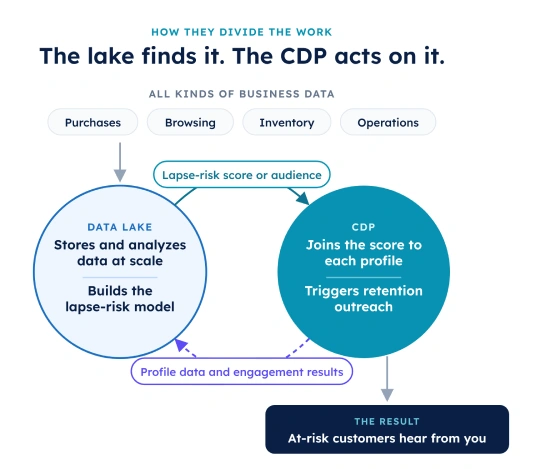
Rather than competing, a data lake and a CDP often divide the work. The lake handles broad storage and analysis. The CDP maintains customer records and pushes selected customer data out to the systems that need it. Depending on how your architecture is set up, data can travel in both directions.
Consider a retailer whose data team builds a model in its lake to flag customers who show early signs of lapsing. The resulting score or audience flows into the CDP, where it's joined with each customer's profile and used to trigger retention outreach. The lake produces the insight, and the CDP gets it in front of the right people. Your integrations, data ownership, and governance rules determine exactly how that flow works. BlueConic, for example, supports exporting customer profile data to cloud data stores, including data lakes.
How to decide what your business needs
The smartest first move is diagnosing the gap. Organizations that already have a data lake often discover the missing piece isn't more storage. It's a way to act on what's already there.
1. Start with the use case
Pinpoint what matters most right now: large-scale storage and analysis, connected customer records, customer engagement, or a mix. Get specific about the decisions or customer experiences you want to improve, since that clarity makes tool comparisons far easier.
2. Find where data gets stuck
Trace where your customer data lives and which teams hit walls trying to access or use it. A storage or analytics bottleneck calls for a different fix than a problem with customer identity, profiles, or activation.
3. Review your existing architecture and responsibilities
Take stock of the systems a CDP would need to connect with, including your lake or warehouse, email and ad platforms, and analytics tools. Weigh integrations, data ownership, technical resources, customer consent, and governance. That picture will show you where a CDP can add the most value and how it fits alongside what you already have.
How BlueConic helps put customer data to work
Data lakes are excellent at producing insight. Turning that insight into a timely customer experience is a different story, and it's often where momentum stalls. BlueConic’s CDP acts as the bridge, taking the intelligence your data team builds and the signals customers generate in real time, then putting both to work across your channels without forcing you to replace the infrastructure you've invested in.
- Profiles organized around the person. BlueConic standardizes incoming data and resolves identities into persistent profiles, so every signal attaches to one consistent picture of each customer.
- Decisions made while the customer is still there. As someone browses or returns to your site, BlueConic evaluates their intent and selects the next best experience in a fraction of a second, rather than waiting for a batch sync.
- Two-way exchange with your lake or warehouse. Data from analytics systems enriches profiles and sharpens segments, while individual-level data and events from BlueConic flow back to improve your models.
- Zero-party data capture with built-in consent. Quizzes, product finders, and preference centers collect what customers want to tell you, while integrated consent management keeps that data compliant.
- Audiences marketers can own. A no-code interface puts segment building and activation directly in marketers' hands, freeing data teams to focus on the work only they can do.
Choose the tools that fit the job
The best architecture is the one that matches your current challenges, not the one with the most components. A data lake is the go-to for storing and analyzing varied data across the organization. But when the goal is to understand customers and engage them in the moment, a CDP is what makes that data work. For many businesses, the strongest setup pairs the two, with the lake powering analysis and the CDP turning insight into action.
If a CDP is on your shortlist, the next step is finding one that fits. See how the best CDPs of 2026 stack up on identity resolution, real-time activation, AI readiness, and usability, and get a clear framework for choosing the right platform for your teams.
Frequently asked questions
Can a CDP replace a data lake?
In most cases, they work better as partners than replacements. A CDP centers on customer records and making customer data usable across systems, while a data lake supports broader storage and analysis for the whole organization. Together, they cover both sides: deep analysis and real-time action.
Do you need a CDP if you already have a data lake?
Very often, yes. A data lake is built for storage and analysis, but it isn't designed to maintain connected customer records or deliver customer data to marketing and engagement tools in real time. If your teams struggle to turn lake data into personalized experiences, a CDP fills that gap.
Can a data lake send data to a CDP?
Yes. Integrations can move data from a lake into a CDP, depending on the platforms and configuration involved. The flow can also run in reverse, with selected profile data or engagement results sent from the CDP to the lake for deeper analysis. Whatever the direction, it should follow your organization's data ownership and governance rules.

Kayte Grady is the Content Director at BlueConic, specializing in customer data, personalization, and AI. Her work focuses on breaking down how modern technology works and how real people can actually use it. A former social worker turned marketer, Kayte earned her BA from Purdue University, where she learned to write clearly and edit ruthlessly. That background shapes how she approaches content, starting with people first and supported by technology. An outspoken champion of ADHD professionals, Kayte has found growth, camaraderie, and kindred spirits in tech—despite her never-ending devotion to the paper calendar.