
How BlueConic Grows AOV With Smarter Recommendations
Frequently bought together isn't enough. Learn how BlueConic uses customer context to drive higher AOV and more add-on purchases.

Key takeaways:
- In-session product recommendations fail to move AOV because they're built on product logic, instead of customer context.
- Order value expansion works when the recommendation matches not just the product in the cart, but the buyer's price sensitivity, declared preferences, and purchase history.
- The in-session moment is the highest-conversion window for basket expansion. Post-session follow-up only works when it accounts for what the customer already saw on-site.
- When the recommendation model learns from every outcome, it improves with every cycle.
A customer is on your product detail page, thirty seconds from adding a jacket to his cart.
He's been to your site twice this week, is a loyalty member, and spent eight minutes in your outerwear category last visit and browsed three accessories.
Your site shows him "Customers also bought" … the same four items it shows everyone who looks at that jacket. He adds the jacket, skips the accessories, and checks out.
That miss? The customer who spends $200 today was probably worth $300 if the recommendation had matched where he was.
Cart value doesn't just grow when you have more things to sell. It grows when the right thing surfaces for the right person at the right moment, but only if the system making that call can see the full picture, not just the product she's already looking at.
Why product recommendations miss the person
The recommendation engines commerce teams rely on were designed to answer one question: what goes with this product? They look at purchase co-occurrence, browsing patterns across the customer base, and category associations.
Sure, those signals are real. They also happen to be incomplete.
What the recommendation knows vs. what it should know
At the moment a recommendation fires, the engine working from your commerce platform or ESP knows the product in the cart and what other customers have bought alongside it. What it doesn't know is anything specific to this buyer.
So it defaults to that product logic. It shows him what goes with the jacket, not what he's most likely to buy.
The obvious fix is to add more behavioral data to the recommendation feed. But that doesn't solve the structural problem.
If the model hasn't been trained to distinguish a loyalty member from a first-time visitor, or a price-sensitive browser from a high-AOV repeat buyer, more data doesn't change the output. It still recommends the same bundle to everyone who puts a jacket in a cart.
Run the math:
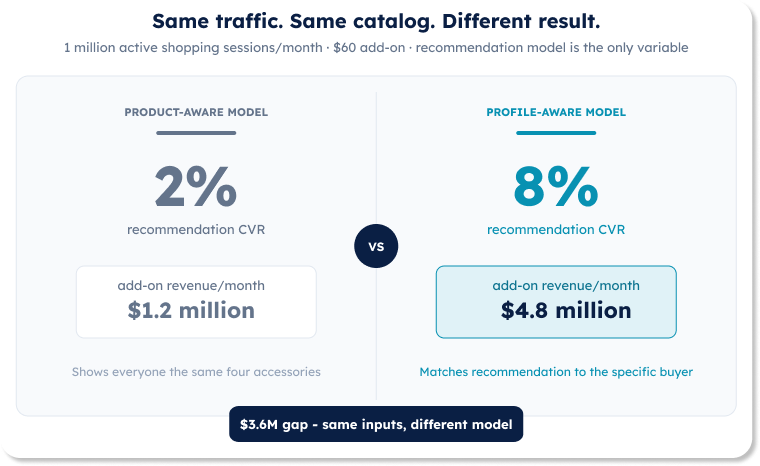
A recommendation that fires for every shopper but converts at 2% looks fine on a dashboard. A recommendation calibrated to the specific buyer converts at 8%. At 1 million active shopping sessions a month with a $60 add-on, that gap is the difference between $1.2 million in add-on revenue versus $4.8 million.
Same catalog. Same traffic. Different input to the model.
What a profile-aware expansion model does differently
The better model separates two questions that most systems collapse into one:
- What is the right product?
- Is this the right person to recommend it to?
How the intervention matches the buyer
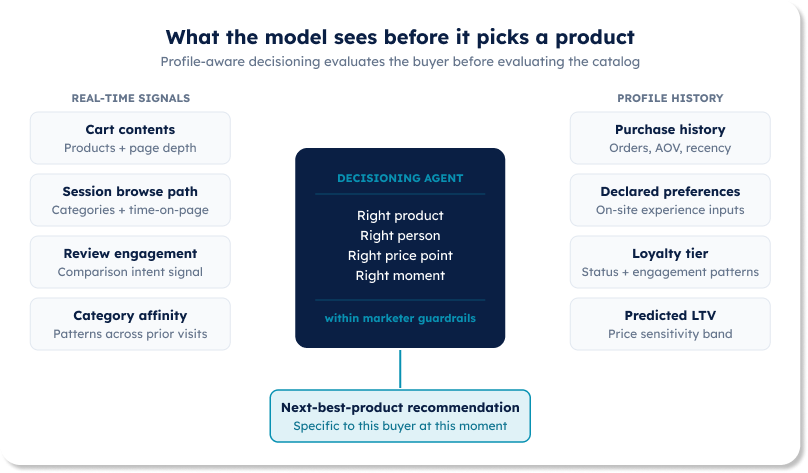
A profile-aware approach starts with the customer before it starts with the cart.
It reads:
- Purchase history
- Product affinities
- Declared preferences
- Loyalty status
- Price sensitivity signals
Then, it evaluates what product recommendation or bundle offer is most likely to generate an add-on from this specific buyer at this price point.
When post-session follow-up actually works
The in-session moment is the highest-conversion window. A shopper actively building a cart is more receptive to an add-on than someone who has already closed the tab. But post-session follow-up matters for customers who don't add the recommended item in-session—and it only works when the follow-up accounts for what they already saw.
If your ESP sends a cross-sell email featuring the same accessories the customer already passed on, it signals that your systems don't talk to each other. The follow-up that works is the one that advances the conversation: a different framing, a bundle not shown in-session, or a message that acknowledges what the customer already considered. That coordination only exists when the recommendation logic and the post-session channel share the same customer profile.
How BlueConic runs this Growth Play
BlueConic calls this the Order Value Expansion play. It's built for the in-session moment when a shopper is actively browsing or building a cart, and the window to grow basket size is open.
What BlueConic reads and builds
The play starts with Listeners, the real-time behavioral tracking layer that detects and records on-site activity as it happens, feeding directly into the customer profile.
As a shopper browses, Listeners capture:
- Current cart contents and product page depth
- Browsing patterns across this session and prior visits
- Category affinity signals from historical behavior
- Review and comparison engagement (an intent signal about where they are in their decision)
Those signals combine with what already lives in the profile: purchase history, loyalty tier, declared preferences from on-site experiences, email engagement patterns, and predicted LTV. The result is a profile that reflects what the customer is doing right now and who they've been across every prior interaction.
From that profile, BlueConic's Decisioning Agent—the AI layer that evaluates the full customer profile and autonomously selects the next best action within the marketer's guardrails—determines the next-best-product for this shopper:
Which add-on, bundle, or upgrade is most likely to drive an incremental purchase given their preferences, price sensitivity, and margin targets?
A loyalty member with a high historical AOV sees a premium bundle. A price-sensitive first-time visitor sees a value-anchored add-on, or nothing, if the model determines no recommendation is likely to convert.
What the marketer controls
Marketers define the guardrails:
- Which products and categories are eligible for recommendation
- Minimum and maximum bundle discount levels
- Placement rules governing which pages surface recommendations
- Any brand or category exclusions
Within those constraints, the Decisioning Agent handles the selection and sequencing autonomously. If the customer doesn't add the recommended item in-session, the play extends post-session through email or app push using the same profile intelligence, not a generic cross-sell template.
Every recommendation outcome—added or skipped—feeds back into the next-best-product model, so it gets sharper at predicting what actually drives incremental basket size versus what generates clicks without conversion.
What KPIs move
The primary metric is AOV lift from recommendation-driven add-ons. Specifically: how much more does the average basket grow when the recommendation matches the buyer?
Two secondary metrics move with it:
Recommendation CVR climbs as the model learns which add-ons resonate with which buyer profiles, replacing the flat co-purchase rules that fire for everyone.
Post-session add-on revenue grows because the follow-up email or push notification advances the conversation instead of repeating what the customer already saw.
The number worth watching: what percentage of your recommendation-driven add-ons came from shoppers for whom the system selected a product different from the default "frequently bought together" output? That's the signal that profile-aware decisioning is running.
The recommendation that earns the add-on
Every brand has more products worth recommending than its customers know about. The problem is rarely catalog depth. It's relevance at the moment of decision.
A recommendation that knows only the product in the cart shows everyone the same four accessories. A recommendation that knows the product and the person shows each buyer the specific item most likely to feel like a natural next step, not an upsell prompt. That distinction is what separates a cross-sell that feels intrusive from one that feels like good service.
That shift—from product-aware to profile-aware—is what changes when this play runs correctly.
To go deeper on how BlueConic runs this Growth Play, visit Order Value Expansion.
This post is part of a series on Growth Plays, BlueConic's outcome-focused approach to turning customer data into revenue action.

Kayte Grady is the Content Director at BlueConic, specializing in customer data, personalization, and AI. Her work focuses on breaking down how modern technology works and how real people can actually use it. A former social worker turned marketer, Kayte earned her BA from Purdue University, where she learned to write clearly and edit ruthlessly. That background shapes how she approaches content, starting with people first and supported by technology. An outspoken champion of ADHD professionals, Kayte has found growth, camaraderie, and kindred spirits in tech—despite her never-ending devotion to the paper calendar.